The signs were there when Sony transferred the rights to Tommy Wirkola’s Shiver – now called Thrash – to Netflix, which the streamer is now attempting to quietly dump a few weeks ago, with minimal promotional awareness. It’s strange, though, because Wirkola’s filmography is filled with impassioned genre works, from the zany Dead Snow duology, 2021’s The Trip, which has been remade by Jorma Taccone and is set for release in theatres later this month, and the surprisingly effective remythologization of Santa Claus with Violent Night.
The Norwegian filmmaker knows how to make pure popcorn entertainment, yet he seems to have great difficulty in visualizing the easiest “popcorn” movie formula of all time: a Shark attack movie. It’s supposed to be dumb fun for 83 uninterrupted minutes, yet most of Thrash’s material is treated in a self-serious way, with limited formal and physical thrills. The dynamism he’s usually known for is nowhere to be found for a good chunk of his runtime, as he attempts to draw audience sympathy for characters that deserve none of our attachment, since they keep making the most shortsighted, ill-advised decisions possible.
The only one worthy of our attention is Dale Edwards, a marine researcher who is attempting to flee a city that will be ravaged by a Category 5 hurricane, only because he’s played by Djimon Hounsou. The veteran actor gives much-needed texture to a character who, on the page, might have desperately lacked humanity. Dale mostly functions as an exposition device, but the way in which Hounsou delivers his lines never feels like he’s actively trying to explain things to the audience. He’s the only actor who can salvage his performance because the character at least acts rationally towards such a cataclysmic disaster.
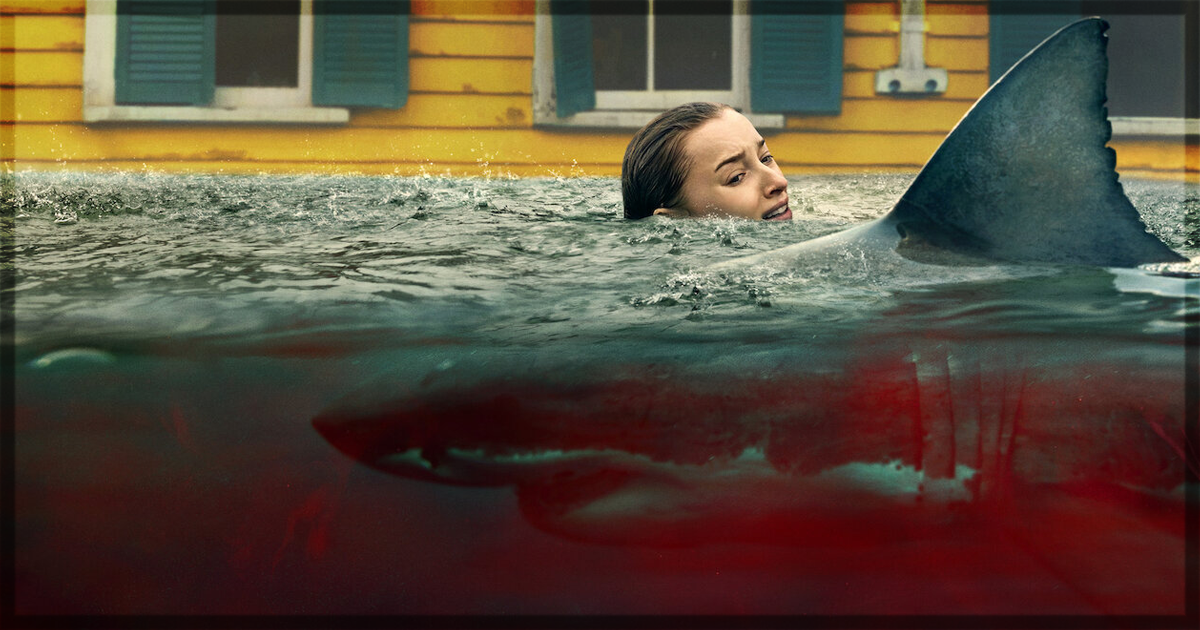
The other protagonists we follow on this quick, but painfully boring, journey have zero development beyond the one-note attributes they’re stuck in, and they continually make the stupidest possible decisions that one even wonders if they are human at all. For instance, Dale’s niece, Dakota (Whitney Peak), doesn’t listen to her uncle’s advice to leave town and instead stays home, which she immediately regrets when the inevitable happens and everything around her house floods. The same is repeated with Lisa Fields (Phoebe Dynevor), a pregnant woman whose reasons for staying in town are so vague one might believe she’s only there for plot convenience’s sake.
In any event, both Peak and Dynevor fail to draw any form of compassion to their characters, with the latter being especially terrible at selling to the audience that a pregnant woman can somehow miraculously survive a house collapsing in on itself, while giving birth, and being able to swim very far away from danger, as she holds her newborn baby in her hand. Even as someone who easily suspends his disbelief in front of movies (if you’re a fan of Indian cinema as I am, it’s par for the course), that feels like too much.
Wirkola is not priming the audience for a cartoonish depiction of a Shark attack, but rather for one very much rooted in the harsh reality of a dangerously changing climate. Do you honestly expect me to believe that a pregnant woman who has just given birth (to the sounds of Vanessa Carlton’s “A Thousand Miles”, mind you) can suddenly swim like Summer McIntosh in flood water with a newborn baby who will absolutely catch no deadly diseases? C’mon, guys. At this point, one could tell me they’re actually superhumans…
There’s no care in anything Wirkola lays out on screen. It’s lazy, pedestrian filmmaking, with zero interest in the characters it depicts or the dull action it stages. For someone who’s usually malleable with his camera, none of that is found here, until the last ten minutes of the picture, where it suddenly morphs into an Edgar Wright-esque ripoff, filled with intense blood squibs and the British filmmaker’s hyperkinetic quick-cut transitions. This is the type of energy you introduce at the top of your movie, but Wirkola seems to have great difficulty in setting this up when Thrash begins. Ripping off such a storied genre artist late in the game doesn’t help your case but actively diminishes it.
I did laugh once during the movie, at an unexpected visual gag that felt exactly like something Wirkola would do in his Norwegian works. However, he’s never fully committed – or found his personal voice – whenever he worked on a Hollywood production, almost to the point of restraining himself. One wonders why that is, because as soon as his filmmaking becomes more stylized, Thrash suddenly finds signs of life, but not enough to resurrect the movie as something worth watching. No wonder Sony wanted to scrap the film and leave it to another studio to pick up the trash…
Thrash is now playing on Netflix.
Learn more about the film at the IMDB site for the title.
You might also like…