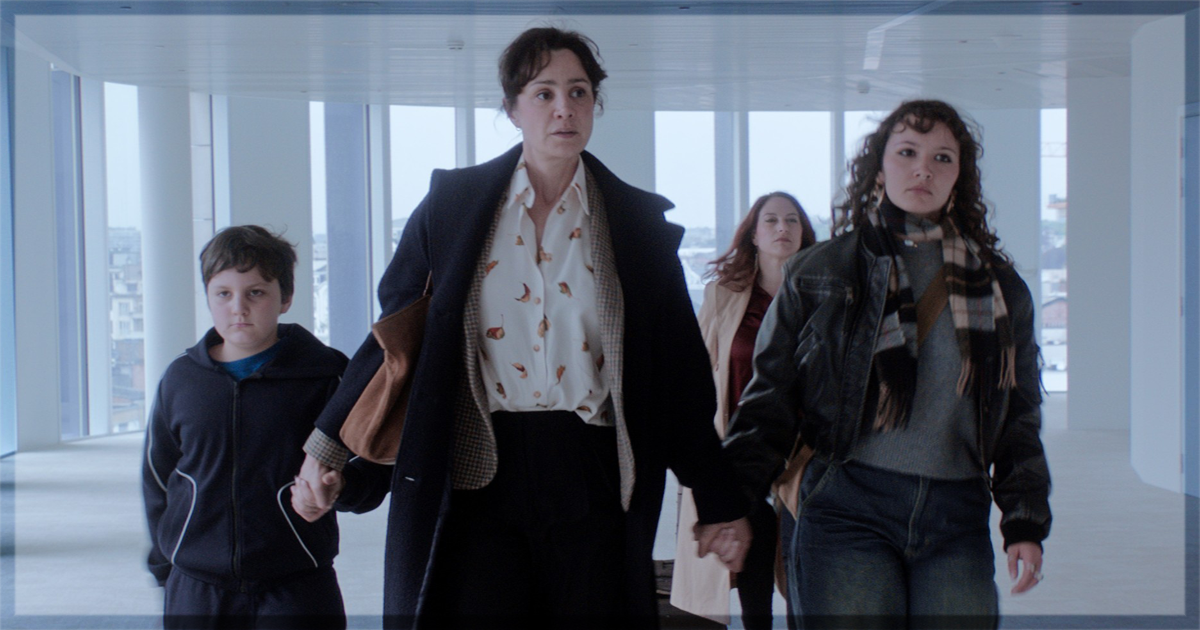
The subject matter of We Believe You is unusually grim, but the grimness is offset by the institutional setting: a custody hearing in a Belgian family court, all pale office furniture and glass walls. Inside this bland setting a family and its lawyers have the most serious conversations of their lives in front of a judge. But slowly it becomes clear that this case is not your ordinary custody dispute, and the problems this mother and her children are facing are some of the worst anyone could imagine. Writer-director-producers Arnaud Dufeys and Charlotte Devillers are clearly interested in examining how justice can possibly be done in circumstances like this. The title of the film makes it clear whose side we ought to be on. But this is not a documentary, and its fictional depiction of one mother’s desperate stand in defense of her children smartly keeps everything plain and simple. Anything more showy would have risked melodrama when the plain horror here is more than enough. Spoilers follow – and in this case, they are also trigger warnings.
Their names are Alice (Myriem Akheddiou with an exceptionally brave performance), Lila (Adèle Pinckaers) who’s about fifteen, and Etienne (Ulysse Goffin), who’s about nine. Despite knowing the importance of the day, Etienne refuses to get dressed, and it takes the combined wiles of Lila and Alice to force him out the door. On arrival at the courthouse there are conversations with Alice’s lawyer (Alisa Laub), who is kind and sympathetic, and the kids’ lawyer (Mounir Bennaoum), who is not. But most of the morning is the testimony of the parents – it was perhaps a mistake not to have given the father (Laurent Capelluto), who is somewhat older than Alice, a name – in front of a thoughtful judge (Natali Broods). The father has brought presents for the children but when Alice refuses to accept them, and the kids refuse to see or speak with him, his lawyer (Marion de Nanteuil) tries to use this as another example of why Alice should lose custody. But that would be the worst thing possible for the kids, and Alice and her lawyer are determined to make the judge understand that at any price. For it is their allegation that the father was sexually abusing one of his children. These polite courtroom conversations are therefore a fight to the death.
What is so fascinating is that it is all filmed in a simple, straightforward style, allowing us the time to act as judge ourselves. We have all the focus needed to compare the demeanours of the parents as they discuss their children, their parenting ethos and their future plans. The father is operating from a sense of entitlement, making clear he is owed time with his kids because of the support money he pays, instead of from a sense of love. Alice is doing her best, but that best isn’t very good at the minute, as she admits in her tear-stained testimony. She might well be parenting from a place of confusion and despair, but if her allegations are true for her to lose custody is unthinkable. Ms. Pinckaers does a really good job too of showing how frustrated Lila is with Alice while also being 100% on her side. When the father forces his way into a waiting room where the kids are, Lila literally throws herself over Etienne as a human shield. Her readiness to protect her little brother against all comers is remarkable. But the script and the performances make it very clear in these kinds of situations there’s plenty of room for error.
But it all builds to an incredible monologue by Ms. Akheddiou as she discusses the before and the after of her life, and how her ex-husband’s actions have damaged all of their lives. What he is alleged to have done is literally unspeakable, yet she is the person who is having to deal with it in a society that would rather shun all of them rather than admit how often such crimes can and do happen. In these circumstances the kids’ lawyer recommending the children work on their anger towards their dad is shocking, and the pressure the father’s lawyer places on Alice is downright cruel. In a part based entirely around listening, Ms. Broods manages to show how seriously the judge takes her responsibilities, and how determined she is to exercise her judgement for the greatest benefit to all.
We Believe You is only 78 minutes but any longer would have been too long. It has been touring the festival circuit for the past year or so and last year was nominated for a whopping eleven Renés (the Belgian Oscar). It’s hard to imagine how We Believe You could have done a better job showing up the limits of the justice system. And it’s hard to imagine how anything could make such terrible topics easier to deal with. But We Believe You is both very brave and very kind, and it’s wonderful to see art which understands how important both those things are when the truth is being told.
We Believe You (On vous croit) recently played at the Glasgow Film Festival.
Learn more about the film at the IMDB site for the title.
You might also like…
Josephine Articulates the Unspeakable (Berlinale 2026 Film Review)