
If you can spot the telltale signs, there’s no second-guessing that Filipino director P. R. Monencillo Patindol’s debut feature I Grew an Inch When My Father Died, now screening at Rotterdam under Bright Future, is in part a spiritual sequel to his previous shorts Hilom (Still) and Abogbaybay (Shoredust), both winners at Cinemalaya. All three films are centered on brothers left adrift in the wake of a tragedy, personal or otherwise; set in the Philippine seaside or countryside, including his Leyte hometown; and piloted by nonprofessional actors. (Rafael, his new film in development, similarly hints at such parallels.) It then makes it convenient to surmise that the resulting pictures are or will just be more of the same, which in turn makes me think of the maxim often credited to Jean Renoir that “A director makes only one movie in his life. Then he breaks it up and makes it again.” It might still be too early to tell, but one can of course argue the opposite: The similarities simply speak of the fundamentals of Patindol’s still-rustling cinematic sensibility.
His latest, loosely penned alongside Dagitab director Giancarlo Abrahan (who has also been his frequent producer), is a small-town story, a fictionalized version of a real-life incident in his community, which upends the more straightforward realist drama of his previous pictures by invoking some magical specifics that heighten its already idiosyncratic visual grammar. Comparing notes and revisiting the film’s predecessors led me to realize that the director’s gift lies in seeing the compelling poetics of boyhood as not an end unto itself, which is a veritable case here.
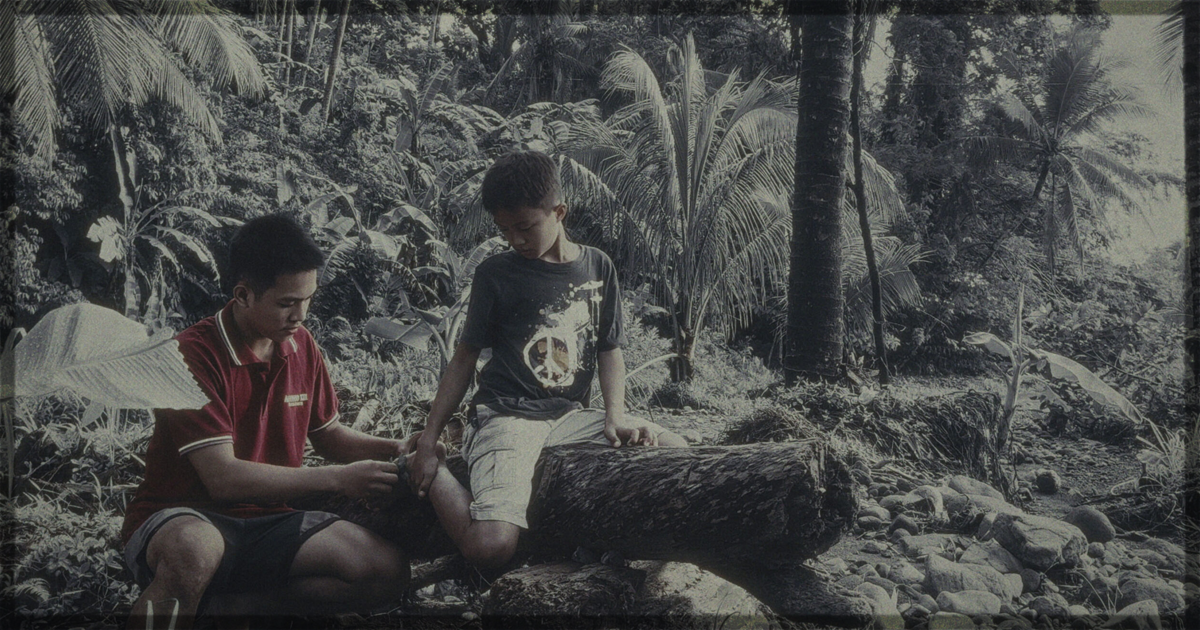
In a rural village by a river, we meet the protean protagonist Kenken (James Kenneth Cayunda), who spends his days meandering through the woods and its waterways, alone and with almost unsupervised freedom, after witnessing his alcoholic father, as shown in a flashback, being knifed to death by a fellow drunkard, who also abuses his children. Kenken has since retreated irreversibly inward so much so that he has stopped speaking with his family and other people, save for his disembodied friend, redolent of the silly, invisible character in Alexandre Koberidze’s Dry Leaf. His elder brother, Ge (Gerald Polea), meanwhile, is best friends and enamored with the murderer’s son, Ricor (Ricor Ventilanon), who’s now constantly shadowed by hectoring, homophobic teenagers. (The homoerotic tension is more openly explored late in the movie.) Whereas the grief leads Kenken to an altogether different realm, Ge dreams of a life in Manila, and this impulse to have a fresh start somewhere else eventually unfolds so complementarily for both characters. Anger is just as potent an emotion as any, which takes the likes of Kenken’s knife-wielding friend (JC Montefolka) to a grim fate. Patindol seems to be gesturing towards the moment at which terror and tenderness coexist in the lives of its young characters, as he forces them to develop rather precociously, while mourning the process of getting there.
Notwithstanding the at-times expositional dialogue, what emerges from the sparse screenplay (the film had “no formal script,” by the director’s own admission) is a moving mood piece that’s a lot less attuned to what happens than it is to what the proceedings feel like. Which isn’t to say that conflict or incident is already out of the question; it’s just that here, the consequence, we will soon gather, is given more heft and intensification. And while the making of the movie relies on “play” and “instinct,” its meditation on the textures of grief and guilt and grudge has a real formal approach and comes across as mesmerizingly measured, which hardly translates through line delivery that’s often strained and soporific but instead through Patindol’s magnification of the expressive gazes and postures of his actors, who doubled as his crew and whose families appeared in the film, making it a collective, communal affair. The director has a knack for photographing his performers from behind and in states of undress — rendered most effectively around the 23-minute mark in which Ge’s unclothed back pictured against the desolate, desaturated landscape evokes both becalming caress and unspoken sorrow, giving us a sense of what coming of age might feel like in this side of the country — in the same way that he treats clothes left to dry on dilapidated roof or a makeshift clothesline along an abandoned basketball court, as if waiting for their bodies to return, as a powerful motif.
Shot entirely on iPhone and shifting between static and handheld camerawork, Patindol’s visual conceit quite literally compels us to view its rural milieu as infertile and inhospitable, stripping his images, for the most part, of color (the opening image is reminiscent of a Lav Diaz frame), while having some of them tinged with blood red. The effect in part recalls the distancing bleakness of crime scene photographs in true crime documentaries, a feeling augmented by often placing the camera at a remove, thereby dwarfing the characters (at one point literally) in the composition. Yet, somehow, the film is just as immersive, reliably aided by an atmospheric, solitude-affirming score, and, when it counts, the director knows how to smartly use a close-up.
Despite it running just a little over 70 minutes, the film is full of languor, which allows it to flow so porously poetic like a river that never ends. At the same time, it is not obsessed with moral clarity, which, in this case, is primarily notional and obscured towards the coda, wherein Patindol and Abrahan come up with a daring, time-shifting switcheroo move: In the film’s final 10 minutes, they will a parallel universe into existence, offering us a version of the verdant village in full color, in which the river already dried up and the two brothers did not exist. The only thing that survives is the endless supply of shirts on the clothesline, remnants of an ostensible old world. Perhaps, this movie, if nothing else, is about reality itself. It’s a gracefully effective reversal of sorts precisely because it doesn’t arrive out of nowhere. It’s a transcendent moment the film has intimated throughout.
I Grew an Inch When My Father Died recently played at the International Film Festival of Rotterdam.
Learn more about the film at the IMDB site for the title.
You might also like…