
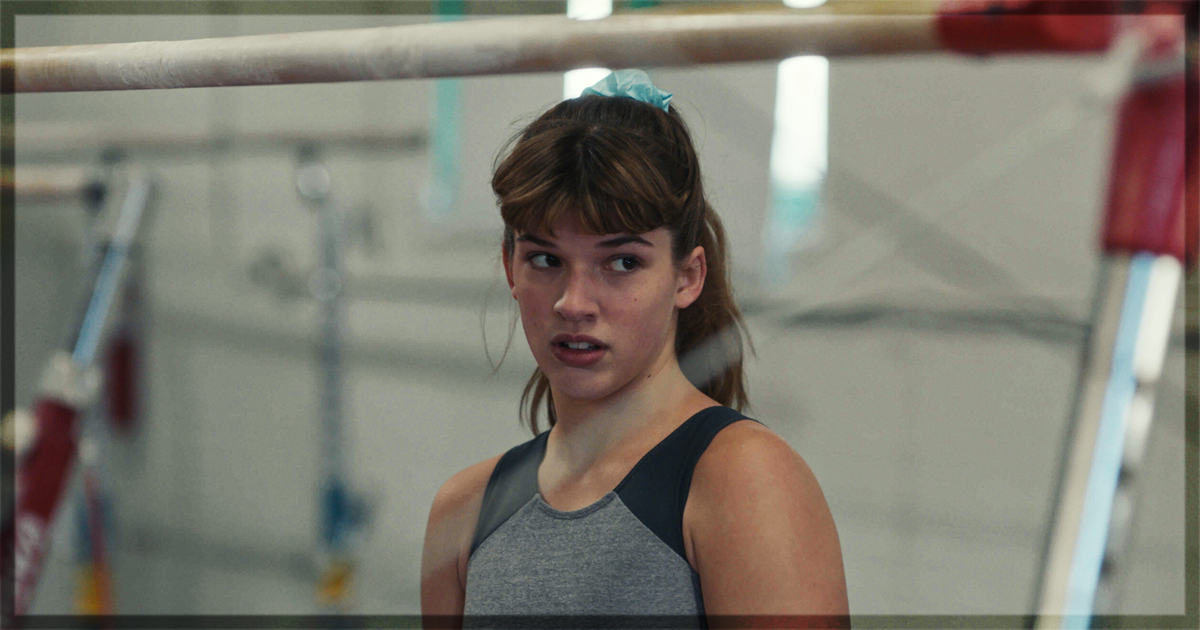
Sports dramas are a sub-genre that allows filmmakers to take multiple different approaches. They can narrate the Cinderella story of an underdog team, the individual evolution of its players, or the downside of being an athlete. In her debut feature, Charlotte Glynn takes the latter approach. The Gymnast is a film about Monica (Britney Wheeler), a talented gymnast who competes at an elite level at a young age. She lives with her father, Rich (Ethan Embry), who raises her alone because Monica’s mother left them. During one of the floor routines, the young athlete tears her ACL (Anterior Cruciate Ligament) weeks before the national competition. Suddenly, her world gets crushed by an intense injury that prevents her from competing at an elite level. Hence, she needs to focus on school, attend physical therapy sessions, and patiently wait for her ACL to heal before returning to the mat. Thus, Glynn takes the audience on the coming of age of an elite teenage athlete who suddenly loses her ground.
The Gymnast is Charlotte Glynn’s first effort in twelve years; her short The Immaculate Reception premiered at the 2014 Sundance Film Festival. It has been a while since the director worked on a film project, and her debut feature is a traditional sports drama that focuses on the psyche of her troubled protagonist. Hence, the film centers around Monica, performed by Britney Wheeler, who debuts as an actor in the project. Therefore, she embodies the titular character, the gymnast whose life revolves around the intense routine of training, competitions, and recovery. At the same time, Monica is a teenager who should be discovering herself, socializing with her classmates, and getting involved in the school’s social life. In this sense, Wheeler delivers a naturalistic approach to a teenager whose life abruptly changes, and now participates in school and must interact with her inner emotions about her colleagues competing. For a first-time performer, she embodies the role of a teenager who fills her maternal necessities with her achievements, as well as her rebellious nature.
Another crucial element to the dramatic structure of The Gymnast is the father’s perspective, graciously performed by Ethan Embry. Rich is a man who attempts to provide everything her daughter needs, particularly in the material sphere. However, as she is growing up, he cannot fulfill her maternal necessities, a gap left by her mother, who is a drug addict, and left them. Still, he is unable to understand the psychological impact of his daughter’s recovery. Instead of positive insights, he warns her, rudely, not to gain weight during the healing process. He observes an athlete, a potential individual who might become an Olympian, and changes their life. However, Glynn’s screenplay thrives in showcasing how the father lacks the emotional support that Monica requires in the moment. Also, another successful subplot involving Rich is his alcohol and one-night stands as an escape for the difficulties of being a single father, and the pressure of the moment they are going through. The director insists on balancing Monica’s wrongdoings, such as skipping classes and alcohol abuse, as a result of Rich’s lack of support, and examples of his own habits.
Visually, Glynn and the cinematographer Kayla Hoff imprint a 1990s and early 2000s look, anchored by the use of VHS tapes as memory souvenirs. Monica constantly refers to the recordings as a way of remembering the reasons she loves the sport and the bond with her father over the countless days of training. Likewise, there is a texture in the imagery, a fogginess in the imagery that represents a foregone era. Despite the minimal approach to the visual aspect of the film, The Gymnast lands in an imagery similar to the indie films of the early 2000s, blending a look that reminisces about the beginning of a digital era and the usage of camcorders. Yet, the film never attempts to deepen its core or take massive risks. It is a film that follows the usual pathos of a psychological sports drama, leaning more on the family aspect than the mental one. It is a project about the emotional gaps between wounded individuals, completely opposed individuals – the blue-collar parent and a potential superstar gymnast. In this context, the sports are the hope for both of them, and substance abuse is a weight that returns to their trajectory. The director assumes the simplistic nature of her script and focuses on telling the story, which she achieves.
The directorial debut by Charlotte Glynn does not contain massive jumps, but it is a well-told story about how an injury fractures a wounded father-daughter relationship.
The Gymnast recently played at the IFFR.
Learn more about the film at the IMDB site for the title.
You might also like…

‘Cuidadoras’ Documentary Film: The Beautiful Union of the Marginalized