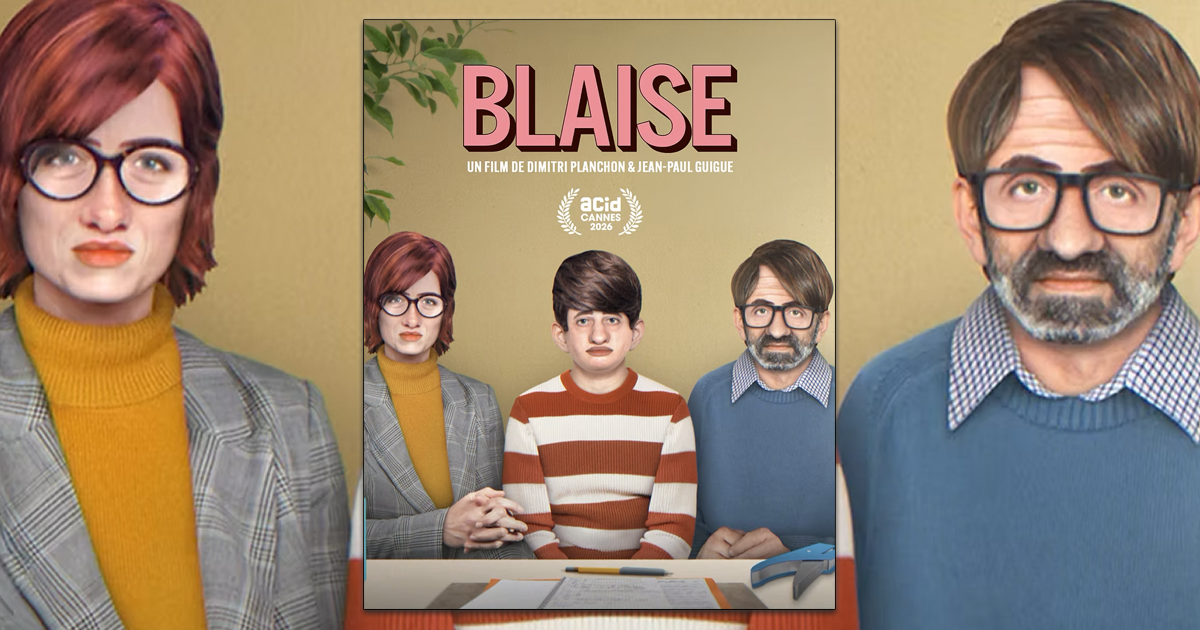
At Cannes, L’ACID presents a range of indie films, including the 2D animation Blaise by Jean-Paul Guigue and Dimitri Planchon. The film is the sophomore effort by Guigue, following his 2024 The Darwinners (Silex and the City, le film), which also premiered at the same festival previously. The director’s latest work, in collaboration with Planchon, presents his first feature. It is a satirical comedy about a dysfunctional family, the Sauvages. Carole (Léa Drucker) is an executive from the mineral extraction sector who is starting at a massive corporation, attempting to land the biggest contract in the sector with the French administration. In the middle of the stressful process, she wants to mingle with her colleagues and starts an affair with another forty-something woman. The father, Jacques (Jacques Gamblin), faces a life crisis, and his son’s school therapist becomes a personal adviser to his dilemmas and conflicts. Lastly, the titular character, Blaise (Timéo), is a high schooler trying to make friends. However, when a childhood friend takes him to a revolutionary party, he falls in love with a bourgeois woman, who dreams of an armed revolution.
The features adapt the 2016 TV show of the same title created by Planchon, which aired 30 episodes. In this sense, the film is a story circling the individual drama of each of the Sauvages members who seek to belong. It starts as a microdrama: the couple’s son, who has trouble making friends. Indeed, the teenager is weird, but aren’t they all? Yet we understand the core of his weirdness, his upbringing, and family. All of the Sauvages are odd in their ways. The mother engages in a sexual affair not to get misunderstood by her colleague, beginning a profound relationship. It applies the same to Blaise, who dates a wealthy heir who pretends to be a housekeeper to be loved by him, who, similarly to his mother, only offers indifference. The father is the weirdest of them all, questioning the relationships that he thought he had, such as the couple’s twenty-year-old friend, and forcing a relationship with the school therapist. The insecurity and the overthinking of each of those members lead them to face undesired situations that shift from the microcosm to the macro.
The visual composition of the animation feels as shallow as its political debates on the modern French sociopolitics, where everyone is attempting to perform a left-wing behavior, but diving into their hypocrisy. In this sense, the animated style follows a similarity to the Mad Magazine, the groundbreaking 1950s American publishing that became an icon for its satires throughout the decades. The drawing reminds one of the freckled redhead boy who is the central character of the magazine. Inherently, the 2D animated work has an intentional limitation in its movements that reminds one of other satirical animations from the 1990s and 2000s, emulating a humour that mocks its characters and the political landscape around them. Likewise, the film appropriates from the complicated turmoil of the French perspective, in a country that is the reflection of the polarization between the traditional left-wing movements, and a rising far-right organization that consolidated itself in recent years. Then, not all of the discussion work, nor the father’s search for meaning, still collides with the notion of belonging that includes a radical necessity to be part of a group, even if it takes extreme measures.
Thus, the Sauvages share their indifference and awkwardness towards the world in Blaise. Each family member partakes in the necessary means to feel loved and a sense of belonging, even if it involves grenades, revolutionary protests, cheating, and an explosion. Jean-Paul Guigue and Dimitri Planchon present an unconventional animation. It reminds one of the 1990s and 2000s satirical comedies, especially the classic Mad Magazine, even if it is never on the same level of sharpness. Still, there is plenty to laugh at in this absurdist representation of modernity.
Blaise recently premiered at the Cannes Film Festival.
Learn more about the film at the IMDB site for the title.
You might also like…
