
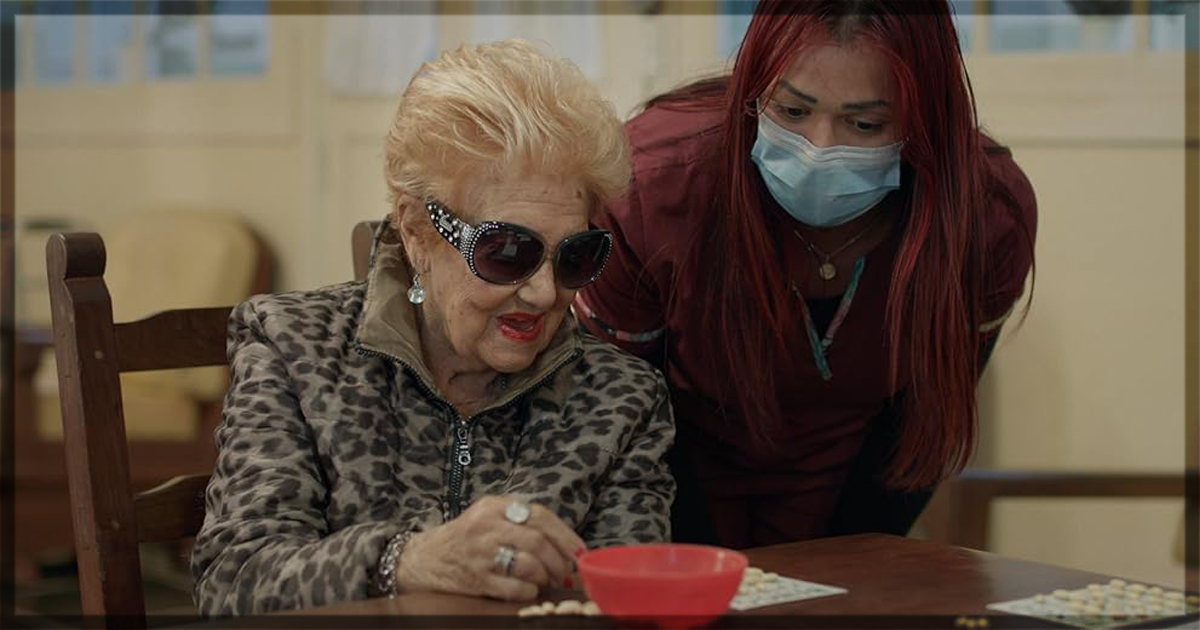
Throughout the history of documentary filmmaking, the observational type captures a story through the absence of direct interference by the director. It is a format that allows the audience to understand the subject more profoundly. An observational film is the one that rejects the talking head interview scheme to create a broader view of a perspective. In Cuidadoras (Care) by Martina Matzkin and Gabriela Uassouf, we watch an elderly caregiving center in Argentina. Multiple senior citizens live in this center, where they live together and receive care from a group of specialized professionals. Matzkin and Uassouf position their camera in front of a group of caregivers: Maia, Yenifer, and Luciana, three trans women who work in that residence. We accompany their day-to-day activities with the older, dedicating ourselves to caring for individuals who are usually on the margins of the society.
There is a fascinating aspect of the relationship between the caregivers and the seniors. In a sense, they are on the same wavelength within the perceptions of the society; they are marginalized. The similarities between the two groups are more prominent than their differences. There is an abandonment of their families by both groups, the brutal act of letting individuals die by themselves, which occurs to these two groupings. The directors position their cameras through the frames in which the dialogue between the young caregivers and their senior patients takes place, which addresses a sense of mutual benefit to both parties. The solitude that afflicts those left alone in a collective world. In one aspect, there is a melancholy in understanding that some families stop caring for the seniors when they enter a facility. Some children never visit their parents, a symbolic transference of responsibility from an individual to the state, which is a right of the citizen secured by the constitution. Still, there is a brutality in the solitude of your final moments, while for the caregivers, it feels the same. In the final cards before the credits roll up, the directors expose that the average age for a trans person in Argentina is still forty years. Ironically, despite providing care for those elders, they might never reach that age because the Latin culture is utterly transphobic and murders those who understand their true identity.
Cuidadoras is also the exercise of reflection for a slow process of Latin cultures in opening up for trans people. In a few scenes, the three caregivers talk about wanting to follow a different life than most of the trans individuals. Unfortunately, there is still a barrier to accessing job opportunities and the professionalization of their labor. It is a sincere portrayal of their sentiment. And softly, while conversing about the hardships of life, they share the space with a man in a wheelchair who wants to throw bread crumbs to the pigeons on the outside patio. There is a simplicity in that contrast that symbolizes the beauty of the film by Matzkin and Uassouf.
In a slightly reductive comparison, the film reminds one of the works by the Chilean master Maite Alberdi, who dealt with the same topic in El Agente Topo, her Oscar-nominated film. Thematically and in its approach, both films connect in their portrayal of the toughness of growing old in Latin America. Yearly, the population is getting older, and there is a shortage of care for them. Still, the success of both works lies in the sweet eye for the narrative that has a final date. When we are born, we know that we are going to die. Still, dealing with and talking about death is a hardship, a taboo that creates barriers to approaches to dealing with the grieving process. There is an agony in waiting for death, but there is so much in the sharing process between the caregivers and the ancient group. Thus, Cuidadoras is a delicate portrayal of the possibilities of uniting those who lack more care from the society. Trans individuals and seniors, both communities that sit in the margins, and directly deal with the brutality of death, both the provoked and the natural. Maia, Yenifer, and Luciana represent a group of women who love to care for the others, either each one of them, or those who are waiting for their last days.
Finally, the young filmmakers Martina Matzkin and Gabriela Uassouf focus on the beauty of unusual connections, which generate the care for the wounded. In Cuidadoras, even the last breath symbolizes hope for the future, one where we care for our people.
Cuidadoras recently played at the True/False Film Festival.
Learn more about the film at the IMDB site for the title.
You might also like…

‘Blaise’ Review: A Satirical Look at a Dysfunctional Family (Cannes Film Festival)