
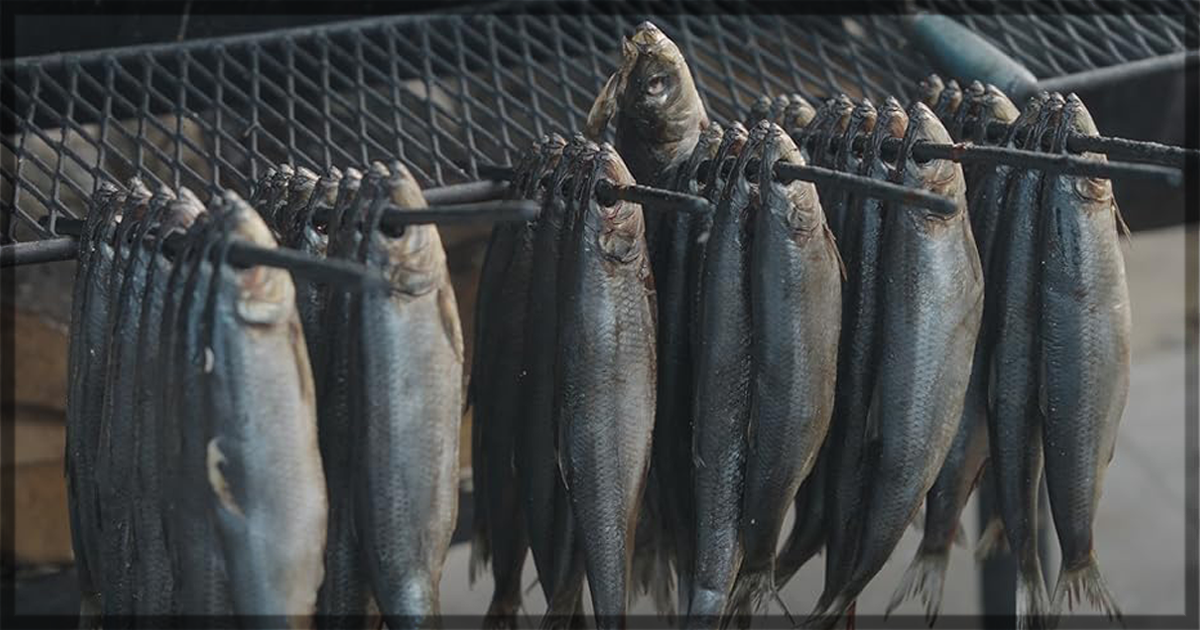
One of the beauties of non-fiction filmmaking is presenting the audience with a reality that they might never have known before. Yet, there is a fascinating aspect to comprehending how human beings behave and live differently in each corner of the world. In this sense, the Polish documentary The Queen and the Smokehouse (Bałtyk) by Iga Lis presents us with a charismatic figure in the seaside town of Łeba. The royalty that the title refers to is Miecia, the owner of a smokehouse stand that sells fish. Tourists love to discover her delicious smoked fish plate, and the locals adore her for the personality, sharp and lovable. Lis documents the life of a tourist town through the eyes of a legendary saleswoman, who raised her family with the stand, and loves the community she has built in the meantime.
In the first minutes of the film, the director is efficient in introducing us to the dynamic. Miecia is sitting near the smoker, cooking a fish, while she answers the phone, and jokes that they incinerate bodies. In one small scene, we learn about her sense of humor, the intimacy she built with clients, and the usual environment in her life: the smoker. There is charisma in that business owner that draws the attention when you are watching the film. She is funny, sarcastic, but highly humane in how she deals with her workers. Her granddaughter sits on the benches near the stand, drawing the team who works there, and Miecia happily shows her baby’s artwork to all of the clients. The director, Lis, thrives in the structure of her documentary because the central subject occupies the frames with her presence. Even in the moments of silence, there is a certain fascination to observe in the film, whether a town populated by vacancies during the off-season or Miecia’s moments.
The Queen and the Smokehouse, in its hour-long length, presents a simple narrative thread. A woman who makes her living through a smoked fish stand, and got severely sick because of decades of smoke burning down her lungs. The documentary explores the difficulty of being away from the activities that monopolized your life for so long. Suddenly, your family has to step up, operate the stand, and work during the summer, the most important season of the year for that small town. In those moments, a heartbreaking sadness peaks within Miecia’s eyes. The pain of abandoning her gift, her natural ability, because of a terrible build-up of smoke that consumed her respiratory system for so long. Ironically, what made her so special is the reason that brought her down. Thus, the contradiction of life makes this film a strong but reflective work that functions as the documentation of life. Reality is ironic, imperfect, and dirty, which provokes us pain even if the item that provided the most joy. There are elements to the irony that teach this strong woman to assign responsibility to the others, especially her son-in-law, but preparing the next generation of the booth, once the signs of the times seem near.
Despite being nowhere near perfect, The Queen and the Smokehouse is uplifting and still heartbreaking. It is an experience of the humane living, which unveils the ironies and the surprises of existence. While watching the film, the director positions us close to that woman and her environment, the logic of her stand, the work ethic that made her a success, and a city. Those creative choices provide Miecia with an image of self that expands to the view of an audience bigger than her usual. The presence of the camera and the act of filming her as the central subject introduce multiple audiences to an empathetic and lovely story. Throughout the filming of the documentary, the subject discovers the worst outcome of her entire lifetime, a terrible chronic sickness that diminishes her capacity to function. Yet, Iga Lis comprises the story of forty years in seventy minutes. By observing interactions between individuals, it is possible to understand how that community interacts, even in the offseason, when the city is empty.
Ultimately, The Queen and the Smokehouse (Bałtyk) is a fascinating and sweet documentary about the reality of a legend in Łeba, a tourist town on the coast. Armed with her sarcasm and her smokehouse, Miecia teaches us that even our most important features lead us to disgrace, but that is fine; it makes life ironic and beautiful.
The Queen and the Smokehouse (Bałtyk) recently played at the True/False Festival.
Learn more about the film at the IMDB site for the title.
You might also like…

‘Given Names’ is a Fascinating Exploration of Who We Are (Berlinale 2026 Film Review)