The 1976 Rocky sits in a strange spot in my movie memory. I hold it in genuinely high regard, yet I can’t call myself a fan of the franchise simply because I haven’t seen most of the sequels, nor the Creed films. Whatever attachment I have is to that first movie alone: the scrappy little boxing drama that somehow won Best Picture.
That made I Play Rocky an easy sell, at least on paper: a behind-the-scenes story of how that film came together, folded into a biopic of the struggling actor who wrote it. Behind the camera is Peter Farrelly (Green Book), who has given me one of my favorite comedy-dramas and, earlier this year, the dull Balls Up. So I walked in interested, wondering what this two-sided story actually had to offer.
Nobody in New York wants to hire Sylvester Stallone (Anthony Ippolito, Purple Hearts), a broke actor who still goes by Mike and keeps auditioning for nameless thugs. While working at a movie theater, he meets Sasha Czack (AnnaSophia Robb, Bridge to Terabithia), who pushes him to stop waiting for good parts and write one for himself. The two eventually move to Los Angeles, where, after watching a journeyman boxer go the distance against Muhammad Ali, he writes a screenplay called Rocky in a matter of days. Producers Irwin Winkler (P.J. Byrne, The Wolf of Wall Street) and Robert Chartoff (Toby Kebbell, Dawn of the Planet of the Apes) want to make it, and studio head Sandy Maddox (Tracy Letts, Ford v Ferrari) is willing to pay for it. There’s just one problem: they want a movie star in the lead, and Stallone won’t sell the script unless the part is his.
The stretch I keep coming back to is the negotiation bit. Once Stallone says the title line out loud, the film turns into a series of rounds across a table, with the offer for his script climbing from a modest writer’s fee into six figures while he keeps saying no. Maddox doesn’t care about the story or the guy who poured himself into it. He just wants a bankable name on the poster and a safe return, and he’ll throw cash at the “problem” before considering that the problem might be the whole point. Letts plays him with such blunt, impatient contempt that every scene becomes a small showcase of studio greed. Admittedly, the rounds do get a little long and repetitive once the number passes six figures. Still, each refusal raises the stakes, and each new figure makes the studio’s priorities clearer: the script is worth a fortune to them, but the person who wrote it is entirely replaceable.
What I genuinely love is how I Play Rocky treats Winkler and Chartoff. Movies about Hollywood tend to lump producers in with the suits, but even early on, when they aren’t sure Stallone can carry a film, they’re never really on Maddox’s side. They’re caught in the middle, and the movie lets you watch them slowly pick a side. Byrne and Kebbell play them as an exasperated double act, but the comedy never hides their growing respect, and by the time cameras roll they’ve become the project’s biggest believers, fighting the schedule and the budget so the film can exist at all. That’s an important message: not every producer meddles with the creative process or treats artists like disposable parts. Some of them are the reason the art gets made.
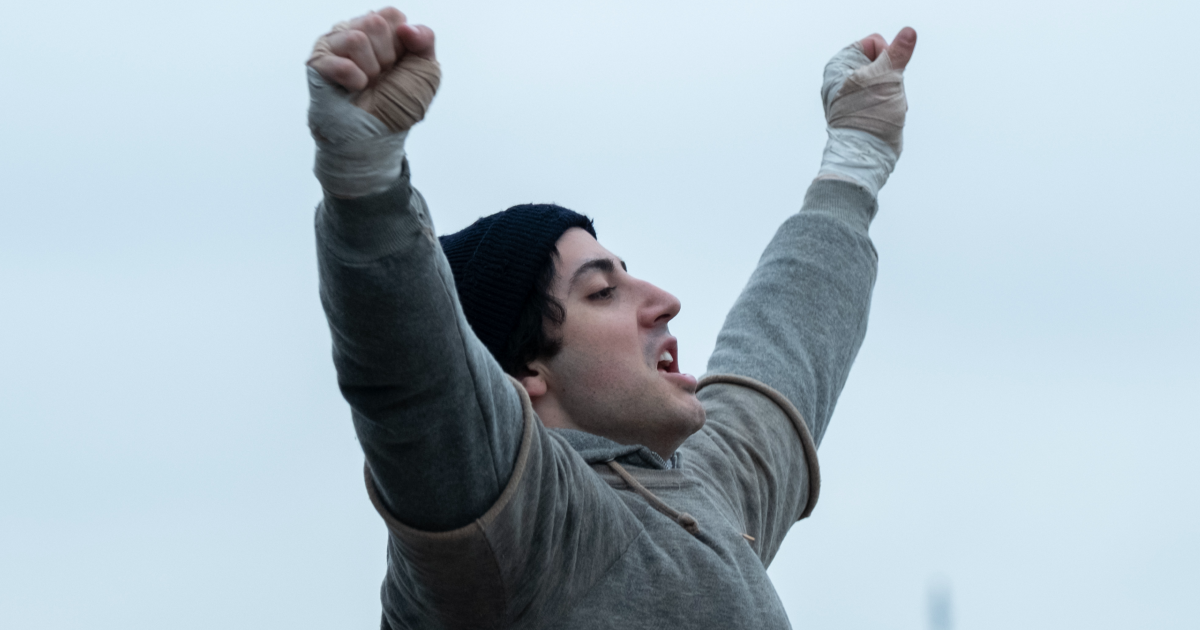
Then there’s Ippolito, the obvious standout. Playing someone as recognizable and easy to parody as Stallone is a trap, and the voice, drooping eyes, and heavy frame could easily slide into caricature. Ippolito nails the external stuff, but what impressed me is how quickly I stopped noticing it. He plays a person rather than a famous face: insecure, stubborn, sweet, a little proud, an unproven actor who knows exactly what he wants and has no evidence he’ll ever get it. It’s a genuinely transformative performance, and I wouldn’t be surprised to see him in the awards conversation.
I Play Rocky also takes the time to explain Stallone’s face and speech. In a quiet early conversation, he tells Sasha about the complications at his birth that left part of his face paralyzed, and suddenly the voice everyone mocks becomes a wound the industry keeps holding against him. That’s where his arc really starts. He begins as Mike, a guy not even using his own name, and it’s Sasha who suggests he go by Sylvester. From there, the movie tracks a man claiming his name, his voice, and his body as assets instead of defects. Writing Rocky is the final step because the character is basically him with boxing gloves on, which is why “I play Rocky” lands as more than a demand in a meeting. It’s a powerful statement about who he is.
That’s where the film’s idea of belief comes in. Turning down a fortune when you’re broke, with a partner and a baby on the way, is either courage or madness, and I Play Rocky lives on that line. Every refusal costs Stallone something, and the movie is clear that betting on yourself isn’t romantic while you’re doing it. It’s terrifying, and it puts the people you love at risk too. Still, its central message is simple yet inspiring: sometimes the only person who has to believe is you, at least at first, and it ended up hitting me in my own life. I didn’t expect that from a making-of flick.
What keeps it just short of the very top for me starts here too, though. Like most biopics, it turns its subject into a near-perfect hero. Stallone’s doubts are small and brief, usually resolved within a scene. He’s rarely wrong and never really difficult, and a man stubborn enough to refuse that much money probably had rougher edges than these.
AnnaSophia is one of my standouts. Sasha isn’t the patient wife waiting at home: she types up the scripts he writes by hand, argues with him, worries about how hard the shoot is pushing him, and believes in him before anyone in the business does. I Play Rocky is full of believers, really, and that’s a big part of what I took from it. Nobody makes a movie alone. Sasha, the two producers, even the prickly director John G. Avildsen (Jay Duplass, Beatriz at Dinner), who sees a character study where others see a boxing picture, each carry a piece of the weight.
As an avid animal lover, I was also won over by Butkus, the stray dog Stallone takes in when he has nothing. The choice he’s eventually forced to make about him is one of the film’s most painful moments. I’ve since read that much of this story may be invented, and, as with most biopics, a few omissions elsewhere left me wondering why. In this case, I don’t mind the license because it serves the character: the dog never matters less to him than the dream, and he never forgets him.
The father thread works for similar reasons. Matt Dillon (The Outsiders) plays Frank Stallone Sr., a man who never believed in his son, which adds real weight to Stallone’s insistence on proving everyone wrong. Honestly, I didn’t know much about any of this, neither the movie’s development nor Stallone’s life before it, and I left far more informed than I came in. That’s the best a biopic can be. It’s also why the production half never felt like a trivia game to me. The shoot moving to Philadelphia to save money, a brand-new camera rig making the famous run up the museum steps possible, two actors who couldn’t box working out the fights themselves: all of it was new to me. Fans who know every behind-the-scenes story might find this half less captivating.
In the end, it’s filmmaking in its purest form: no money, no time, just people finding workarounds for impossible obstacles and making real sacrifices, all for a small little flick they hope might inspire someone.
As a homage, it’s lovely. The film retells Rocky in spirit without trying to replace it or squeeze it dry, and everything it adds only makes the original’s success feel more incredible. That said, my main criticism sits right next to that compliment. I Play Rocky doesn’t crudely copy famous scenes, but it leans on them heavily for its emotional peaks. The final stretch feels as nostalgic and epic as it does largely because of images and music we already carry from 1976. Part of those goosebumps belong to the original, and I can’t fully separate the two.
Farrelly deserves real credit for the balance, though. We get the “great” Farrelly back, not the Movie 43 Farrelly. The humor and the drama rarely step on each other. The rest of the cast shines in their own corners, from Duplass’s short-fused Avildsen to Stephan James (If Beale Street Could Talk) strutting into his audition as Carl Weathers. The runtime felt perfect, and don’t leave when the credits start: the post-credits scenes are mandatory watching.
One final thing: it matters to me that Stallone had nothing to do with this movie. Nobody can call it self-serving, so I can only read it as an homage to a great film and the actor who did everything to make it.
Final Thoughts on I Play Rocky
I Play Rocky completely surprised me. Peter Farrelly delivers a warm, funny, genuinely moving look at how one of cinema’s greatest underdog stories almost didn’t happen, anchored by a transformative Anthony Ippolito who never lets Sylvester Stallone become a caricature. The negotiations expose studio greed through Tracy Letts, while P.J. Byrne and Toby Kebbell’s producers become the project’s biggest believers alongside AnnaSophia Robb’s wonderful Sasha. It makes its subject a slightly too perfect hero and borrows a good chunk of its final emotional punch from the 1976 classic, but I left knowing far more than I did walking in, with a message about betting on yourself that followed me home. Few movies this year have made me believe in myself a little more. This one did.
Rating: A-
I Play Rocky releases in theaters on November 20th.
Learn more about the film, including how to watch it, at the official website for the title.
You might also like…