
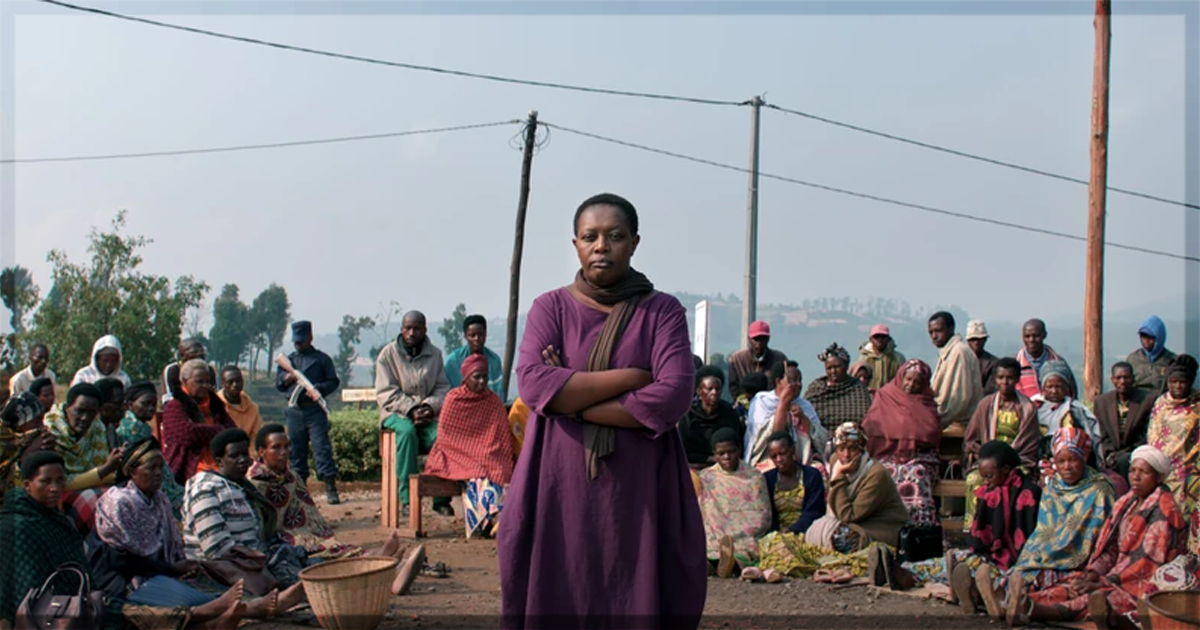
Rwandan filmmaker Marie Clémentine Dusabejambo won the Camera d’Or – the prize for best debut feature in any of the festival’s competition strands – at this year’s Cannes Film Festival for Ben’Imana. This is a double achievement as Ben’Imana is also the first Rwandan film ever to compete at Cannes in any of the official selections. It is only unfortunate that such a trailblazing film had to tell the most obvious possible story about Rwanda, about the aftermath of the 1994 genocide. That said, Ben’Imana has a loving but angry heart, which makes it remarkable on its own merits.
It’s 2012 and Vénéranda (Clémentine U. Nyirinkindi) has a prominent position in the village. She is the leader of the local women’s group that meets regularly as part of the community justice and reconciliation work. Trials from the genocide are still ongoing, but the film begins with Vénéranda publicly forgiving the latest defendant, Karangwa (Aime Valens Tuyisenge). This decision is not universally admired, and definitely not by her sister Suzanne (Isabelle Kabano), who had to watch Karangwa and his friends kill her husband and children in front of her. Those murders were not the worst thing that they did to her, either. Everyone in this small place knows everything about everyone else, but the students at the local school are determined the genocide, which none of them are old enough to remember, doesn’t matter to them. Starting with their head girl, Vénéranda’s daughter Tina (Kesia Kelly Nishimwe), the teenagers are convinced that their lack of prejudice and open-minded attitudes are the way forward. The women in Vénéranda’s group, who witnessed the genocide from both sides, know better but say nothing. Until it becomes apparent Tina is going to have to learn some lessons the hard way.
Now it is hard to believe that a young woman as bright as Tina is this bad at basic math. But Tina is still very much a child who doesn’t know how carefully she has been protected. This puts Tina in the position, common to clever girls who don’t realise how sheltered they really are, of thinking she is much smarter and sophisticated than she is. Vénéranda both knows why she raised Tina so carefully and also why forgiveness of Karangwa felt like the only option. Otherwise the events of the genocide will control her life forever. She has only to look at Suzanne, whose grief is still so red raw that she still acts out constantly in public, meaning the other villagers keep their distance. But Vénéranda’s act of forgiveness is awfully high-and-mighty of her, as the women in the support group point out. In a few ways Vénéranda is even lucky, as the aftereffects of her experience are not directly ongoing. But Madeleine (Léocadie Uwabeza), the woman in the support group who most laments her missing sons, has to be reminded that they’re actually on the run from arrest for the crimes they committed. And that’s before these neighbours all must go home to their neighbouring houses in the village, where they’re permanently surrounded by people who know exactly who they are. And when it becomes clear that Tina really isn’t as smart as she thinks she is, Vénéranda has to start facing her own mistakes as well.
This is pretty heavy stuff, but Ben’Imana is actually considerably lighter-feeling than all of this sounds. A large part of that is that the squabbles between Suzanne and Vénéranda are those of most adult siblings focused on daily life, worried about their mother, worried about Tina, worried about themselves. Another issue is that the women in the support group have an extraordinary coping tactic when their memories and discussions get too grim: they sing. The songs feel like lullabies instead of hymns, but they are definitely the songs of reassurance and consolation, the kind that calm the heart when it gets too overwhelmed. And the problem of Tina’s situation, one which happens to teenage girls all over the world, manages to blend the specificity of the genocide with that universal one. Vénéranda is very upset with Tina for causing all these topics to be considered. But for all Tina’s stubbornness and teenage self-centeredness, she loves her family. She loves her crabby aunt, she loves her disabled grandmother, and she loves her overbearing mother. And the women in this place need each other. In this unfair place where wrongs are not always righted, the way the women hold each other up is the best support they have.
Mostafa El Kashef’s cinematography and Nadia Ben Rachid’s editing bring together to shifting sands of Vénéranda and Tina’s relationship without ever being exploitative. Ms. Dusabejambo also made the wise choice to keep everything firmly in 2012, without any flashbacks. The issue is the now, and how these women can manage to build a better future. It’s hard to imagine watching Ben’Imana and not wanting them to succeed. Let’s hope the award from Cannes will enable a better future for Ms. Dusabejambo’s career, too.
Ben’Imana recently played at the Cannes Film Festival.
Learn more about the film at the Cannes site for the title.
You might also like…