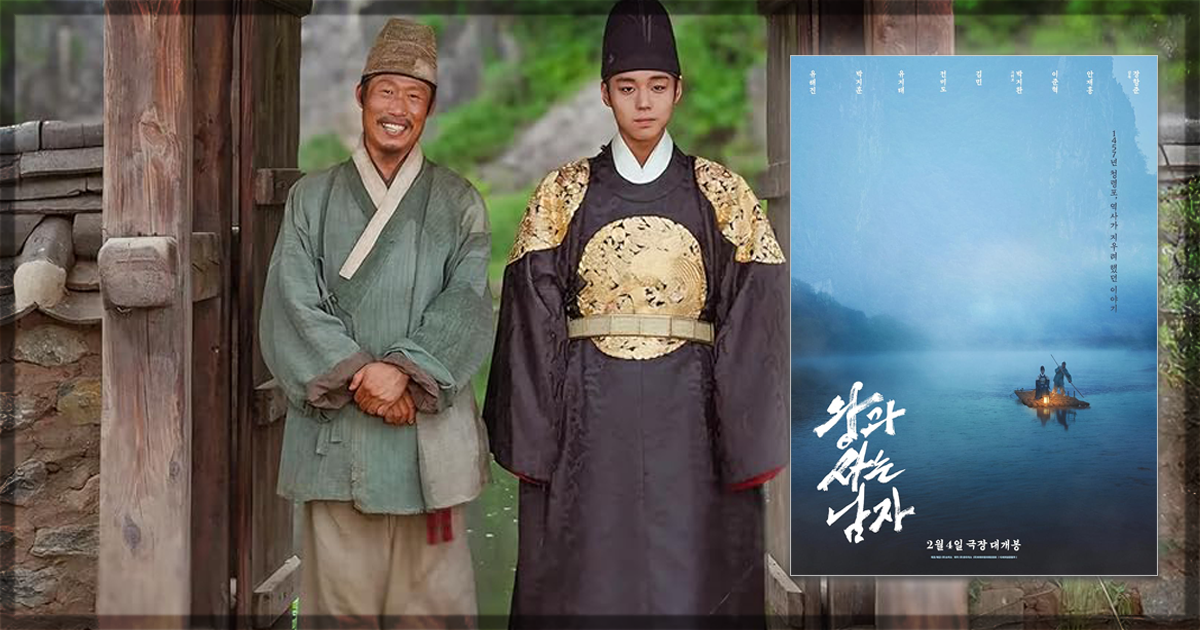
The King’s Warden was released in February 2026 and has already become one of the most successful movies in Korean history. That’s possibly because it tells a story already known to most Korean schoolchildren, like how American kids know about George Washington and the cherry tree. A boy king in exile is an easy gateway into history, even when there’s plenty of massaging of the historical truth. For example, in real life the teenage king had a teenage wife, at whose existence The King’s Warden does not even hint. Instead the focus of this strangely charming film is an aspect of life modernity lets us take for granted: food.
It’s the 1450s and Eom Heung-do (Yoo Hae-jin) is the headman of a remote village, Cheongnyeongpo, which is so poor its villagers eat rice only on their wedding day. Their staples are bulghur wheat, vegetables and any meat they can manage to hunt. Heung-do is so disliked that when he falls and hits his head during a deer hunt, the other villagers, including his teenage son Tae-san (Kim Min), leave him there. After getting lost in the forest Heung-do ends up in a nearby village so prosperous that they have both rice AND pork for a mere child’s mere birthday party. The secret to their success is freely provided: the village was considered so awful that some wealthy noblemen were exiled there by a change in government. The noble’s friends and supporters sent so much food that the villagers were able to intercept most of it, freeing their time for things like educating their children and making everyone better clothes. Well. Cheongnyeongpo is an even worse village than that! The villagers are thrilled to support Heung-do as he travels to the big town to proclaim its suitability as a place of punishment. These efforts, played as comedy, pay off, and everyone is delighted to learn they are being sent someone called Lord Nosan (Park Ji-hoon). It’s only once the young man, with a single maid whose name is not given in the English subtitles but is Mae-hwa (Jeon Mi-do) is settled in that everyone realises his true identity. The question becomes how on earth these day labourers and subsistence farmers will be able to keep royalty in any kind of lifestyle whatsoever, much less the one to which he’s become accustomed.
For all the constant discussion of hunger and how hard it is to scrabble an existence from the wild, the focus is the presentation of meals to Lord Nosan, which he often declines to eat. But if you think about how modern children relate to food, which comes from supermarkets in boxes, that makes sense. What child hasn’t refused to eat something of the wrong shape or color, or gotten upset because two items on their plate were touching? More surprising is that since only Heung-do is initially allowed to visit Lord Nosan, it’s initially only Heung-do who has a chance at the leftovers, and the other villagers allow his appalling selfishness to pass without comment. But what seven year old has never been caught with their hand in the cookie jar? Adults know how important to respect food and the work it takes to eat well, so director Jang Hang-jun, who co-wrote the script with Hwang Seong-gu, is to be commended for finding a historical tale all generations of a family can get behind. Choi Young-hwan’s clean and bright cinematography and Heo Seon-mi’s editing, which cleverly highlights subtle interplay between people, also keeps things family-friendly without becoming saccharine, an unusual achievement.
This is broadly a true story, one so famous most schoolchildren will already know the ending, so the choice to minimise the politics and instead pay attention to how the villagers and the king change each other is smart and maintains an element of surprise. Mr. Yoo manages to be sympathetic in a largely one-note role, while Mr. Park does a nice job of showing the boy king growing up. The big tearjerking finale also minimises the bloodshed, though several earlier sequences don’t. And while a few of the village women have personalities of their own, it’s disappointing no poetic license was taken to modernise the portrayal of women here. Mae-hwa’s character arc especially could have done with a lot more backbone. If we’re making a whole movie to inspire modern kids to eat their dinners, it would be nice to for the mothers and grandmothers to have something delicious to digest as well. But on the whole The King’s Warden cleverly uses its historical setting to make some modern medicine go down, and its message of respect, self-care and delicious food is one the whole family can enjoy.
The King’s Warden is now in theaters.
Learn more about the film at the IMDB site for the title.
You might also like…