
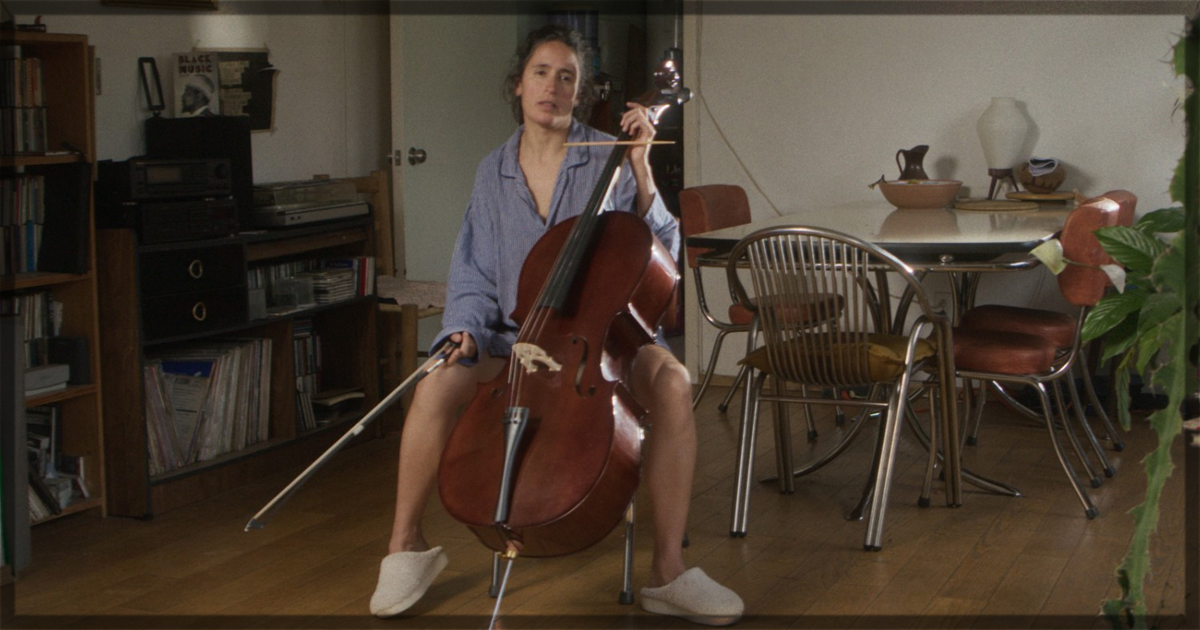
The Mexican director Nicolás Pereda has proven himself as one of the most prominent filmmakers of the new generation. In the last three years, he released three films. Lázaro de Noche premiered at the 2024 FIDMarseille, and Cobre was also a world premiere at the French experimental film event in 2025. Now, Pereda releases a new work at this year’s Berlin International Film Festival. Everything Else is Noise (Lo demás es ruido) is his latest work, a Forum section selection, dedicated to formally bold projects. Similar to most of his filmography, the new film is a study of the daily life. Set in a building in Mexico City, we follow Tere (Teresa Sánchez), a respected contemporary composer who lives in a simple yet comfortable flat in the city. One day, her friend Rosa (Rosa Estela Juárez Vargas), also a musician, asks Tere to use her apartment for a video interview, a secret from her husband. Suddenly, a simple interview becomes an odyssey after the building suffers from power outages, barking dogs, and an impromptu visit.
The young Mexican director invests in the small dramas of the daily life, the mundane. Hence, there are little tensions in the relationships that unveil different perspectives of each character. At first, it establishes the building as a character in itself, the ultimate creator of problems that unfold throughout the other interactions. Initially, Tere and her neighbor argue over her playing the violin at 11 a.m. In most residential buildings, it is the appropriate time for it, from the 8 a.m. to 6 p.m., the tolerable time set that most administrations standardize to prevent discussions and clashes between the residents. Still, the neighbor complains about the sound of the instrument waking his baby, who spent all night crying, and is now sleeping. In this sense, Tere’s noise is harming the neighbor’s environment, while for her, it is the time for practicing her artistry. Throughout the initial conflict, a simple dialogue that most people have had during the time living in a building, Pereda points in the direction he is leaning over. It is about the differentiations of the perspective towards the sounds, whether it is haute artistry or unbearable noise.
Consequently, the interactions between the trio of the women are the skeleton of this narrative, where Tere, Rosa, and Luisa (Luisa Pardo), Tere’s daughter, join them to talk poorly about her father. Each new character introduces a new lawyer to that environment. Luisa is the result of an extraconjugal relationship between a famous musician and a young composer. Rosa’s secret interview results in a disastrous recording due to the power outages, which occur only in that building, and the impromptu noises that interfere with the direct sound recording. In this sense, there is a humor inherent to the film that reminds one of a comedy of errors. Everything seems to go wrong when the young journalists press play in the camera, and sometimes life is like that. Therefore, that day sounds like a planned one where everything went wrong. However, Pereda concedes the rhythm to breathe out the events and extract the humor of each situation.
Another crucial aspect is the intimate setting of the film. The filmmaker’s films feature a smaller scope that highlights the intimacy of their settings, the natural background, such as Cobre, and the apartment as the scenario for all the scenes of the film throughout the day. Among the comfortable, welcoming decorations by Tere, there is a particularly engaging preference for the simplistic elements of filmmaking in Pereda’s new feature. He only needs a couple of actors, an apartment, and a narrative that occurs during the day, emulating the problems that everyday life presents to anyone. Therefore, it presents a particular self-criticism from the author on how artists deal with their own personas, egos, and artistic legacies. Nonetheless, we observe artists unwrapping from their skins and egos anchored by the public admiration to unveil the truths of their relationships, the immorality in the extraconjugal relationship that resulted in Luisa’s birth, or the secrecy from Rosa to her husband. There is an irony and the humor that criticize well the tendency that artists have to position themselves at an altar, requesting people around them to look up and admire them in those venues. Even if erudite artistry, such as classical music in Latin America, is not as praised as in Europe, the intellectual superiority compensates for the monetary benefits for some of those artists.
Finally, Nicolás Pereda shows us that each soundwave is a noise, except for those who expect the intellectual superiority and praise for their musical waves. Thus, Everything Else is Noise is a clever satire of high artistry in Mexico and a comedy of errors that illustrates the difficulty of living in society.
Everything Else is Noise recently played at the Berlinale Film Festival.
Learn more about the film at the Berlinale site for the title.
You might also like…