
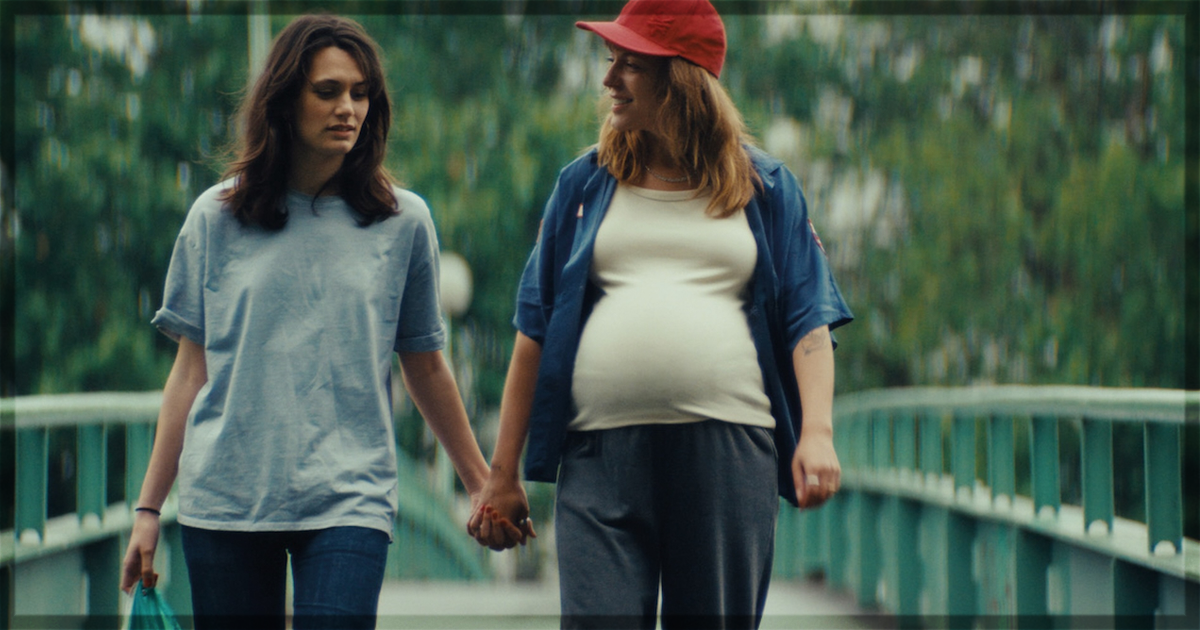
It’s 2014 and Nadia (Monia Chokri) and Céline (Ella Rumpf) were recently legally able to get married in France. Hooray! And anyone who’s ever heard a playground chant knows what comes after love and marriage. Nadia is pregnant thanks to IVF and a Danish sperm donor, but Céline will have to adopt her own wife’s child as the laws around this haven’t caught up to the new reality. As part of this process, they have to collect fifteen ‘love letters’ from friends and family to attest to Céline’s commitment to parenthood and explain why she should be allowed to adopt her own child. This journey is the point of Love Letters, a very sweet film that ignores the legal requirements of the process to focus on the emotional ones. It does the great trick of telling a universal story of love and family by telling a very specific one.
Nadia’s family didn’t speak to her for a few years after she came out, but now she’s in a settled relationship and about to provide a grandchild things there are fine. For Céline things are less simple. Her father died when she was a child, and her mother, Marguerite (Noémie Lvovsky), was never mother of the year. Marguerite is a world-famous pianist almost permanently on tour, and Céline learns she’s back in town from a poster in the subway advertising a concert. Oof. On the other hand, Céline hasn’t mentioned her marriage or the baby either. Oof! Céline would be perfectly happy to let this lie, but their lawyer has made it clear that without support from their families they’ll struggle to have the adoption approved.
As a result of these changing circumstances, one of Céline’s closest buddies, François (Julien Gaspar-Oliveri), is delighted to provide Céline with the chance to practice her parenting skills, aka free babysitting for his infant son and small daughter Erika (Emy Juretzko). The scene where Céline must give the baby a bath is both disgusting and hilarious. Anyone who’s ever looked after small children will laugh until they cry at everyone’s facial expressions here, especially the baby’s. Céline is the sound tech and house DJ in a nightclub and therefore not used to handling bodily fluids like this, and this incident helps her realise what she and Nadia signed up for. The aftermath also includes an unexpectedly positive relationship with Erika, an observant little girl who likes Céline more than Céline realised she might. Meantime Céline and Nadia bicker about names, go to hospital appointments, and work down their list of letter writers. But it’s the one from Marguerite that will matter most.
Writer-director Alice Douard was clear at BFI Flare that the movie was inspired by autobiographical events, to the point of bringing her own small daughter onstage. But this is also the universal story of realising how looming parenthood is going to change your life. The picture of daily life here is very ordinary, and the kind of thing at which French cinema excels. Nadia watches TV from her yoga ball and frets. Céline doesn’t handle the occasional thoughtless comment very well. They buy groceries and assemble flatpack furniture for the baby’s room. They comment on their friends’ parenting techniques, and reassure each other they they will do a much better job. Nadia likes Marguerite, but Céline is deeply uncomfortable with them spending time together, not least because Marguerite is the kind of woman who can’t bear not to be the center of attention for very long. If Marguerite does write the letter, it will be the first things she’s done right for Céline in years. And Céline can’t bear to imagine what might happen if she doesn’t.
Ms. Lvovsky, a director and the actress with the most ever nominations for Supporting Actress César, portrays Marguerite as someone at home in her career and bewildered by her parental responsibilities. Even though she never quite stepped up as much as she needed to, there’s lot of empathy there, matched by Ms. Rumpf as a woman who’s so glad her childhood is over she’s a little anxious about revisiting it from the other side. If she plays her cards right she could very easily become a great big star. Ms. Chokri, another movie director, has the less glamorous part but has a lot of fun emphasising Nadia’s competence and excitement about her new responsibilities. She also has an absolutely terrific scene in a bar, standing up on behalf of Céline, which makes it palpable why and how these two people love each other.
There’s subtle use of music and sound to reflect the shifting relationship between Céline and Marguerite, and Jacques Girault’s cinematography makes Paris feel like a comfortable place to raise a family. By the end the focus is so squarely on the imminent arrival that all the other issues kind of slide into the background. Relatable! It does provide a strange feeling that Love Letters is only half a movie, but somehow this is not a complaint. The picture of ordinary life here is so interesting that it doesn’t matter if it’s incomplete; it’s of course going to continue long after the credits roll.
Love Letters recently played at BFI Flare.
Learn more about the film at the IMDB site for the title.
You might also like…
‘Washed Up’ Sparks So Much No-budget Joy (BFI Flare 2026 Film Review)