A family is a fragile thing too often taken for granted, and once the love is gone it’s very hard to bring back. A Common Story has an unusual gimmick: it is about a family, but the child hardly features. For she has grown up and gone off to university, and her parents now are living with her absence. This is a remarkable way of looking at how the routines of our days add up to our lives. Whether or not we like how we’ve lived is what we examine towards its end, and A Common Story is very much the story of the aftermath of the life of a family. How does one choice lead to another? How do all the little minutes of our days add up? Most of all, how do parents go back to being people once their work of parenting is done?
However, director Anna Foglietta (who co-wrote the screenplay with Tania Pedroni and Matteo Ferri) might have made a few mistakes, which are: Erika (Alba Rohrwacher) and Mauro (Guido Caprino) are in their mid-forties. This is unusually young these days to have a grown-up child. Around the world it’s more common for people to start having their kids in their thirties, and first-time mothers over forty are hardly unusual. But what is gotten right here is that if you do become parents in your twenties, even in small-town Italy, your career never gets off the ground. Erika is a cashier in the local supermarket, and Mauro works for his controlling father’s shopfitting company. They own their home, and they’re okay, but there are certainly not a lot of extras.
There is never any discussion about whether being parents before their careers were established put them on this path, or if this path was what they both wanted. There are no big plans for what to do with their extra space and money now their daughter has left. We also don’t see either of them with any friends to compare lives with. Were they the youngest parents in their daughter’s year group, or did they blend in with everyone else? Did some of their friends wait until they were successful and now have toddlers to wrangle? Is there any worry they did things the wrong way around?
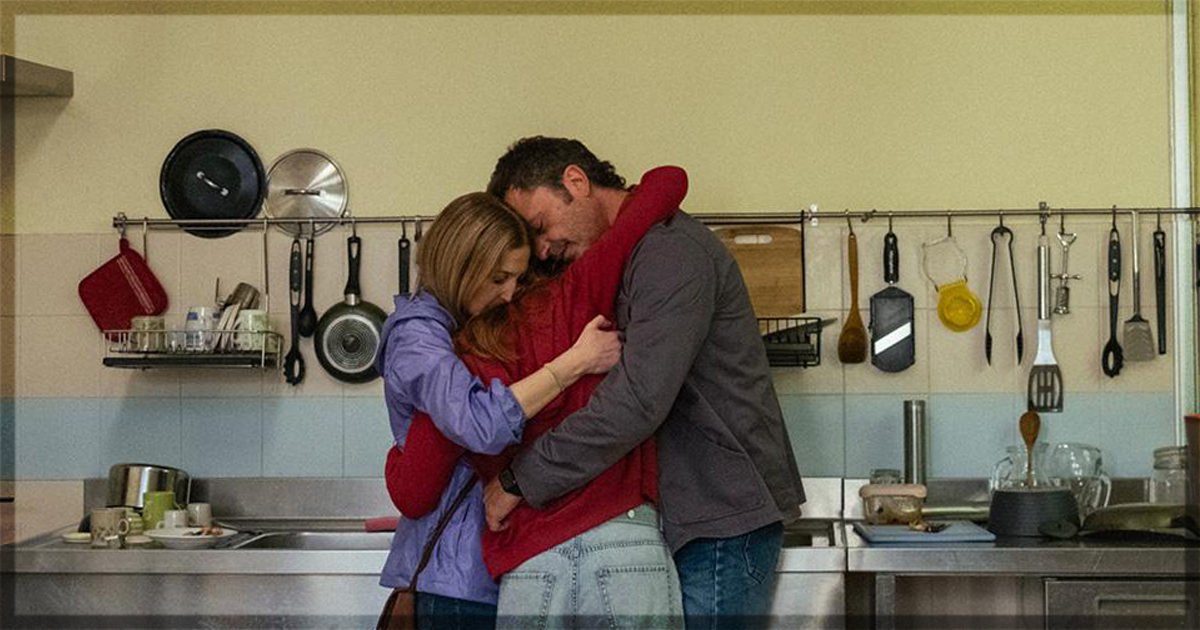
None of those questions are really asked. Instead we watch Mauro and Erika go about their lives. Erika is so disconnected from her own self she can’t even tell a make-up salesgirl whether she has dry or oily skin. She pops round to her mother’s house several times a day, who despite being a practical shut-in has an active social life with lots of friends and activities, and who mocks her daughter for thinking she needs looking after. She makes small talk at work with customers who are embarrassed the cashier knows their name. She cleans an already spotless home, and broods.
On the other side of the equation, Mauro has spent so much of his life under his father’s thumb he hardly knows what it means to be his own person. The only independent thing he does is coach the town’s kiddie soccer team, bossing around the local ten-year-olds with a smile on his face. He and Erika have been a couple since they were teenagers and Mauro starts to wonder what the wider world looks like – soccer players have moms, after all. When his father makes an outrageous personal decision behind Mauro’s back things get worse again. Who is Mauro when he is by himself?
Who are they, without their responsibility for their daughter?
The big finale makes the unusual choice to split the screen in two so that Andrea Benjamin Manenti’s cameras only show their faces. Almost like they’re under interrogation. Is this all there is? And the thing is that the emotional power of that question means A Common Story rises above all its weaknesses to have a remarkable impact. Small questions like that are often the ones on which entire lives can hinge, and even the most ordinary life has incredible hidden depths. Both Ms. Rohrwacher and Mr. Caprino are easy to watch thinking, and their characters are such good people you really do want them to be happy somehow. A Common Story knows there’s no easy solution to that question. Its excellence is a fragile thing, and the existence of small, female-centric movies like this should not be taken for granted, either.
A Common Story recently played at the Venice Film Festival. It will be in theaters on 10/20/2026.
Learn more about the film at the IMDB site for the title.
You might also like…