Who’d be young? With your whole life ahead of you and no sense of who you’re truly are, you live in anticipation of a brilliant future that will obviously come to pass somehow. On the other hand, who’d be old? Either you had your chance and it didn’t work out, or your chance never came around and all your hard work and talent has gone to waste. Late Fame wants to know what happens when you get a small second bite of the apple. It’s not very good, but with two central performances so powerful, who of any age could resist?
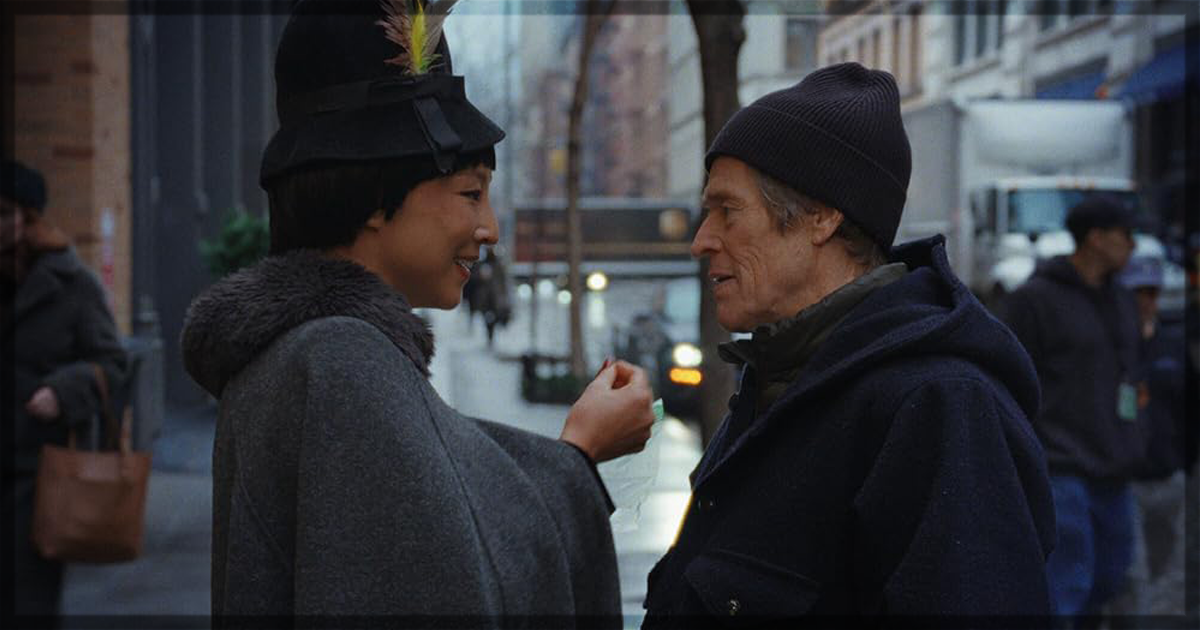
Ed Saxberger (the wonderful Willem Dafoe) has a quiet working-class life in the downtown Manhattan circles that still exist, but only just. He works for the post office and spends his free time in a bar where the clientele is entirely other working men of a certain age, and the pretty bartender has his usual dinner order waiting for him as soon as he walks through the door. But one day a young man is on his doorstep. He goes by his surname, Meyers (Edmund Donovan), and found Ed’s out-of-print book of poetry in London. Meyers thinks the book is a work a genius, is delighted to be able to tell Ed to his face how much he admires him, and is desperate for Ed to come meet the circle of young intellectuals to which he belongs. Ed listens to all this silliness with a half-smile on his face, the kind that tells you he’s thrilled to hear all these compliments and despite knowing better will ride this train to the end of the line (as any out of print and underappreciated author could tell you, ahem).
When Ed does show up to Meyers’ group hang he’s surprised to see it’s only young men, all brunettes, the kind of pretentious pretty boys who wear fluffy pink sweaters, little designer glasses, and capes. Capes! They mock influencers while remaining glued to their phones and want to be influential writers without reading; not unusual, but when Ed name-drops poets he knew around the time his book was published in 1979 they clearly don’t recognise any of them. Well, maybe Burroughs. Ed is so amused by their self-regarding foolishness he calls them “bullshit poseurs” to their faces and they barely even blink. Ed’s presence among them allows them to think of themselves as curators, rediscoverers, and anything he does can therefore be waved away by their reflected glory. Don Fleming’s guitar-focused score manages to meet both groups in the middle, too. But there is one woman in the group after all, Gloria (Greta Lee). She’s an ACTRESS, the kind of woman who makes an ENTRANCE everywhere she goes, holding out her hand to be kissed while ordering absinthe she doesn’t even drink. Who could resist? Certainly not Ed.
Director Kent Jones meant to contrast someone who had a brief moment of glory and has reconciled himself to that part of his life being over, and the new strivers who are convinced their glory is to come without actually doing the work that could justify it. Clay Singer uses a wary, observant physicality to distinguish himself amongst them. None of Meyers’ crew needs to work – one of the movie’s mistakes is making them full adults instead of students, when their posturing and trust funds would be a little more forgivable – but they maintain implausibly old-school ideas about how to build their careers. By contrast, Ed lives in a small apartment filled with books, with a cassette hi-fi for his bootleg recordings of poetry recitals, and even if he doesn’t write anymore he’s still very much the real thing. The script was adapted from a novella by Arthur Schnitzler, and while the pseudo-intellectuals are indeed straight out of 1930s mittel-Europe, better modernisation was needed. Samy Burch’s adaptation leans too hard on making Ed salt-of-the-earth. The subplot of the voice notes Ed receives also raises some tantalising possibilities that go nowhere.
But who needs plot when Gloria brings Ed to the cabaret where she works. The whole film comes to a screeching halt to watch Ms. Lee perform in full Bertold Brecht’s “Surabaya Johnny,” a hymn to abusive love that has a room full of men including Mr. Dafoe, and the entire cinema audience, in the palm of her hand. Wyatt Garfield’s cinematography eats her up. But in addition to talent you also need luck, and Late Fame exists to examine the gap between people who have one but not the other. It doesn’t quite succeed, but thanks to the scorching talents of Mr. Dafoe and Ms. Lee it’s no failure at all.
Late Fame recently played at the Glasgow Film Festival.
Learn more about the film at the IMDB site for the title.
You might also like…