
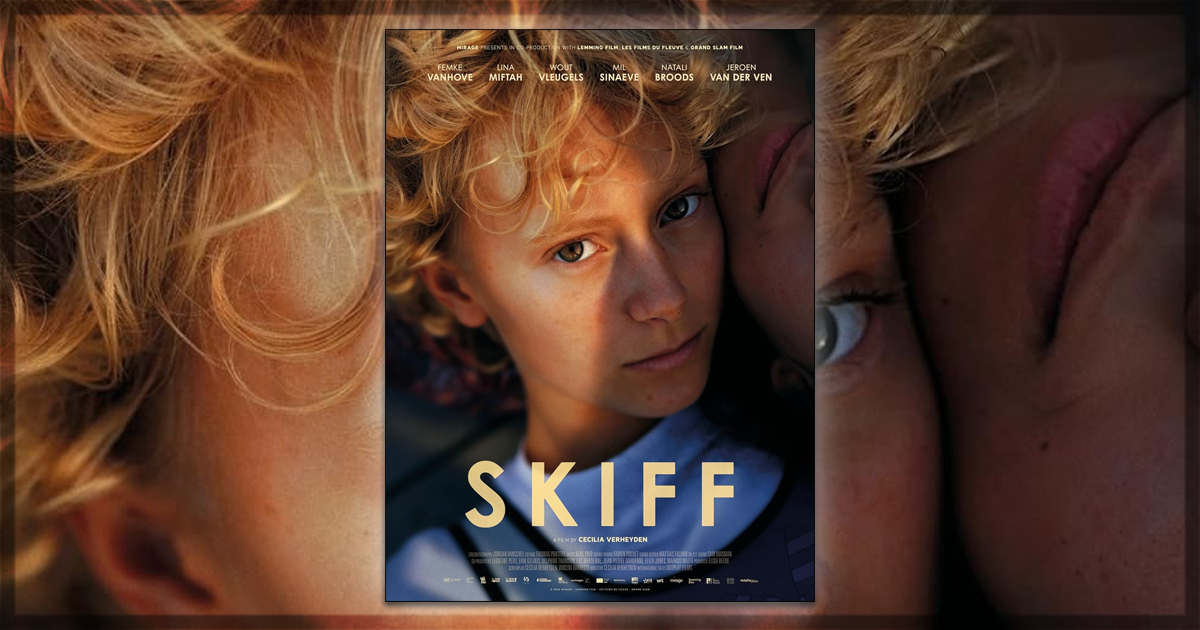
The main takeaway from Skiff is that it is an unusually kind portrait of a family. It’s a picture of the time when the children are in their late teens and can largely take care of themselves. They have jobs, can transport themselves around town, and will shortly be leaving the safety of home for the wider world. But they are still very much children, of course, and they still need the safety net of their family. The main question of Skiff is whether their tribulations over this summer will spoil their charmed lives. But the dynamic is so positive that there’s an unusual amount of hope here that everything will work itself out.
Annick (Natali Broods) has three teenagers: Alex (Mil Sinaeve), who is preoccupied with studying for some exams he must retake; Max (Wout Vleugels), who is friendly and popular; and Malou (Femke Vanhove), who is turning sixteen. They live in a suburb in the Dutch-speaking part of Belgium and apart from the usual squabbles theirs is a happy home. Annick is not around much, thanks to work and a new boyfriend, but for the most part the kids can look after themselves. More or less. Malou idolises her older brothers, to the point of dressing almost exclusively in their cast-offs or hand-me-downs, and they in turn love hanging out with her. Malou works as a cashier in the local gas station and regularly goes to the local rowing club, where despite her love for the sport she is unpopular. Part of this is her insistence to always row single skiff instead of treating it as a team sport. Another issue is that she doesn’t shower there, which the other girls think is gross. It becomes clear that Malou is uncomfortable, but doesn’t quite know what the problem is (her body? her sexuality?) and therefore can’t articulate it. Then Max begins dating Nouria (Lina Mitfah), a French-speaking Muslim girl from Brussels staying with relatives for the summer. As Malou and Nouria begin spending time together, other problems start to develop.
Trying to avoid spoilers: some discussions of Skiff have a specific idea of aspects of Malou’s identity, but Skiff’s entire point is that Malou is on the cusp of defining herself, but not quite there yet. The fact she wears boys’ clothes 99% of the time might be a clue, but it’s also not a big deal; certainly the family doesn’t care and her brothers love her very much. So does her mother, but Annick can also see that Malou is having a harder time than her sons did at that age, and doesn’t quite know the best thing to do. For Malou’s birthday, Alex and Max give her a helmet for the scooter she has secretly purchased from a colleague at the gas station, and immediately take Malou’s side when Annick gets upset about this. (There is some teasing of Malou about the crush this guy has on her, but he is the repulsively elderly age of twenty, and it’s nice to see a teenager react with the correct combination of disgust and contempt at the mere idea.) To her credit, Annick apologises pretty soon, but Malou is in a snit about being misunderstood and starts acting out a little. Teenagers! Luckily Nouria’s influence is a very good one. It’s clear Malou wants to impress her and certainly she tells Nouria things she doesn’t even discuss with her brothers. But what might be good for Malou and Nouria is very bad for Max. If there’s anyone in the world Malou loves, it’s Max. But even a brother has his limits.
Director Cecilia Verheyden cowrote the script with Vincent Vanneste and told the audience at BFI Flare that she modelled the sibling relationships here on those she has with her own older brothers. Certainly the most memorable shot in the film is when Jordan Vanschel hoisted his camera directly over the backyard paddling pool in which Alex, Max and Malou create a whirlpool that allows them to spin in the current for a good long time. The sunny weather and the atmosphere of safety and friendliness is unusually strong, and it makes poor Malou’s unhappiness even sadder. Ms. Vanhove has wide brown eyes and a very expressive face, and she makes it very easy to understand Malou’s thoughts as the summer continues. The peace she finds on the water means that the meanness of the other kids is worth enduring. Not that Malou always behaves perfectly herself, of course.
It’s hard to watch such an adorable young person having such a tough time, especially when her equally adorable siblings are having such an easy one. Nouria’s situation is also complex, and even though the siblings don’t fully appreciate it, the instinctive solidarity young people have for each other against the adult world makes an important difference. Our main characters are surrounded by love in a safe and happy home, with no serious responsibilities and plenty of age-appropriate freedom. It’s hard to think of a better environment in which to figure yourself out. Everyone struggling with aspects of their identity should be so lucky. And it’s that golden aura which carries Skiff right to the end of the line.
The BFI Flare screenings of Skiff also included the equally sunny short Brazilian film Theo, about a young girl’s insistence on playing football/soccer in a time when the sport was only for boys.
Skiff recently played at BFI Flare.
Learn more about the film at the IMDB site for the title.
You might also like…

‘You, Me & Tuscany’ is a Delicious Little Treat (Film Review)