
Originally titled Sehnsucht in Sangerhausen, which translates as “Longing in Sangerhausen,” Julian Radlmaier’s latest feature and Locarno 2025 in-competition entry Phantoms of July unfolds as a spirited absurdist dramedy set in the titular mining town that formed part of East Germany prior to reunification. It is the kind of movie that shifts between timelines and obscures dream and reality, as it explores, formally and narratively, how the past hacks into the present in the small and working-class lives of three women who cross paths in their persistent search for meaning and purpose past the everyday monotony they endure. The effect is pretty fascinating and playful, in that it operates as a slippery tale whose lack of clarity and linearity does not necessarily deflate its power. If anything, its ambiguity gives the movie a sort of mythohistorical allure.
It is episodic in nature, as Radlmaier divides the film into four chapters, which highlight in a not-so-subtle manner the inevitable function that serendipity—or “the alchemy of encounter,” as the director puts it—plays in a narrative that doesn’t readily point to a particular ideological anchor. It isn’t that the movie is textureless or lacks direction and specificity, it’s more to do with Radlmaier’s insistence on reflection through fragmentation above anything else.
The film begins in a relatively distant past, with the story of Lotte (Paula Schindler), a servant who works for the 18th-century Romantic poet Novalis, whose poem about an enigmatic blue flower constantly reminds her of her dream to “set off and see a thousand wonders” and have a life outside of picking cherries, cleaning dusty surfaces, and emptying chamber pots. She eventually meets her lover who entertains people by swallowing stones, including the blue stone that Lotte curiously fixates on (Radlmaier turns that blue stone into a motif). After stealing horses, the couple attempts to escape and forge another life, only for that plan to end in tragedy, in a chase through a cave around the scenic mountains of Harz and Kyffhäuser—an episode closer that the movie repeats more than once in service of some parallelism.
Following its opener, the film tersely cuts to the present, which finds Ursula (Clara Schwinning), who has a certain connection with Lotte, and like her, she finds no satisfaction in her work as a waitress and as someone who enters marriage because of an early pregnancy. Tired of tidying tables and serving customers, she finds excitement and a reason to escape in Zulima (Henriette Confurius), a lovely musician who shows up in town and whom she immediately falls in love with but soon leaves her devastated. Then enters Neda (Maral Keshavarz), an Iranian content creator who films the town’s famous tourist sites to earn money before her visa expires. While filming, she claims that she has seen her old friend from Tehran named Marjam (Ghazal Shojaei), who, just like her, dreams of becoming a filmmaker. Neda encounters her friend in a dream after falling asleep in a moviehouse believed to be haunted by ghosts.
As these storylines overlap, the movie verges into surrealist territory and becomes more difficult to pin down. It simultaneously surprises and unnerves you with its stylized turns and symbolisms. Its images are particularly dreamlike and painterly, as cinematographer Faraz Fesharaki takes advantage of natural light and the stunning urban corners of Sangerhausen as well as the striking features of the mountainside, which is reminiscent of another Locarno title, Maureen Fazendeiro’s breathtaking 16mm docufiction The Seasons. It also feels clever and frisky, as Radlmaier’s editing insists on numerous cut-ins and a rather off-kilter rhythm, with a soundscape that matches such energy.
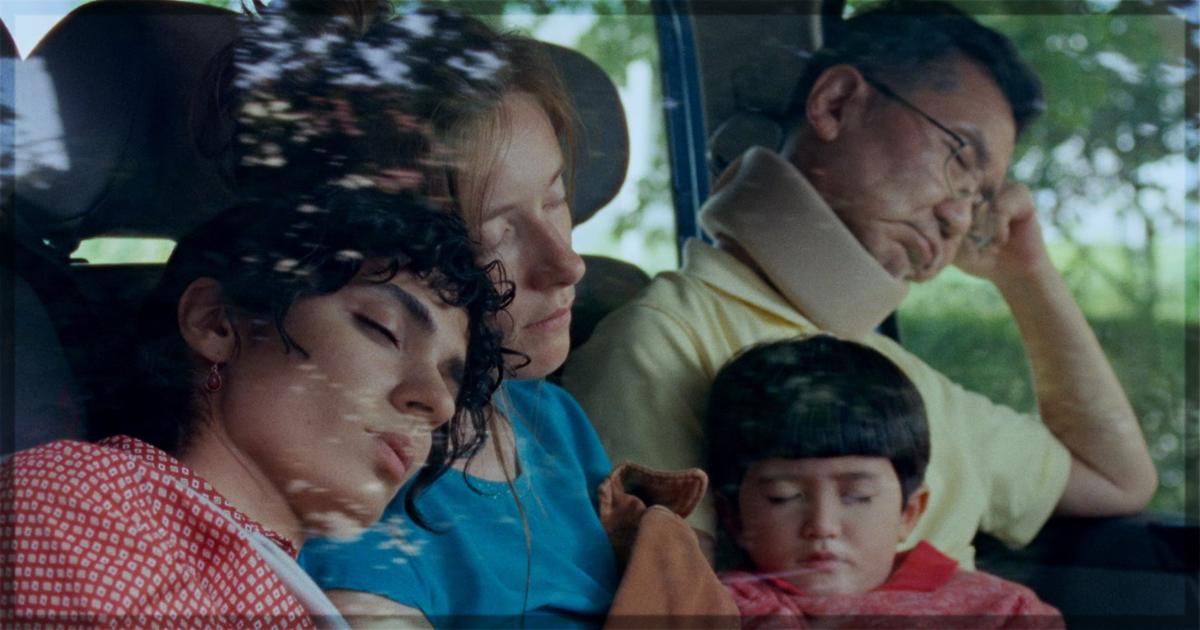
In its most compelling gesture late in its runtime, Phantoms of July turns into an unlikely road movie, as Neda signs up for a tour through the region’s supposedly most interesting sights via the services of the charming Korean tour guide Sung-Nam (Kyung-Taek Lie), who takes care of the young Buk (Buksori Lie), an undocumented immigrant. As they foray deep into the forest, they come across Ursula, who completes this strange group of people who find a sense of community and understanding in each other and eventually end up in the cave where they encounter the spirit of Lotte. Beyond its experimentations, it is this kind of intimacy that elevates the film into a delightful and tender picture. It is not just concerned with the idea of freedom on an existential level; it grounds that freedom in issues concerning labor, class war, and even the immigrant experience. In many ways, Phantoms of July offers curious commentary on familiar issues in the contemporary world against the majestic backdrop of a town that, on the surface, seems to not have a lot going on. The textures of the past, the film argues, lie in the most minute of details and the most unexpected of encounters.
Phantoms of July recently played at the Locarno Film Festival. It is now playing in limited theaters.
Learn more about the film at the IMDB site for the title.
You might also like…