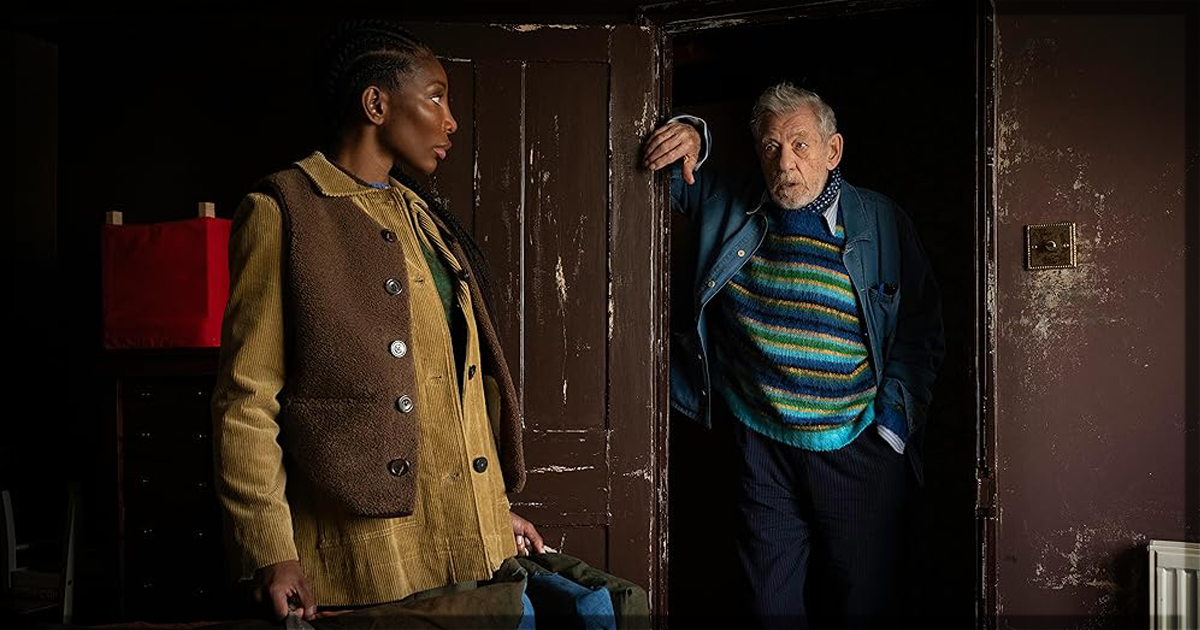
Life rarely works out the way you want, whether or not you get what you want. The Christophers uses the art of painting as its metaphor for how people come to terms with what life has given them, and also what they do about it. It’s set entirely within London’s zone one (the public transport ticketing zone that denotes the heart of the city) and involves two giant, equally matched performances from Ian McKellen and Michaela Cole. It’s amazing both to look at and to contemplate.
Julian Sklar (Mr. McKellen) came to fame and glory in the nineties with two sets of paintings of a young man called Christopher. They sold for millions but since then Julian has done not much, instead becoming notorious for cheap stunts and cheaper TV appearances. He now relies on Cameos (short personalised video messages for which he charges around $200 a pop) to keep the bills in his giant Fitzrovia home paid; he gets extra if he mimes signing them. But there remains a third batch of Christopher paintings that have stayed unfinished since the nineties. Since Julian is not getting any younger his grasping children Sally (Jessica Gunning) and Barnaby (James Corden) are frantic about the potential income lost if the paintings stay that way. Fortunately Sally went to art school with a woman named Lori (Ms. Coel), who is currently running a food truck at the Tower of London. Lori is also currently living as a property guardian in Farringdon, and reeling from a double breakup, in that both of her partners ejected her from their three-part relationship to be exclusive with each other. In other words, since Sally and Barnaby are looking for someone to complete the Christophers without Julian’s knowledge, Lori has the skill, she has the time, and she needs the money. The lie to Julian is that Lori will become his assistant, and when on first meeting Lori repairs a humidifier while Julian ‘interviews’ her by talking about himself, she’s in. But neither Julian nor Lori are so simple, and neither of them like Barnaby or Sally.
Writer Ed Solomon (whose previous screenplays include all three Bill and Teds, both two Now You See Mes and one Charlie’s Angels and Men in Black each) and cinematographer-editor-director Steven Soderbergh are thinking about two things here. The first is the control an artist has over their work, and the second is the control an artist doesn’t have over how people react to their work. Lori is a thoughtful and discerning artist whose massive talent has only been matched by her bad luck, while Julian achieved so much so easily thanks to the Christophers he buckled under the pressure to live up to himself. There’s some discussion about how an artistic ‘brand name’ has become almost more important than authenticity, despite the entire concept of art holding its value because of the identity of the artist. (Don’t get me started on how much art is made by ‘assistants’ or ‘interns’ of the artists themselves these days.) There’s also discussion about how art is valued, and why something awful by someone as famous as Julian is automatically worth much more than something perfect by someone who works fast food like Lori. It is also much funnier than this description sounds, with the sight gag of Sally’s childish attempt to complete one of the Christophers only matched by Lori’s surprise that Sally has improved since their art school days.
This would make a great double bill with Two Pianos, another recent movie about a surprising artistic combination enhancing the artists’ lives and work in unpredicted ways. Mr. McKellen gets to have a wonderful time pontificating around his gorgeous house, expecting everyone to fall in with his perfect opinions and showing Julian’s combination of irritation and respect that Lori knows how to handle him. Ms. Coel, who has mainly worked in television and who got her start as a slapstick performer, contrasts that energy with a tight silence. Lori knows a great deal more than she’s ever been able to express and normally keeps her mouth clamped shut, but when the dam bursts Ms. Coel makes the great decision to show that avalanche as a choice. Her self-assertion is not even calm, it just simply is, and because she is right Julian has no choice but to agree with her. Here is someone, possibly the first someone since Julian entered the public eye, that he can’t steamroll. And to Julian’s surprise this is even more valuable to him than the paintings, or the promise of the paintings, themselves.
Musician David Holmes, who frequently works with Mr. Soderbergh, does his usual excellent job underlining the visuals, and production designer Antonia Lowe does spectacular work at making Julian’s home feel like a real space, cluttered with the detritus of a working studio and the memorabilia of a major career. The paintings are stored in a bathtub in the attic, for goodness’ sake. This attention to the small details of real life as Londoners live it was not expected from either Mr. Solomon or Mr. Soderbergh (even though two of his three most recent films, Black Bag and Magic Mike’s Last Dance, are London movies). But it can be said that this is another one of Mr Soderbergh’s heist movies, except the heist here shouldn’t be spoiled. What gives art its value? How do we decide what is good or who is important? And how do we bring out the best in each other? The Christophers knows, and shows us so expertly it might not get its full due. This is what happens when an artist’s normal standard, like Mr. Soderbergh’s, is so high we forget how hard it is to be this good. But we shouldn’t take excellence like this for granted, and we should feel so lucky to have movies as great as The Christophers ready for us when we are ready to appreciate them.
The Christophers is now in limited theaters.
Learn more about the film at the IMDB site for the title.
You might also like…