
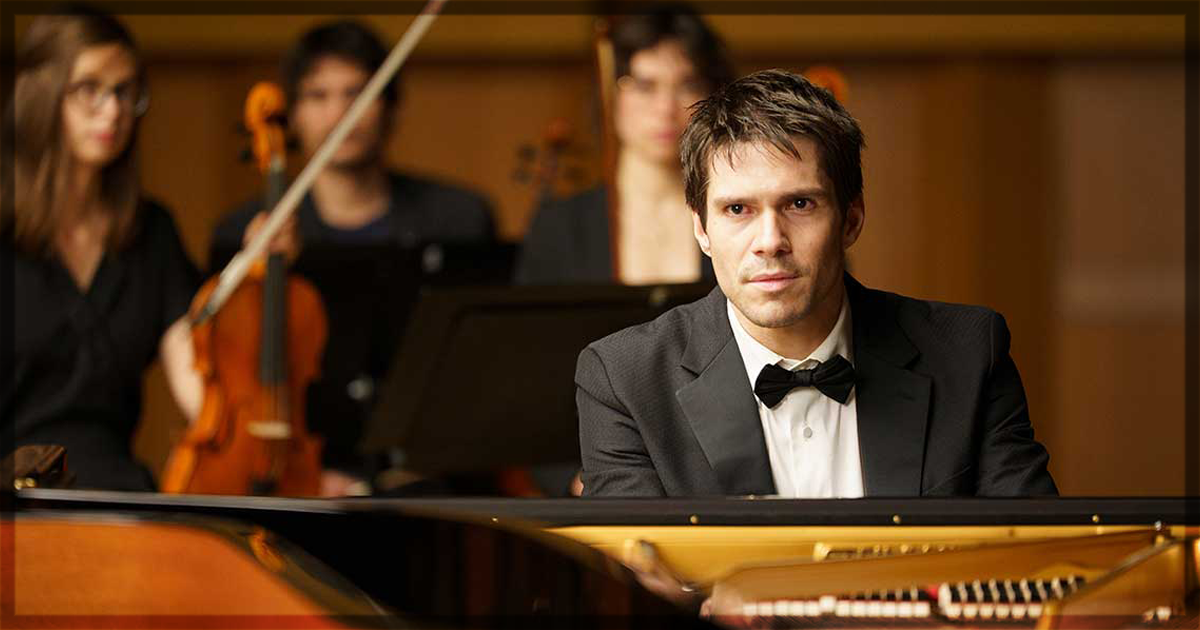
First we must congratulate Laura Caselli, the casting director for Two Pianos, for realising the male movie star currently working in France whose vibe best matches Charlotte Rampling’s is François Civil. He has a tendency to play hotheaded romantic heroes and recently carried the two-part adaption of The Three Musketeers with his quicksilver, brittle, charming intelligence. In Two Pianos he has to play two very different love stories and does so with a raw and damaged aura that matches the unpredictable plot. He, as with Two Pianos, is mesmerising from start to finish.
Elena (Ms. Rampling) is the conductor-pianist who rules an orchestra in Lyon. She is preparing a concert of the Bartók piece which lends the movie its name, and to that end has summoned her former student Mathias (Mr. Civil) to play the other half of the duet. Mathias is also a world-class pianist but left Lyon about eight years ago for a peripatetic touring life, most recently in Tokyo. (Both Mr. Civil and Ms. Rampling did some of their own playing, though for the toughest stuff their hands were doubled.) Only Elena could have gotten him to come back, as even his mother (Anne Kessler) knows. But as Mathias leaves a party at Elena’s house, he bumps into a woman named Claude (Nadia Tereszkiewicz). They stare at each other in shock before Claude turns and leaves without a word. Mathias immediately drops into a dead faint, then gets so dead drunk he awakes in the drunk tank with his agent Max (Hippolyte Girardot) impatiently waiting to bail him out. Things only get more complicated from there.
The great wonder of the film is how Elena and Mathias treat each other as total equals, a courtesy neither extends to anyone else. They are very fond of each other while entirely aware of the other’s personal failings – Elena has never cured herself of her bad habits towards her much younger girlfriends, and her anger at Mathias’ tendency to self-destruct is more than justified – but have nothing but respect for each other as musicians. Mr. Civil and Ms. Rampling convey a level of artistic commitment, emotional intelligence, and personal respect you sometimes see in real life between ride-or-die business partners but which is rarely accurately reflected in cinema. (The Christophers, also out now, also shows a surprising rapport between two peers, and the movies together would make a fantastic double bill.)
To see this mutual admiration society in the hierarchical and cutthroat world of classical music is a great joy. But Elena has a terrible secret, and it shortly transpires that Claude does too. She is married to Mathias’s student best friend Pierre (Jeremy Lewin, making an enormous impression with his limited screen time) even though any fool can see that Mathias is consumed with love for her. His love for her is so strong it’s kept him restless and roving since he left Lyon, though it’s hard to know if the approximately 700 women he claims to have slept with in the intervening years is a big lie. Looking like Mr. Civil, anything’s possible.
The question is whether Mathias and Elena will be each able to hold it together to pull off the concert, and because the pull between Claude and Mathias could probably pull satellites out of orbit. To hint at anything more would be a spoiler. But it is very pleasing to report that co-writer/director Arnaud Desplechin does the very rare trick of hitting the standard movie marks in fresh and unexpected ways. This is a movie about adults, by which is meant there’s a frankness about human weakness that’s becoming rare in cinema. Adults are unpredictable and messy, they pick fights in bars and tell inappropriate jokes, they lose their temper and go swimming and need cold showers in order to function. They let each other down, but they also forgive. When one friend asks another if she will sleep with someone again, the friend replies without animosity, “Well, that’s up to you.” They make surprising choices. And sometimes they have no choice at all, because they feel a certain way about someone and that’s all there is to it.
Paul Guilhaume’s camera feels like a fascinated observer, coming in close to observe hands and faces, before pulling back to see the bigger picture of Mathias coming home and trying to figure out what he’s to do. There’s an enormous sense of curiosity here, as if the movie wasn’t scripted, which is not often felt from a scripted film. Ms. Tereszkiewicz does excellent work as a woman who has successfully avoided a conversation for nearly a decade and can’t cope with time being up. Ms. Rampling brings her gravitas and the weight of her entire career to be so excellent that there’s very little to be said about how expertly she steers the film. But Mr. Civil is the star here, and unusually compelling as this musician who has both exactly the life he wanted and also absolutely nothing he wanted at all. It’s not a spoiler to say the final shot of the film, of Mathias falling asleep in the passenger seat of a car Max is driving, conveys acceptance and resignation mixed with hope through Mr. Civil’s body language and facial expressions in a way that will be studied by other actors for years. In order to succeed Two Pianos needed someone to match Ms. Rampling and make it feel easy, and Mr. Civil does that and more. It’s an off-key treasure.
Two Pianos (Deux Pianos) is now in theaters.
Learn more about the film at the IMDB site for the title.
You might also like…
‘Zi’ Film Review – Three Characters in Search of an Author