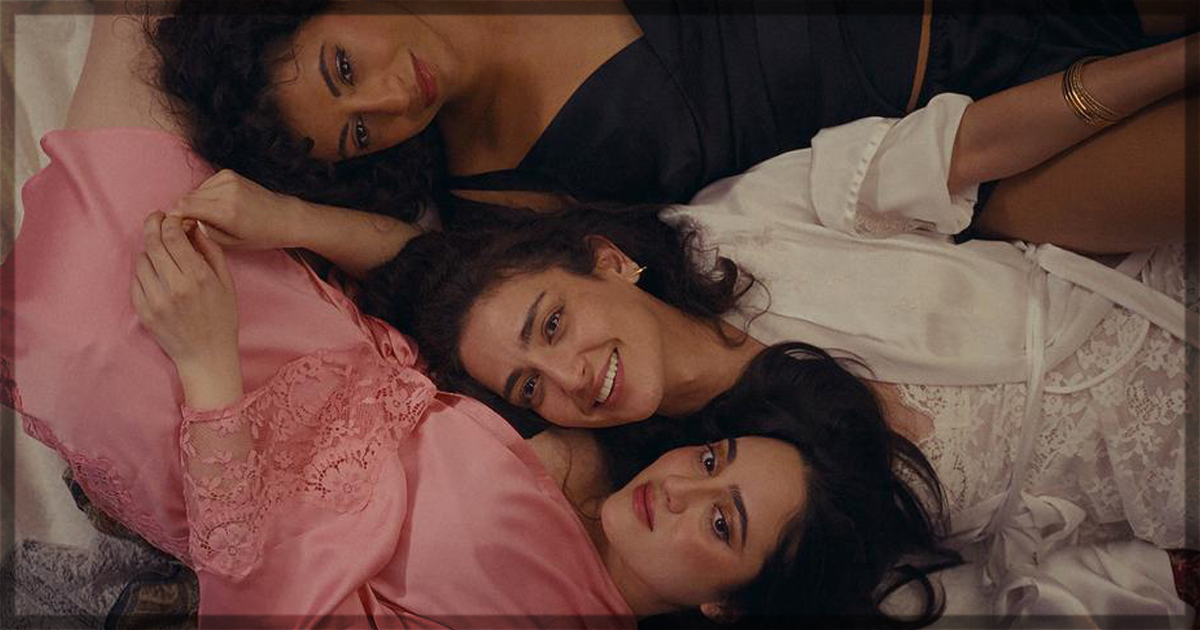
The LA-Based director and actor Lauren Noll made a splash in the short film circuit, leading the award-winning film The Heart of Texas by Gregory J.M. Kasunich. Besides working as an actor, she presents her first feature as a director, an effort funded through crowdfunding campaigns that allowed her to display her talents as a storyteller. The result is Same Same But Different, a comedy about three best friends from Iranian heritage in the United States. Rana (Medalion Rahimi) is an Iranian woman who moved to the United States to pursue her dreams of being an accomplished writer and works as a caregiver for the ill patriarch of a wealthy family on Cape Cod. Despite her efforts, her visa application to stay in the country receives its third rejection. Adam (Logan Miller), the family’s son, suggests that Rana marry him, then she can apply for citizenship. Thus, the Iranian writer ought to assemble her two best friends, Set (Layla Mohammadi) and Nadia (Dalia Rooni), to organize a wedding in the shortest time.
In this sense, the film is about the differences in their Iranian upbringings and the difficulties they face in adapting the American society, especially in the context of intercultural relationships. Written by Rooni, there is an inherent conflict about moving forward in the U.S., while not forgetting the traditions, the religion, the memories, and the poetry from their homeland. Rana faces an internal dilemma when marrying a wealthy man to legalize her immigration status, but adopting his last name, especially to protect his family’s billions of dollars. Therefore, the change in her name is not for the love or the prospect of building a family, but the legal protection of the status quo that she used to serve before it became the solution to her most prominent problem. In this sense, there is only a shallow debate about the consequences of the union between a suggested billionaire heir and an Iranian caregiver. Narratively and subtextually, the director aims for the strengthening of the dramatic structure by underlining some of the most complicated discussions of the intercultural and interracial discourses in an increasingly conservative United States.
Yet, the film drives through the comedy lane to satirize and poke fun at the appropriations of other cultures by the white perspective, in this case, incarnated by the Kevin Nealon, who portrays a guru called Siddhartha. The manner in which Noll frames him, and the writing mocks the usage of other religions and cultures, while not entirely respecting the traditions, and whitewashing them. Even if the scenes featuring Nealon feel a bit off from the rest, there is a crucial spiritual session that emulates couples therapy. In the context of the other subplots, it adds to the comedy of that situation. Still, the trio’s relationship is the strongest feature of the film, which, even if directed by a white woman, respects the artistic integrity and ideas of the writer and the Iranian actors, who are also producers of the project. Therefore, the script discusses the insecurities of the descendants who carry the culture and the traumas of a generation post-revolution, who immigrate to the United States searching for a new life.
Dalia Rooni thrives in debating the tough nuances of the Iranian experience in the United States: the sexuality of women raised as Muslims, the traditions of marriages, and the generational weight of moving forward with your life in a country, when your family is incommunicable in your birthplace. Furthermore, the sexual aspect of the trio is fascinating, especially in the contradictions of Set, who is ashamed of her boyfriend’s plumbing business, and states conservative understandings of feminism and sexuality. Still, she kisses Adam’s sister, played by the director herself, on the first opportunity. The most vital aspect of the film is the dynamics, who are not supposed to work, but do: Pat (Richie Moriarty) and Ryan (Michael Baszler), who are the opposite in looks, but grow fond of each other. Another compelling subplot is Rana’s breaking of her own rules, such as not having sex with Adam, and avoiding deepening their affection. Life is about expecting something, but meeting with the unthinkable. This notion is the most fun of the situations in the film, which takes place in one location over a short week.
Lauren Noll still shows a certain inexperience in a few blocking and organization of the scenes, as well as the spotting of the score in the film. Yet, led by the chemistry of Medalion Rahimi, Layla Mohammadi, and Dalia Rooni, who create a fascinating comedy about the Iranian experience in the United States, expanding on the interculturalities and the challenges of marriage. Ultimately, Same Same But Different is a film about utterly searching for your dreams, even when you feel lost; there is still a strong foundation of our friends and those who love us.
Same Same But Different recently played at SXSW.
Learn more about the film at the IMDB site for the title.
You might also like…