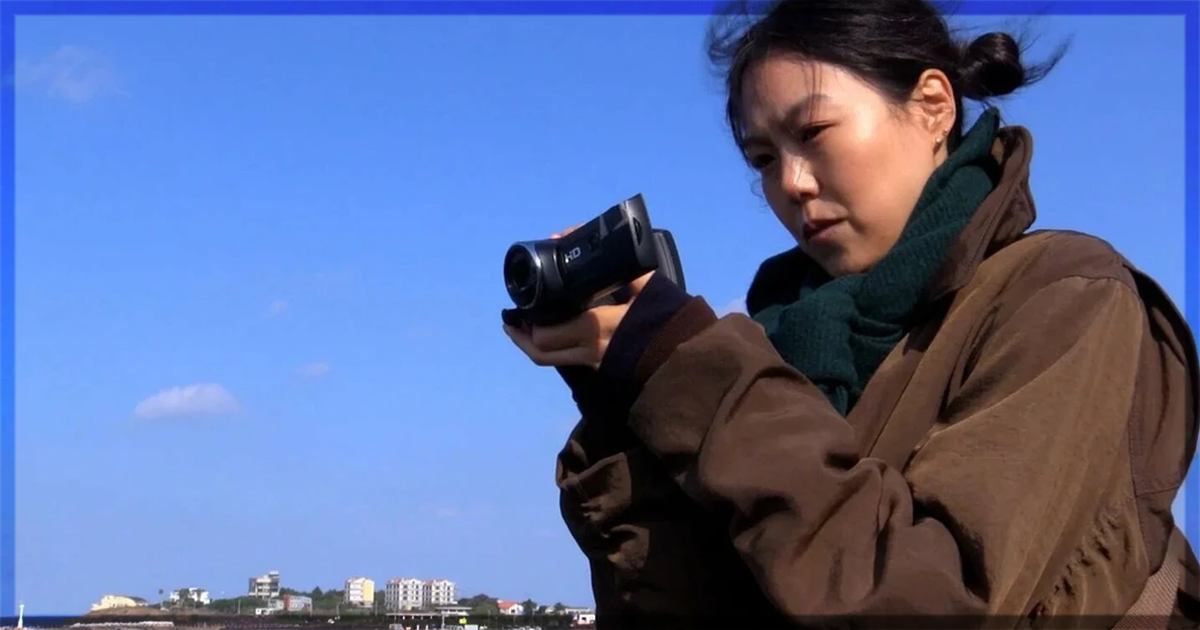
In the festival circuit, with each announcement of a major festival, there is a name that people expect to hear: Hong Sang-soo. In February, he premiered The Day She Returns , which played at the Berlinale’s Panorama. Six months later, the Korean master is back with his latest, Nowhere to Lay My Eyes (눈 둘 데가 없네). It is the return of his muse and wife, Kim Min-hee, who last performed in one of his films, By the Stream, released in 2024. Here, the director applies his simplistic and minimalist structure to its core: a woman, Sang-hee, returns to visit her family in Jeju after ten years. Her mother (Choi Myung-gil) has a popular restaurant on the island, and her stepdad (Kwon Hae-hyo) is shooting a film about a grass tomb. Over the course of the day, they talk about their lives and the artistic approach of the woman, who is a filmmaker, while they enjoy each other’s company.
While watching Sang-soo’s films, there is a strong sense of shared elements between them. In this sense, the journey home is reminiscent of aspects of What Does Nature Say to You?, which depicts a return to the countryside and an individual’s roots. Meanwhile, the artistic approach and its discussions are present in most of the filmmaker’s filmography. In this sense, in mere seventy-two minutes, we dive into a meditation on a numb relationship between family members. At the first interaction, when they arrive, Sang-hee discovers that her brother (Shin Seok-ho) has been there before, while he only said that he had called their mother. Therefore, in the introduction, we learn about that woman’s feelings of abandonment and detachment from her parent. Hence, the naturalism of the actors presents the essence of the Korean master’s style, such as the construction of the film through its dialogues, the expositional nature of the daily life, and the spotlighting of events.
Despite the short duration, the slice-of-life portrayed by the director creates a sense of familiarity. Similar to his past work, Sang-soo creates a rather simple story through the passages of that family. They talk about the blooming restaurant business, which the mother is a part of. In the same conversation, the daughter states her opinion on documentary filmmaking. In a fascinating statement, Sang-hee mentions the non-fiction production surrounding the Palestinian genocide. She states that the aggressor films their side, defending their violence, while the people suffering the ethnic cleansing document their bombed villages. To her, it is a form of brainwashing to insist that your side is the correct one; hence, it is the reason she prefers drama. At those moments, the auteur establishes a representation of truth that echoes his works, mostly because he believes in the dramatic construction as his vision of cinema. Indeed, rather than demoralizing the efforts of the filmmakers capturing genocide, the Korean director arguably justifies his choices in crafting his films.
In this aspect, almost believing in an apolitical virtue of art, even if everything in life is a political statement, that woman aims for her work as an analysis of the human psyche and the emotional state. Consequently, it becomes a fascinating game of living the everyday to inspire yourself in the craft of your art. Fascinatingly, it becomes a process that takes the necessity of observing the nature around you and conversing with people to craft your work. Funnily enough, she hides her work from her family, afraid of people watching it. It is indeed a compelling experience to unveil that woman’s skin, the layers that compose the complexity of an artist meeting with her family again. Of course, as with other entries in the filmmaker’s oeuvre, there are underwhelming moments, breathing moments between the long conversations and/or walks.
Yet, the Rohmerian brushes in the work by Sang-soo create a picture that, similar to the French master, studies individuals confronting relationships, past stories, and life in general. Still, armed with his cheap camera and the diminutive structure of a film production, the Korean director provides a fascinating and coherent film in Nowhere to Lay My Eyes. Guided by the naturalism in the performance of his muse, Kim Min-hee, they understudy the branches of artistry and its connection to life. Thus, even if underwhelming in parts, such as a few excerpts in those conversations, there is much to reflect on and admire in the director’s latest effort. Alongside his earlier entry, The Day She Returns, Hong Sang-Soo creates films that rhyme with artistry and the daily life, attempting to capture the glimpses of beauty in the passage of time.
Nowhere to Lay My Eyes recently played at the Locarno Film Festival.
Learn more about the film at the IMDB site for the title.
You might also like…