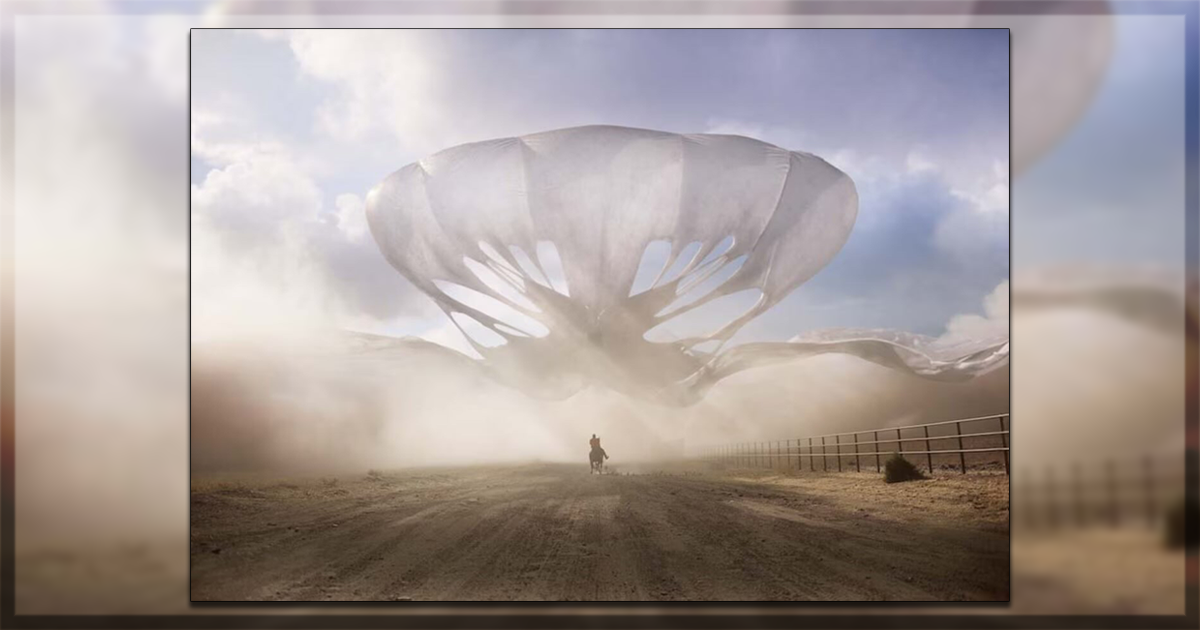
Jordan Peele’s third feature film, Nope, was kept a mystery in its marketing and has been slotted into various categories since its release: supernatural horror, science fiction, modern Western, creature feature, and sardonic look at a society obsessed with getting the perfect money-making shot. Nope is all of these in its ambition, scope, and excellence across all elements of filmmaking, but it is also one of the best films made about the bond between humans and animals. Namely, it is a film about the dangers of sentimentalising this bond while celebrating the power and promise of the earliest moving image: a man on a galloping horse.
Nope follows the Haywood siblings, Otis Jr “OJ” (Daniel Kaluuya) and Emerald “Em” (Keke Palmer), descendants of the Black jockey Eadweard Muybridge immortalised on the first moving pictures in 1887. They are working hard to keep their family’s Hollywood horse training business alive, but times are never easy in showbiz; following the death of their father (Keith David) in a freak accident, when keys and coins were pelted from the sky with alarming ferocity, and OJ’s favourite horse Lucky striking out on set when spooked by a lighting test, the siblings need a big break to stay on their feet. Making matters worse is that their neighbour, amusement park maven Ricky Park (Steven Yeun), has found massive success in his line of work, monetising his trauma from his child star days and buying up the Haywood’s horses for his ranch-themed live shows.
But perhaps that earlier freak accident was not actually an accident; perhaps there is something hiding in the clouds that will earn them fame and fortune if they can prove its existence on film – the “Oprah Shot”, as Em calls it. This fame and fortune, of course, is dependent on everyone surviving to tell the tale.
Nope is big, funny, thrilling, and just messy and sprawling enough that its characters and themes can be interpreted in a myriad different ways. Hoyte van Hoytema’s cinematography looks terrific, and Michael Abels’ score evokes Aaron Copland and the great Westerns of yesteryear. Amid the tension and the terrors, the result is adrenaline-pumping joy at the possibilities of cinema. Nope works so well on the first watch because every reveal is a surprise (like Peele’s previous films Get Out and Us, much of its substance was kept deliberately hidden until opening day – and also like these films, worthy of the hype this strategy generated). Nope works so well on each subsequent watch because its rich tapestry of characters, motivations, and references generate a plethora of subtextual connections.
Jordan Peele’s script borders on the cynical. A twist that sets up the climatic set piece is incredibly, deliciously mean-spirited (albeit entirely rooted in everything the film establishes before and after). One character in particular reads as a send-up of a certain film industry type, whose choice at a pivotal moment means that the film’s most exhilarating moment quickly becomes its most sickening. Some of the commentary about the need to film and document everything also reads a bit “boomer” (even though, in the first twist mentioned above, this is masterfully subverted). But cynicism is no fault of its own, and horror thrives on regressive fears (a conversation too deep for one review). When the result is this ambitious, audacious, and excellent, these possible flaws melt away.
More importantly, like his protagonists, Peele cannot resist pure Hollywood magic. Nope might be critiquing spectacle and its exploitation, but it does so through glorious visuals, stunning sound design, and a seamless integration of visual effects with location shoots.
Nope is, moreover, one of the best “horse girl” (gender neutral) films ever made. As anyone who lives around animals – especially working animals – knows, the way humans understand the world is not universal among its life forms. Popular fiction has always anthropomorphised its non-human characters – think of Anna Sewell’s Black Beauty and its many screen adaptations. It is only natural to ascribe human emotions, motivations, and characteristics to these animals we wholeheartedly love – and science has shown many of these animals truly love humans, at least in their own way.
But animals do not reason with and react to the world the same way humans do. If you count on animals to think, react, or behave as humans would, you are setting yourself up for trouble – or worse. Nope it knows that horse (and other non-human) intelligence does not always read as human intelligence, and woe betide anyone who thinks differently. Ricky’s storyline, containing two of the film’s most shocking sequences, proves this to a very tragic end.
There is a bonus for the horse lovers in the audience. It is no spoiler to say that some horses fall afoul of Nope’s mysterious horror happenings. Watching the Haywoods desensitise and train their horses, the effort that goes into developing safe and healthy workplaces for on-screen animals is front and centre. But even as panicked neighs are overlaid when things get scary, the horses’ ears stay pert. The pawing and kicks are clearly cued. Sometimes they will shift all weight onto one back leg – a sign of equine relaxation. Even in moments of nail-biting tension, these horses were having a great time.
Nope is available to stream or purchase at your retailer of choice.
Learn more about the film at the IMDB site for the title.
You might also like…