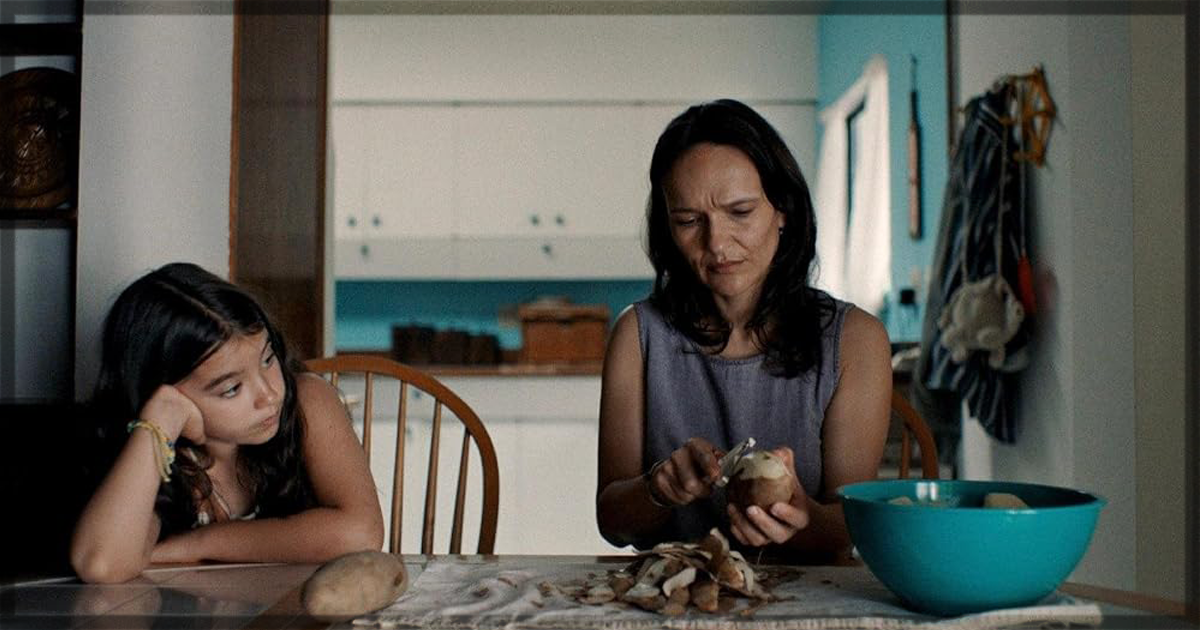
For a movie about the limits of memory, Blue Heron made the bad decision to be from the point of the youngest family member. That’s to say, the person present with the most limited understanding of what was happening while it was happening. The fact that the young daughter, Sasha (Eylul Guven), is clearly a stand-in for writer-director Sophy Romvari is neither here nor there. A better movie would have been from the point of view of one of the story’s active participants. Instead Blue Heron is two different kinds of attempts – direct and indirect – to reconstruct the memories of how this family was pulled apart. And while its mood is unusually strong, unfortunately its mood is all it has.
It’s sometime in the 90s in western Canada and they are a Hungarian-speaking family of six: mother (Iringó Réti), father (Ádám Tompa), oldest brother Jeremy (Edik Beddoes), two other brothers around nine and eleven, and Sasha, who’s about eight. Jeremy is in his mid-teens and blond where everyone else is brunette, so clearly has a different dad, not that he is treated as such. The family has just moved into a new house and the father – it is a mistake for the parents not to have names – is so swamped with work the mother must take the kids on excursions to keep them occupied and away from him. For the most part they are an amiable family, running through garden sprinklers, building rock castles on the beach and cheerfully posing for photos. These are the indirect attempts at reconstructing memories, especially when Jeremy lashes out. Sometimes he’s up on the roof with mother begging him to come down, as Sasha watches the latkes burning on the stove. Sometimes he lies motionless on the front stoop for hours, as concerned neighbours call the parents and Sasha steps right on over him. And sometimes he harms himself in his basement bedroom as the parents try to stop him and Sasha watches.
Maya Bankovic’s cinematography and Kurt Walker’s editing does brilliant work in making all this feel like hazy memory, with the dialogue much less important than the sense of mood. It’s the kind of feeling you get on a hot, boring and unimportant day, where the hours stretch out like taffy, except Jeremy is also there, thoughtful and selfish, unpredictable and dangerous. Various social workers chat with the parents about how he is beyond their or anyone’s control, though the mother is mainly concerned about whether anyone thinks she’s a bad mother. When Sasha is an adult (Amy Zimmer), she goes so far as to convene a round table of social workers to discuss the historical case files and ask for their opinions on what might have been done to – well, no spoilers, though the whole concept of this film gives you a pretty good idea of where it’s going. That’s the direct attempt at reconstructing memory. And look, there’s nothing wrong with film as therapy, far from it. There are countless films about summers from the director’s childhood trying to address the lessons that summer taught them. Blue Heron is unusual only in how explicitly it is a therapeutic exercise, aimed at reassuring absolutely everyone they did their absolute best. And while that might have been important to the filmmakers, for the audience it doesn’t land nearly as strongly.
That’s because Blue Heron should have been made from the perspective of the mother. To have a child who is a danger to their siblings, their self and to you is very dramatic! The fact that the child is not much of a child anymore, is outside anyone’s control, and refuses all attempts to talk about it means the stakes are also quite high. It would have been more interesting to show how the parents were trying to address Jeremy’s pain and violence instead of hearing them, and only them, talk about it. But working from the mother’s point of view would have included addressing if the parents know why things are going so wrong. Just because the smallest sibling isn’t aware of something doesn’t mean it didn’t happen. Instead Blue Heron is more interested in reassuring everyone that sometimes, despite everyone’s best intentions, things just can’t be fixed. And while that might be an important thing for five of these family members to hear, there’s six of them.
The title is a reference to a keyring Jeremy steals (as Sasha silently watches) from a nature reserve gift shop. The opening and closing images are of a sunset over an island hillside as a voiceover muses about whether memories can be trusted. It was Maya Angelou who said (paraphrasing slightly) that people will forget what you say or do, but they will never forget how you made them feel. It is clear that Blue Heron has been designed to make one specific family feel one certain way, and there’s nothing wrong with that. But because it’s so uninterested in thinking about those therapeutic exercises will land with an audience, it shows its own limits. And that’s not the limits of memory. It’s the limits of empathy. The choice Ms. Romvari made to center herself in Blue Heron is the same mistake Charlotte Wells made in Aftersun, which also has a critical reputation far beyond what it deserves. But it seems people prefer movies to be “my problem is my male relative has a problem” and not “my male relative has a problem.” What might a therapist have to say about that?
Blue Heron was recently in theaters.
Learn more about the film at the IMDB site for the title.
You might also like…