
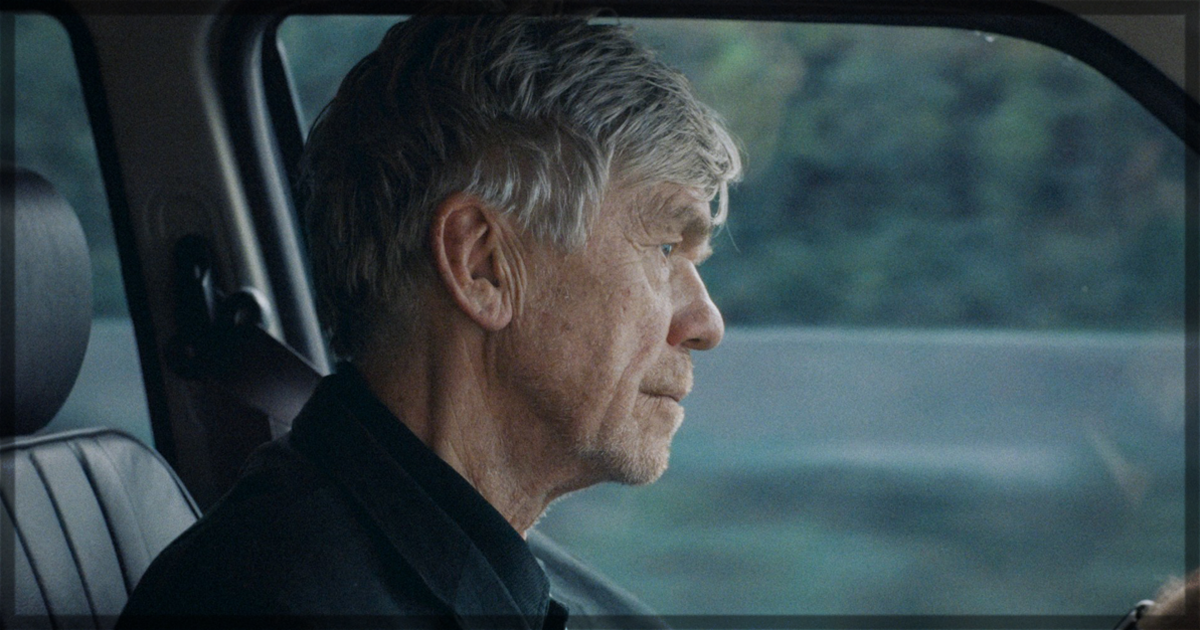
The director Sebastian Brameshuber presents his new film at this year’s Berlin Film Festival in the Panorama section. London portrays the life of a seventy-two-year-old man, Bobby Sommer, who drives back and forth between Vienna and Salzburg, in Austria. He gives lifts to people traveling to these cities and he converses with these individuals to pass the time. He talks to a young soldier on the verge of deployment, while they compare the differences between serving the army in the past and now. Bobby also drives a young trainee from a supermarket, who talks about slicing sixty different types of sausages and all of the delicacies he has to name. Another passenger talks passionately about James Cameron’s Avatar and shares the experiences of working as a museum guard with Bobby, who also claims to have worked at the Museum of Art back in the day. Each new passenger is a different conversation that unveils the driver’s life experiences.
Brameshuber’s film features a fascinating cinematic identity. The lines between fiction and documentary are blurred. Hence, Bobby plays himself, a man interested in giving lifts to people who need them to go from Salzburg to Vienna, and the other way around. Yet, there is the uncertainty between what the fiction is and what the truth is. We land on the fascinating nature of the conversations, which promote the interaction between young individuals and someone who lived during different decades in Austria. The results are exchanges that expose the various realities of the passengers and the driver, who listens carefully to each of their stories and contributes to passages on his trajectory, or questions that expand the topic or the personal story that they tell him.
Fascinatingly, the first conversation, in a travel with the young private, sets the tone for the rest of the film in terms of structure. In a sense, we learn about the driver, who picks up the passenger on the McDonald’s parking lot, and shares that he prefers going to the fast-food chain in the morning. He likes the McMuffins, he says. From there, the conversation unfolds naturally. The young man is wearing his uniform, which generates questions about the time left of service, if he ever shot a gun, and the regime of the training. In those exchanges, Bobby shows himself as a natural interviewer. It is not that the film functions as a recorded interview, but conversations are a series of questions and answers. And the driver is great at asking them. The film borrows from this humane ability that the man has for conversations, extracting anecdotes from those individuals. For a few hours, he has a profound interaction with these people he will probably never see again. Yet, there is a fascination in hearing them and sharing moments of his trajectory.
Still, there is a repetitive structure in Brameshuber’s film that controls the rest of the narrative. The director chooses to frame the driver and each of the passengers in a general framing, which portrays them from the waist up. The film spends all the scenes inside the car in that setting, shifting from Bobby to whoever is beside him. In this sense, the director manages to induce the interest throughout the first conversations; yet, it diminishes as the conversations lose the engagement and the film becomes a repetitive sequence of conversations in a restrained ambient. Occasionally, the director shoots the driver at a gas station, eating a snack, or having breakfast somewhere. Those moments are necessary breathers to a project that is two hours long. The project chooses to observe the nature of a driver who has these different interactions while driving back and forth in Austria. At first, it is a successful portrayal of the conversations that encapsulate multiple moments of sincere statements and anecdotes of their lives. The relief of leaving the Austrian Army soon, the fear of a conflict, the excitement of going on a road trip before starting work at a supermarket, and even the language barrier between the driver and a Romanian passenger.
The most engaging element of Sebastian Brameshuber’s London is the uncertainty of what is fiction and what is non-fiction. Bobby is a character who fascinates with his generosity in providing active listening to anyone who needs it. However, despite the engrossing nature of this structure, London is a film that tires the audience with its repetitive essence, as the conversations diminish their impact throughout its duration. Nonetheless, it is an appropriate example of the experimentation between the notions of fiction and documentary, anchored by a sympathetic lead figure.
London recently played at the Berlin Film Festival.
Learn more about the film at the IMDB site for the title.
You might also like…

Festival Bananada 2026 Review – The Arena