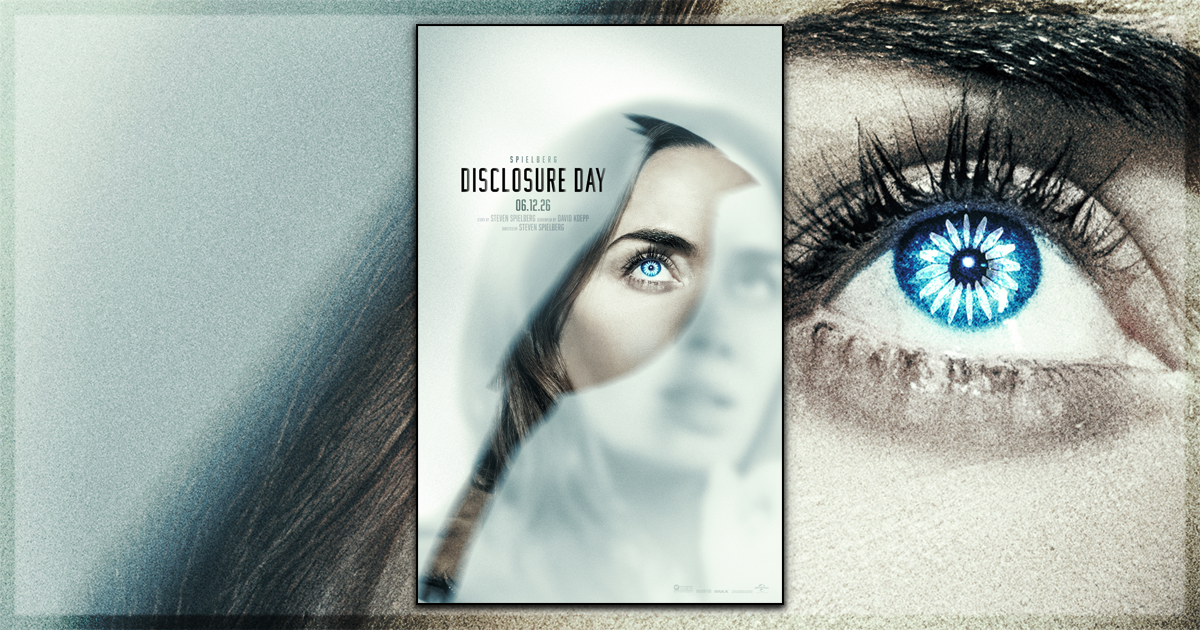
Steven Spielberg is, inarguably, one of America’s most recognizable filmmakers in cinema history. This is not always indicative of a particular level of quality. We have all talked about the auteur theory to death, but all levels of talent can be recognized by visual style. Visuals are not the only part of this theory, though it may be the easiest to recognize. Overexaggerated slow motion, lens flares, split diopters; all of these can be a clue to who you are watching. But a much more interesting indicator is that of repeated themes. It takes a skilled director to revisit ideas without simply becoming as repetitive as a broken record. Last year brought us Guillermo del Toro finally making Frankenstein, after arguably making Frankenstein stories for his entire career as a director. Spielberg, on the other hand, due to his much larger catalog, has a plethora of ideas in his filmography. His latest film, Disclosure Day, revisits many of those ideas in astounding ways
Disclosure Day is, in many ways, a feint. Just looking at the title, you might think that this is where the story begins: when the world finds out that aliens exist. But Spielberg does not seem particularly interested in showing us how the world might react to this news. Instead, he focuses on the decisions that lead to disclosure and what it could mean for us, as a human race. The film opens with a two-pronged approach, focusing on Dr. Daniel Kellner (Josh O’Connor) and Margaret Fairchild (Emily Blunt). The film smartly, despite a slightly uneven screenplay from David Koepp, sets the two on a collision course for reasons unknown. It feels as if they must share the screen, not because of contrivances, but because of something deeper entirely.
Parallel Paths
Kellner is a cybersecurity expert at WARDEX (Waived Reporting Development and Extraction) who has relieved them of sensitive information, as he believes it should be public knowledge. This has, unfortunately, led to his girlfriend, Jane (Eve Hewson), being kidnapped by his employer. Spielberg is able to both impart this information and film (with the help of stunning cinematography from Janusz Kaminski) essentially a heist and escape sequence. He does this with such ease that it reminds us of his prodigious talent. When a filmmaker has been working for decades at a high level, it becomes easy to take this for granted. But the escape sequence is so smoothly built that even moments with Kellner and Jane in the car afterwards, has us leaning forward in our seats. Some of this is due to a perspective through the windshield and around both shining light and purposely fuzzy backgrounds. After an energetic escape sequence, this silence makes the audience even more engaged and concerned.
On the other hand, Margaret is a meteorologist at a local Kansas City news station who dreams of becoming an anchor. In her opening, Koepp is again able to provide a lot of background information in a short period of time. She does have a talent for the anchor desk, her relationship with her boyfriend, Jackson (Wyatt Russell) is mildly strained, and, upon a visitation by a bird, begins speaking a language that she has never studied. Blunt is tremendous throughout, and this opening scene is no exception. The only shame is that she and Russell have no chemistry to speak of, which makes several key moments between them a tad difficult to suffer through.
Watching these two on parallel journeys allows Spielberg to widen the scope to include an intimidating amount of ideas. This feels appropriate given the plot of the film. One thesis of Disclosure Day asks the question, “Can we handle this truth?” If we were to know that a greater life form exists, what would this do to us? He asks this question using a few lenses, including faith in both a higher power and humanity in general.
Different Kinds of Faith
Strangely, one of the most interesting characters dealing with these questions is neither of our protagonists. Instead, when Jane is shown proof of our government doing terrible things to aliens, her reaction is that this should be kept hidden. After all, if we as humans are not special in God’s eyes, won’t the whole structure of many societies crumble? In this scene of revelation, Kaminsky and Spielberg flip the camera upside down as she views the evidence. This, besides looking incredible, also allows us inside her experience without unneeded expository dialogue. It also serves, eventually, to introduce Sister Maura (Elizabeth Marvel). This performance should be studied, especially in terms of using limited screentime to maximum effect. Marvel might have five minutes in the film, but without her, Jane’s journey has major gaps and ceases to make sense. Her discussion of biblical ideas, which could have been tedious, is desperately exciting, even for viewers who are not people of faith.
The other deeply important aspect is the war within ourselves. In Disclosure Day, this is clearly represented by the back-and-forth between Noah Scanlon (Colin Firth) and Hugo Wakefield (Colman Domingo). Both of these men have a past at WARDEX but have very different perspectives. If you view them as two sides of the same character, Disclosure Day opens up even more. Koepp and Spielberg inherently understand that mustache twirling villains are deeply uninteresting. Scanlon, who does many terrible things to aid his goals, still has many salient points about humanity. His perspective is more akin to another gruff character who dealt with aliens, Agent K from Men in Black.
“A person is smart. People are dumb, panicky, dangerous animals and you know it.”
Wakefield could not take a more different perspective if he tried. Although Domingo is certainly saddled with extended wordy monologues, he is more than up to the task. He, as he should be, is the physical embodiment of hope and empathy. This is certainly not subtly put in the film. He states that the aliens believe that empathy is humanity’s foremost evolutionary advantage. Spielberg and Koepp not only put these words in the mouth of the character that we trust, but also report this information back from a higher life form. This is truly the point of the film. Our differences will not make us stronger. This is easy to forget, especially now, but humans working together is what brought us so far on this planet. The aliens see and understand this, even as we drift apart in this tumultuous day and age.
Is Wakefield right? Is Scanlon? This all depends on the day you ask. All of the thoughts within both are within all of us. Who among us has not had days in which humanity seems hopeless? And conversely, we have all experienced that, beyond all logic, a belief that we, as a people can both do and be better. Given our current political context, Disclosure Day feels radical. And nowhere is that more true than in the last 15 minutes of the film, in which Spielberg throws a perfect curveball to the audience.
The Real Disclosure Day
The finale of the film is the literal Disclosure Day. It features none of the previously mentioned, or even shown, characters. Featuring a news anchor, portrayed by Courtney Grace, it allows the audience to understand the context of everything we have seen before. The fictional audience of the film is not given this opportunity, but it is important that we understand it. The film closes with Spielberg begging us to stop fighting and hear one another. Stop fighting with your neighbor, with strangers, and even yourself. There is an old proverb stating that we have two ears and one mouth for a reason. No one in this film, or truly in life, has all of the answers. There is much to gain by listening.
Spielberg has had a long and fruitful career, and hopefully he is not finished. Disclosure Day is a beautiful film that has a lot to say. One can view it as an adventure film, a film about radical empathy, an exploration of alien technology. It is all of these things and more. And more than that, this may be the quintessential Spielberg film. It is foolish to get caught up in talks of bests or rankings, especially after nearly 40 feature films over five decades. But for that long career, among other things, he has been obsessed with trust, empathy, truth, and finding knowledge in the unknowable. Frankly, Disclosure Day is a perfect litmus test to find out if you really enjoy Spielberg or if you simply like a good blockbuster. Either is fine, but Spielberg has depths that bely the numerous moneymakers in his career. He is speaking, and we should still be listening.
Disclosure Day us now available on digital at the retailer of your choice.
Learn more about the film at the IMDB site for the title.