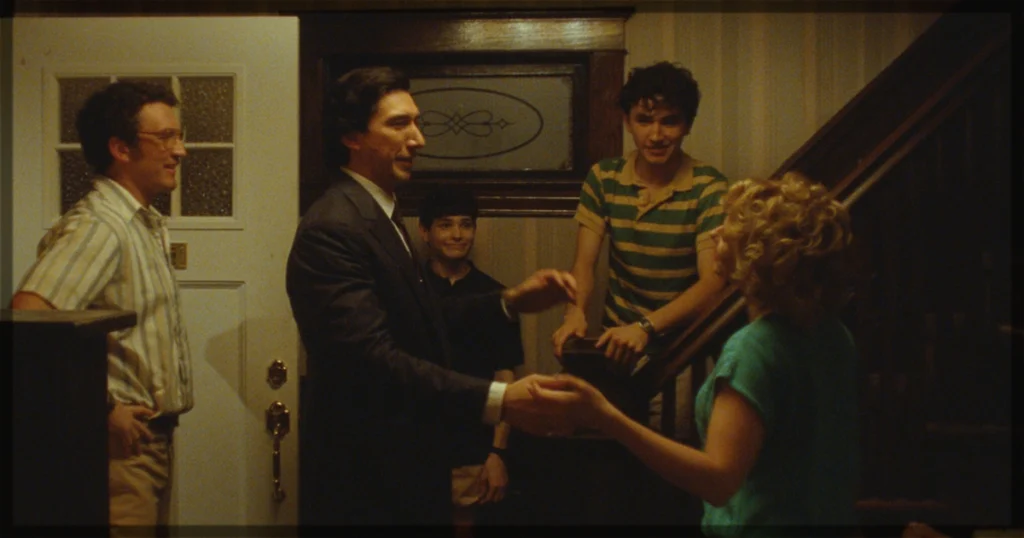
The wild success of the mediocre A Complete Unknown has at least opened up a new trend for cinema: a fictionalised exploration of specific albums recorded by specific artists. These stories tend to hark back to the analogue era, not only because young people who can’t imagine making music without a computer are fascinated by the old school tech, but also so the oldheads can enjoy back-in-my-day reminiscing. However the ways the stories are fictionalised can be deeply problematic. Either you have to deal head-on with some unpleasant personal choices that tarnish the musical legacy, or you look the other way. (The fact the girlfriend character was the only fictionalised one in A Complete Unknown is the perfect example for that. Everybody Digs Bill Evans didn’t flinch from the drama, but that could be because all the real-life people in that story are no longer with us.)
The real-life people in Köln 75 are very much with us, but this story of how the best-selling solo jazz album of all time, The Köln Concert by Keith Jarrett (John Magaro), came together attacks the story from a very different angle: it focuses on the teenage concert promoter. This is an outstanding idea, because it allows space for fiction within the story without insulting the important true facts, and it also tells a parallel and less well-known version of the famous concert, without which the concert would not have existed. What’s more that teenage concert promoter is a real person, whose name has not been changed. It is also, and delightfully, a huge amount of fun. Teenage girls who love music, jazz fanatics and people who like a rollicking good time will all fall in love with Köln 75.
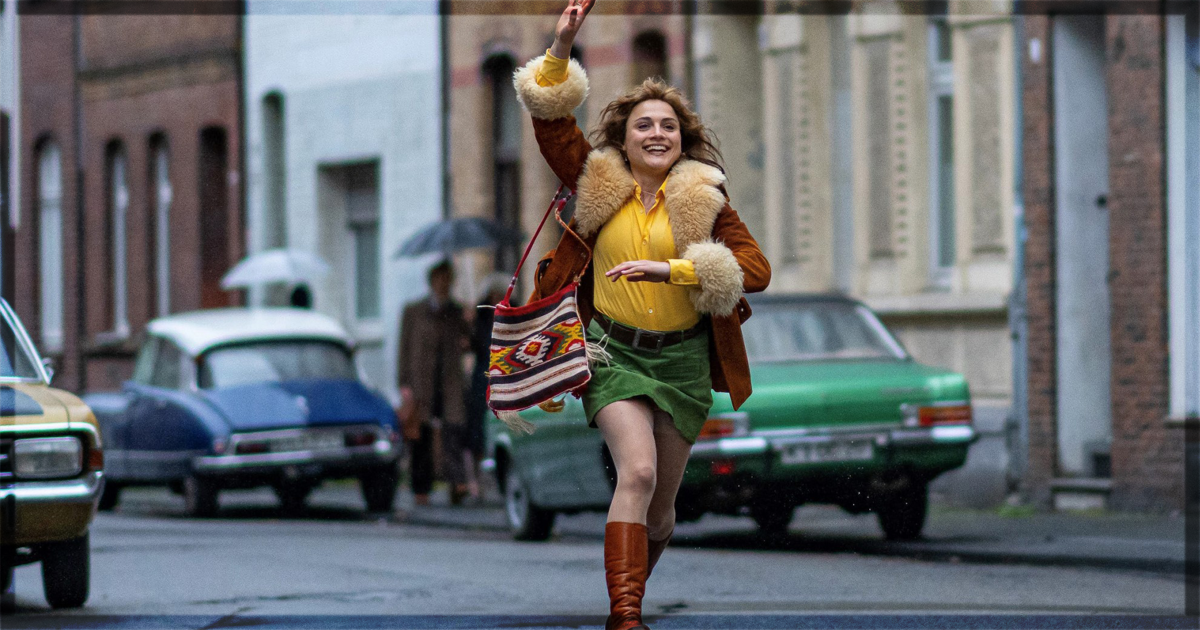
In 1973 Vera Brandes (Mala Emde) is sixteen and irrepressible and bored out of her mind at school. She and her best friend Isa (an extremely good Shirin Lilly Eissa) spend all their time prowling the venues of Cologne for jazz wherever they can find it. For Vera this is a release valve, as home is unpleasant: her mother Ilse (Jördis Triebel) is exhausted, her unemployed older brother Fritz (Leo Meier) hates her guts, and her dentist father (Ulrich Tukur)’s parenting style is “the beatings continue until morale improves.” Fortunately Vera has the self-belief to ignore them and go her own way. Her father does offer one positive thing: a separate phone line in his downstairs office. That means when a chance chat with a musician passing through (who is decent enough to let Vera claim to be 25 while very much knowing better) turns into an offer to book his next German tour, Vera picks up the phone and starts calling. Why not? She’s charming and smart, with a gift for getting people to do the things she wants with a smile. She does so well other work starts pouring in, to the point she can soon afford to rent her own ‘office’ without her parents knowing. Vera also has a cheerful boyfriend named Jan (Enno Trebs, here ratcheting up the charm so obvious in Afire), and Isa has a devotee named Oliver (Leon Blohm) – more on that later – so the four of them, plus a grumpy but desperate for the work Fritz, start building a jazz scene in Cologne with little more than their enthusiasm. It’s exactly the kind of youthful foolery and freedom people dream about.
As part of that enthusiasm Vera takes herself off to a jazz festival in Berlin, where she first sees Jarrett play. She is so blown away by the experience she becomes determined to book him a concert in Cologne, a decision she arrives at during sex with Jan, who followed her to Berlin as a surprise, aka he had to sleep on the street outside her cheap hotel. It’s quite a sequence, all the more so because it pivots into an explainer of both jazz music generally and Mr Jarrett’s talent specifically, done to camera by Michael Chernus as music journalist Mike Watts. The thing is this somehow works? The rapid-fire name-dropping is exactly the kind of thing those who know love to debate endlessly. For those who don’t, a quick primer to bring them up to speed ensures we understand just how extraordinary a musician Mr. Jarrett is – especially since none of his music was used in the movie – within a three-minute potted history of the entire musical genre. The sequence of Watts, Jarrett and Jarrett’s manager Manfred (Alexander Scheer) travelling to the concert gives cinematographer Jens Harant a chance to expand the scope of his images. The sound design by Frederik Van de Moortel also plays with letting us experience a little of how Mr. Jarrett must hear the world.
But that is the calm before the storm, as a variety of catastrophes happen so suddenly that it seems impossible the concert will come together. (Between this and Tuner, the career of piano tuning is experiencing a sudden resurgence. People hunger for the analogue!) Writer-director Ido Fluk keeps the pace lively and the problems palpable as Vera runs around trying to solve all the unexpected problems of the day. The way Ms. Emde, playing a decade younger than her age, shows how Vera attacks every problem with anxiety hidden under forthright good cheer means that we can’t take her success for granted. What if something happens she can’t fix? That would be an unforeseen catastrophe indeed, mostly because Ms. Emde is so likeable and charming that it’s upsetting to see her cry.
The codas which bookend the film don’t add much except a nice little part for Susanne Wolff as Vera on her fiftieth birthday, but at least those reassure us that Vera’s friendship with Isa has persisted. It’s really wonderful to see art pay attention to female friendship, especially within such a blokey concept. Isa is also very cool: she has exceptional taste and is a committed anti-fascist. She and Vera bring out the best in each other. Oliver meets them by chance on his first day at their school, when they immediately insult him, lie to him and then kiss him on the mouth. A bewitched, bothered and bewildered teenage boy therefore can only do one thing for these attractively intimidating girls: designate himself their slave. Throughout the film Oliver carries their stuff, risks his neck at their bidding and otherwise follows them around in awe, hoping his mute but transparent worship means Isa will give him a chance. The ideal relationship dynamic! Ms. Eissa and Mr. Blohm clearly had a wonderful time on set, especially in the scene where Isa leads a lipsync of a sarcastic song about heteronormative adulthood which Oliver can only watch open-mouthed. The hijinks and happiness go a very long way to making Köln 75 one of the most fun movies we’ve had for a while. Everybody gets to go home feeling uplifted after experiencing expert hands giving us something new. And isn’t that what art, and music, and movies are supposed to be about?
Köln 75 (Cologne 75) is now in theaters.
Learn more about the film at the IMDB site for the title.
You might also like…