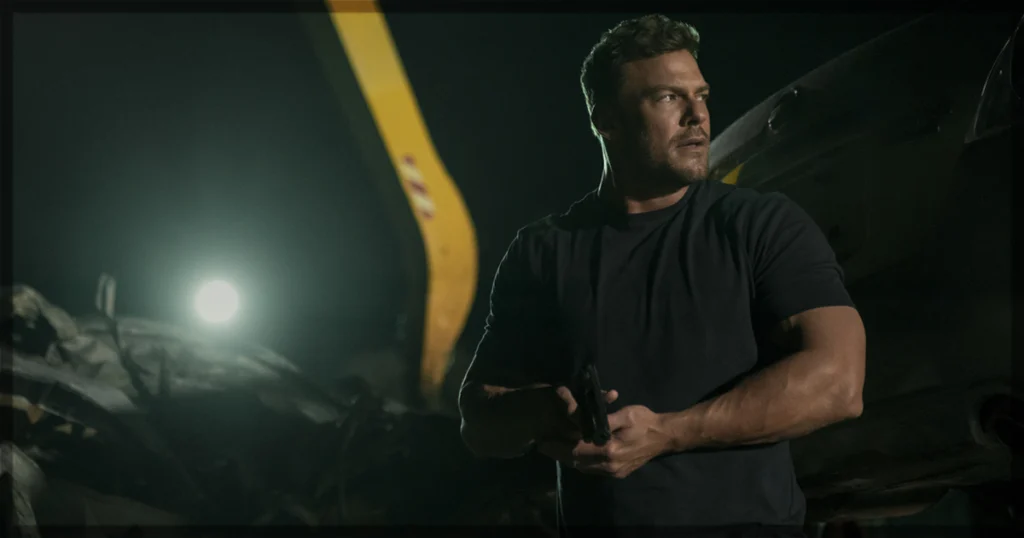
It’s been eighteen months since Season Three of Reacher and the series’ appeal is more valuable than ever. The character of Reacher – ex-military brat, ex-military police, now a keenly observant drifter with no living family, no possessions, no way of being traced as he moves through the world, and most of all, thanks to his tremendous physicality, firm moral code and willingness to get violent, no need of fear – meets the fantasies of the current moment in ways most of us can only dream of. Modern life, especially in modern America, is scary these days, but not for the man who doesn’t even bother with a first name. Just Reacher (Alan Ritchson) will do.
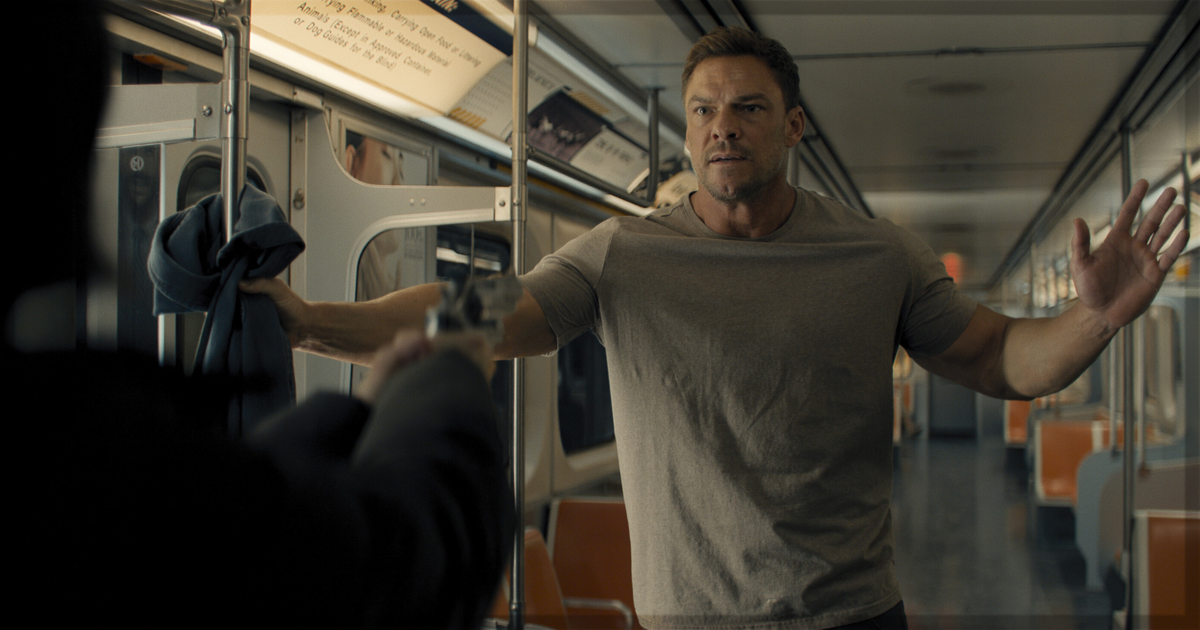
That description of Reacher, as someone who walks through the world with only the clothes on his body, a toothbrush, a bank card, a bankroll and his passport, makes him sound like someone who doesn’t care about the world. This is very far from the truth. The issue is Reacher’s interest in participating in the world is solely on his terms. He carries this commitment much further than most, but on the other hand, he can. A career in the military gave him the lifetime pension that more than meets his needs. He doesn’t have a driver’s license because he doesn’t have a physical address, not because he can’t drive. He doesn’t carry a cellphone because he doesn’t want to be found easily, not because he’s anti-social. If that means he loses touch with people, well that happens anyway. Thanks to not having to work or consider anyone else, he can go where he pleases and do what he likes. If he wants to see an impressive new pitcher with a 100-mph arm, he can travel to Philadelphia and catch a baseball game. He can leave a bar very late at night and get a hoagie to eat on the subway. He can notice a crying woman in the subway car and realise she has a weapon hidden in her bag. He can get up and approach her. He is a man without fear.
But instead this lady named Anna Merrick (Karen Kwong-Chip) shoots herself in the head. As the last person to speak with her, Reacher is arrested and interrogated by two night-shift cops, Detectives Green (Sydelle Noel) and Docherty (Kevin Corrigan). He is then held and spoken to by three men in suits, clearly feds, who wants to know about the jump drive/flash drive/thumb drive/USB stick that Anna gave him before she killed herself. But Anna did no such thing, and it’s suspicious that so many people are insisting she did. And we all know Reacher doesn’t like people throwing their weight around, especially at him. He is not remotely impressed with Docherty, who asks bad questions, but Green seems OK. She likes sports, and has a Gritty bobblehead on her desk, which of course Reacher doesn’t recognize. Reacher also is pretty upset that his attempts at helping Anna went so badly wrong. So he gets himself involved.
Anna’s brother Jacob (an outstanding Christopher Rodriguez-Marquette) is a small-town New Jersey cop who loves his sister more than anything and is willing to fight God himself if that would get her justice. Green might be weary and barely interested but she’s a good policewoman; Jacob means well and doesn’t back down but is minor league. Anna worked down in DC for the Army in HR so it’s a mystery why she was in Philadelphia in the first place, much less on a 2 am train. But while Reacher is investigating the fuss over the missing jump drive, he is led to a quite beautiful Indonesian lady named Lila (Agnez Mo, 40 playing a very believable 29). She is in America with her mother Amisha (Anggun) because she needs a bone marrow transplant. The trouble is her father, an American soldier who had a brief liaison with Amisha back in the 90s, doesn’t know she exists. What’s more, these days John Sampson (Marc Blucas, who women of a certain age will immediately recognise as Riley Finn from Buffy the Vampire Slayer), happens to be a congressman. We all know Reacher is a respecter of women, who also has eyes in his head. He agrees to help Lila, too. But that creates a whole other set of problems.
This is a solid beginning, not least because this show has already done the work. We know why Reacher is such a lone wolf, we know about his background as a special investigator, and we understand his mania for living life on his own terms. We don’t need to wonder about his previous connections to everybody here (though Neagley has her own spinoff starting next month) because there aren’t any. That makes this season of Reacher its strongest, because at last it can allow Reacher the character the full chance to demonstrate what he can do without being slowed down by exposition. It’s also clear that showrunner Nick Santora, who also wrote this episode, has determined there will be some humor to leaven all the violence, as well as a somewhat kinder and gentler ethos to leaven all the violence.
A kinder and gentler Reacher? Well, yes. The first few shows begin with a trigger warning in reference to depictions of suicide, which is unexpected but also worthwhile. Separate to the mayhem, the season has a willingness to poke fun at itself without sacrificing its key theme of justice delivered outside of the law. America has become a much darker place in the last eighteen months, and it’s become more essential than ever that people rely on their own conscience instead of what other people tell them to do. This is a new experience for Americans: we are used to being the good guys. We are used thinking of our country as a place where we do the right things. Since the civil rights era [sarcastic airquote] ended racism [sarcastic airquote], America enjoyed a comparatively golden era of growth and opportunity that ended with 9/11. That was only a few years after the first Reacher novel (Killing Floor, basis for the show’s first season) was published in 1997.
We’re in an entirely different world to the late nineties. Nowadays someone who is not only able but willing to achieve justice for other people is practically a superhero, a Robin Hood. They also don’t really exist in real life. Justice is a fantasy so far out of reach for normal people these days – working past exhaustion in crap jobs to pay for terrible health care, lousy housing and increasingly expensive gas, whose phones are besieged with scammers, and whose lives can be destroyed by corporate interests who will never be held accountable – that anything which can provide it is incredibly cathartic. Reacher is not consistent and it’s very bloodthirsty, but it sure it cathartic.
But the image at the core of this season is that shot of Reacher on the subway. He’s minding his business while making eerily accurate snap observations about everyone else, like a muscled Sherlock Holmes. (Or Sherlock Has-No-Homes, as Docherty calls him.) But when he sees Anna crying, he doesn’t roll his eyes or look away. He gets worried. Maybe even a little scared; it sure does look like there are tears in his eyes while he approaches her. Maybe she has a bomb, but the important thing is she’s crying, and nobody else has noticed. Something is wrong, and there’s no cavalry that’s going to ride in and fix it. Reacher is the cavalry, and that’s not meant physically. It’s a recurring question throughout the episode as well as the season: “Why do you care?” Not “why did you get involved?” or “why did you do that?” The surprise is expressed at the fact that he involved himself in a stranger’s problem when he didn’t have to.
Well, tried to. The fact trying to help resulted in Anna’s death has greatly upset Reacher, not that he would ever admit it so directly. A woman is dead because he made a mistake, and that’s not something he’s going to walk away from. The world might be selfish and self-obsessed, but Reacher isn’t. That’s how come this season is set in Philadelphia, the city of brotherly love.
A few other observations: the fight in the library is both gruesome and clever, and smartly takes place in the archival stacks, where there’s no one to complain about the noise. The way Reacher reacts to being told to look at ‘old stuff’ is funny and clever, as is the mention of subreddits being used instead of other search engines. The location shooting, which did take place in Philadelphia, adds a layer of authenticity that the previous series, almost entirely filmed in Canada, lacked. On the other hand, you can call Reacher a lot of things, but ‘dumb’ has never been one of them.
Credit needle drop: “Boom Boom” by John Lee Hooker.
Reacher is now streaming on Prime Video.
Learn more about the show at the IMDB site for the title.
You might also like…