How much are you actually supposed to care about a family being hunted by dinosaurs? Normally the answer is simple: just enough to root for them, not so much that a stray death throws the whole experience off balance. David Robert Mitchell (It Follows) spends most of The End of Oak Street treating that boundary as a given — and then, right around its midpoint, seems to forget the rule he set for himself.
Mitchell’s filmography up to now has nothing to do with tentpole spectacle, so an $80 million Warner Bros. dinosaur film felt like a strange fit on paper. This mismatch is exactly what pulled me toward it — I wanted to see whether someone with his slower, more unsettling instincts could pull off pure blockbuster mechanics without losing what makes his work distinct. Add Anne Hathaway (The Odyssey) and Ewan McGregor (Doctor Sleep) to the marquee and the curiosity only deepened: two performers capable of real depth, headlining something being sold, deliberately, as dumb summer fun.
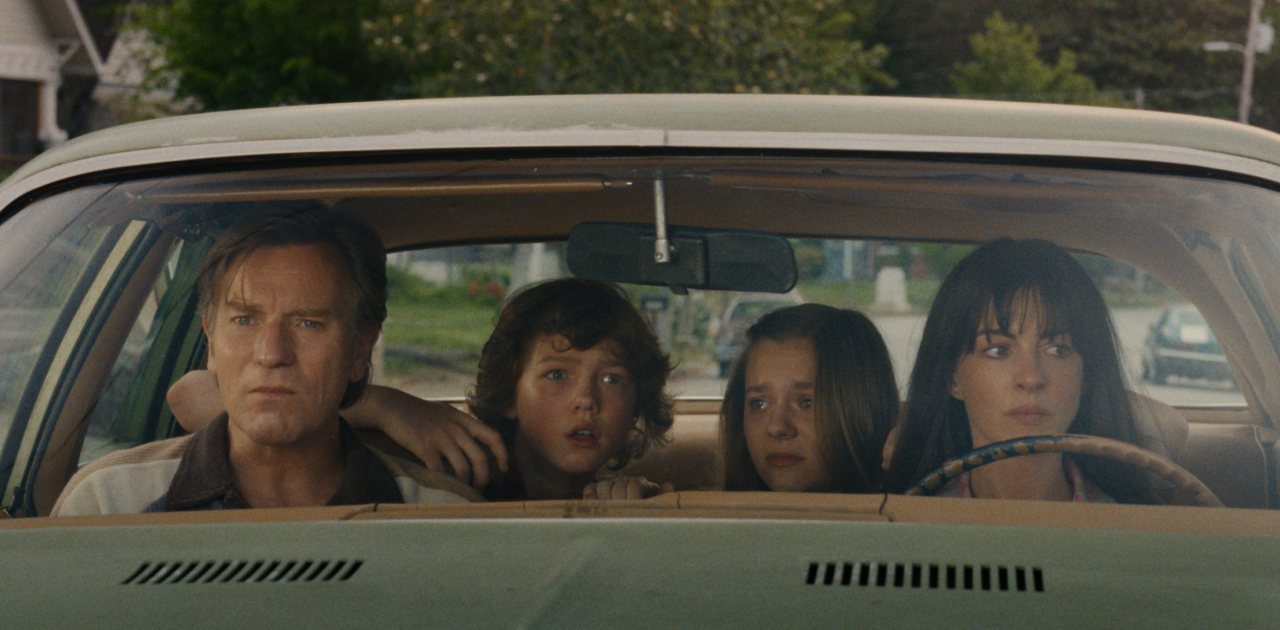
Set in 1982, the story follows the Platts — father Greg (McGregor), mother Denise (Hathaway), teenage daughter Audrey (Maisy Stella, My Old Ass), and younger son Brian (Christian Convery, Cocaine Bear) — an ordinary, quietly strained family whose street gets torn from its suburban setting by an unexplained cosmic event and dropped somewhere unrecognizable and prehistoric. Cut off from the outside world and suddenly hunted by creatures none of them could have imagined, this family makes survival the only language they have left.
What makes The End of Oak Street work for long stretches is how confidently it commits to being pure entertainment. The visual effects stay consistently polished, the dinosaur set pieces carry real blockbuster weight, and the nods to Steven Spielberg-era Amblin filmmaking land as affectionate rather than derivative — there’s genuine craft in how Mitchell frames scale and danger without leaning on exposition to sell it. At under 100 minutes, the pacing stays brisk enough that momentum never has a real chance to dangle, and Michael Giacchino (Up) contributes a score doing serious work in nearly every major sequence, frantic when the movie needs urgency and unexpectedly tender in its quieter beats. This is “dumb fun” executed with real skill, a film willing to trust its audience instead of over-explaining what doesn’t need explaining.
Hathaway is doing the most interesting work in the cast by some distance, bringing a ferocity and exhaustion to Denise that keeps even the movie’s silliest beats tethered to something real. McGregor is perfectly solid, hampered less by his own performance than by how little Greg is actually given to work with on the page. Stella and Convery both handle roles that are sketched rather than fully written, but neither tips into the overplayed, precocious-kid energy that could have sunk scenes meant to carry real weight.
That equilibrium starts to crack once The End of Oak Street decides it also wants to be taken seriously. For a film built around a family with real, specific dysfunction — a strained marriage, a teenager who feels invisible, a kid acting out because nobody’s paying attention — Mitchell mostly treats those threads as background texture rather than arcs it intends to resolve, right up until a major character death partway through that lands with startling emotional weight. I won’t detail how it happens, only that the moment arrives so abruptly, and clashes so hard with the tone the movie had spent nearly an hour establishing, that the audience around me visibly recoiled from confusion about what film they were suddenly watching. The dialogue doesn’t help matters either, frequently spelling out feelings the performances were already communicating just fine on their own.
The back half never quite recovers that footing. The ending smooths over some of the tonal damage, but it resolves the family’s central conflict so quickly it plays less like earned catharsis and more like the script running out of time to deal with what it raised. It leaves an odd question hanging over the whole thing: is this a movie asking me to invest in these people, or one asking me not to think about them too hard? It never fully picks a side, and that indecision costs it more than any individual plot hole does — and to be fair, there are a couple of those too, though most are minor enough to forgive in the moment.
Final Thoughts on The End of Oak Street
The End of Oak Street is a well-built summer blockbuster whose biggest obstacle is its own indecision about what it wants to be. The dinosaur spectacle is thrilling, Anne Hathaway anchors it with real gravity, Michael Giacchino’s score elevates nearly every set piece, and the Amblin-inspired craft on display is a genuine pleasure to watch unfold — but the moment the film tries to layer real emotional stakes onto a story built for popcorn thrills, the seams show, and they never fully close back up. Setting the right tone is a promise to the audience about how much to feel, and breaking that promise even once can undo a lot of goodwill a movie has otherwise earned.
Rating: B-
The End of Oak Street releases in theaters on August 14th.
Learn more about the film, including how to watch it, at the official website for the title.
You might also like…