
A Michael Jackson movie was always going to be riddled with curiosity. With a life and story as extensive as the late singer’s, it certainly was not going to appease everyone. Director Antoine Fuqua was saddled with a difficult task in Michael. How far can he go into the man’s life, given how much cultural legacy there is today? Before delving further into Michael, something should be made clear. This will not be a review of the man’s personal life and the controversies that affected it. This will be a review of the film and whether it gives an accurate and engaging portrayal of his life. Michael chronicles only a part of Michael Jackson’s life from the 1960s until the late 1980s. What follows is a film that hopes to celebrate the man’s legacy, and nothing else.
To get my sentiment out of the gate, Michael did not work for me as a film. While often glossy and entertaining, the story lacks depth. Instead, Michael exists as a “celebration” of Michael Jackson’s life, which, for many, is all they’ll need. The musical numbers are fun, vibrant, and well worth a trip to the theater for fans. The problem is that the screenplay by John Logan (Gladiator, The Last Samurai, The Aviator) lacks genuine characterization. Michael Jackson is portrayed as a saintly figure, whereas his family, particularly his father Joe Jackson (Colman Domingo), is portrayed as a supervillain or non-existent individuals.
To further dissect the film, it is best to start with Jaafar Jackson’s performance. He certainly nails the voice, demeanor, and familiar classic dance moves. The problem is that the performance never feels like a real person. He can certainly move and sing like Michael Jackson, but Jaafar struggles to make the character his own, playing the role as a one-note saintly do-gooder. What is difficult to decipher is how much of the performance is just a victim of poor writing. We, as viewers, never feel the “why” behind the decisions Michael Jackson made in his life. Yes, he wanted to break free from his father, but the film offers little insight into his real artistic process. Therefore, it makes the performance feel quite limiting, existing as an idea over a person.
Limiting is a perfect word to describe the other performances in Michael. That word can be best described through Colman Domingo’s performance as Joe Jackson. Domingo is inarguably one of the best actors working today. He has a serious versatility as a performer, with a varying range from project to project. As Joe Jackson, Domingo plays what the script requires of him. At 127 minutes in length, the character feels like nothing but repetitive actions on screen. He wants to overwork his family, abuse them, and put money over their well-being. That requires him to play the character in such a broad manner that he never once feels like a real person. While that may be effective for some, the performance feels tiresome as it progresses. The result of which makes the character leave an impression (but not a good one), which wouldn’t work without an actor of Colman Domingo’s caliber.
Jaafar Jackson and Colman Domingo get the showiest performances in the film. They’re the biggest, broadest, and what will make or break viewers’ experience. What makes that even more frustrating is that every other performance is the equivalent of a cardboard cutout. Of this crop of supporting performances, they all suffer from the same issues of being one-note. There are three in particular that have to be highlighted. These include the performances of Nia Long, KeiLyn Durrel Jones, and Miles Teller. Long portrays Michael’s mother, Jones plays Michael’s bodyguard, and Teller plays Michael’s attorney; each following the same kind of characterization. They are all concerned for Michael’s well-being, and it is conveyed only by worried looks.
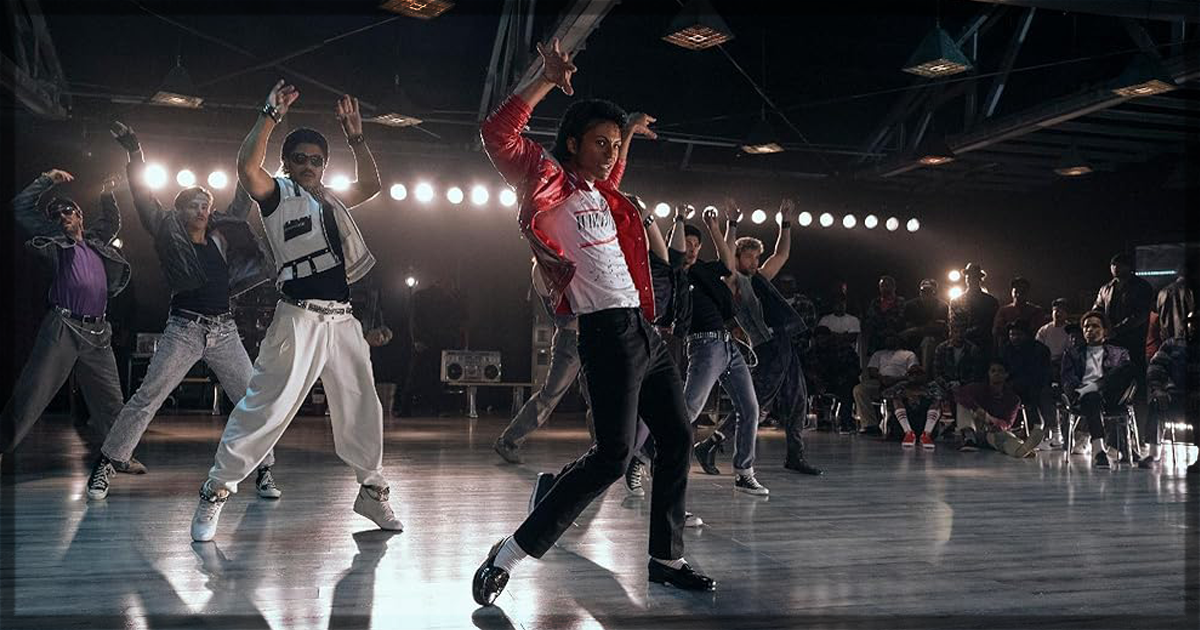
The biggest blame for Michael has to fall on the director Antoine Fuqua (The Equalizer trilogy, Training Day). Fuqua seems interested in one thing and one thing only regarding this story. He wants to convey Michael Jackson’s concerts and the power he held over an audience. In those moments, it’s easy to tell what Fuqua wants to prioritize as a director, strictly the musical legacy. Those concerts and musical numbers are inarguably the best part of the film. Everything around those moments feels like nothing more than a lifetime movie. Such a sensation makes the film one of the most lackluster musical biopics in recent memory.
As the credits screen for Michael, there is an implication that this film is only “part one” in his story. If that is the case, there is a chance that this “part one” of the story could be looked back on more fondly. Jaafar Jackson has an undeniable screen presence, keeping Michael from being an unmitigated disaster. What makes the film a crushing disappointment is a fantastical portrayal of this musician’s story. As a whole, the story takes an almost mythological approach to Jackson’s life, lacking realism. For many, that will be more than enough to justify a trip to the movie theater. What has to be said is that, fan or not, audiences deserve better musical biopics than Michael that are nothing more than fan service.
Michael is now in theaters.
Learn more about the film at the IMDB site for the title.
You might also like…

‘Den of Thieves’ Film Review