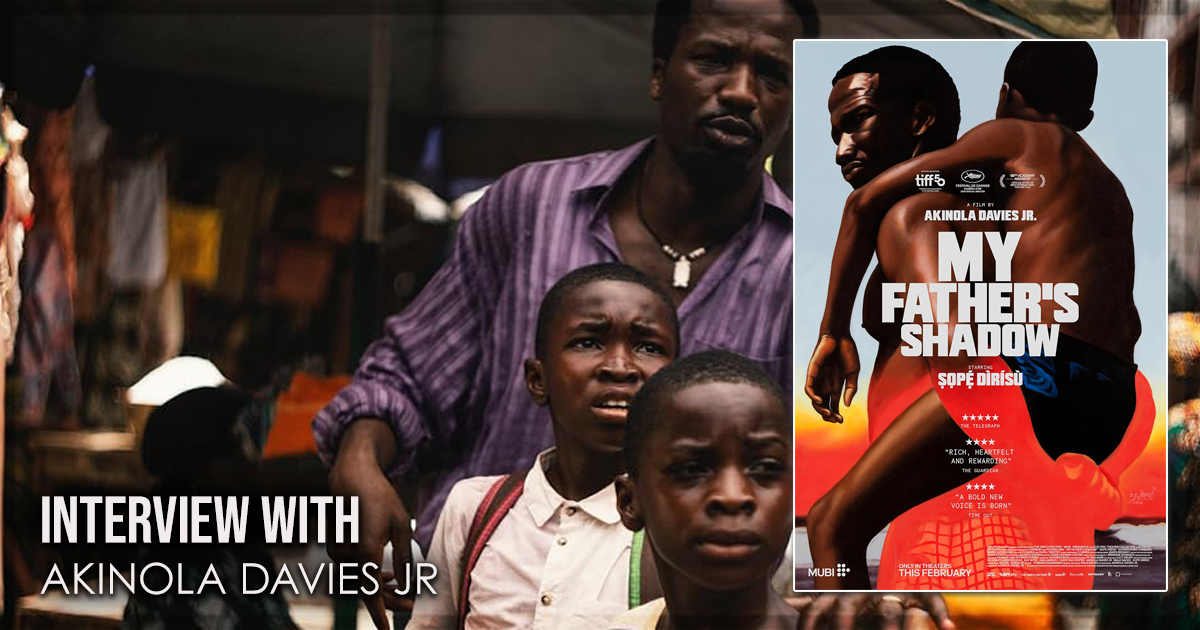
A trivia shocked the cinephile community when the line-up of the Cannes Film Festival was announced last year. For the first time in history, a Nigerian film was in the selection. Despite being one of the most prominent film industries in the world, it had never participated in the competitive sections of the festival. The film was My Father’s Shadow by the young British-Nigerian director Akinola Davis Jr. the film is his feature debut. He had previously directed the short film Lizard, which received a BAFTA nomination for Best British Short Film. The anticipation for the project was so massive that MUBI, the giant streamer and distributor, pre-acquired the film’s rights in its initial development.
My Father’s Shadow narrates the story of the last encounter between a father (Sope Dirisu) and his two sons, Remi (Chibuike Marvellous Egbo), and Aki (Godwin Chiemerie Egbo). They spend a day wandering around Lagos, the massive Nigerian city, where the father takes them to the amusement park, to have ice cream, and a bar, while the father fears the political aftermath of the country. Despite the beautiful visual craft of Akinola’s film, it is a delicate portrait of loss and the last days between a family. Impressively, the director transports the audience to Lagos of that era, creating a nostalgic effect that amplifies the dramatic effects of this beautiful drama.
Movies We Texted About had the opportunity to talk with Akinola Davies Jr., the director and co-writer of My Father’s Shadow. Read our conversation below.
The Interview with Akinola Davies Jr. of My Father’s Shadow
Pedro Lima: Thank you so much for talking to me, Akinola. I really love the film. I’m Pedro Lima, and I’m from Brazil. I know you’ve been in Brazil for the Mostra de São Paulo.
Akinola Davies Jr.: Yeah
Pedro Lima: I’ve seen you talk to a lot of people (other film critics). I really hope you enjoyed Brazil.
Akinola Davies Jr.: I love Brazil. I’m going back in April for the film’s release in Brazil.
Pedro Lima: Oh, it’s amazing that you’re coming back.
Pedro Lima: First of all, My Father’s Shadow is about the last trip to Lagos of a father and his two sons. You’ve co-written this script with your brother, Wale, who also collaborated with you on Lizard, your short film, which was BAFTAs nominated. How is it for you to have your brother as a central creative partner, especially in a film that features such a profound biographical layer for both of you?
Akinola Davies Jr.: Well, great question, Pedro. You know, my brother and I are two years apart in age, and I think I’ve always idolised my brother. He is the closest thing I’ve ever had to a father figure. I think he has always been very encouraging of me being an artist and me making films and pursuing my dreams because he did that. He pursued his dreams in music even when people really doubted him. And I think he’s also someone I’ve always known from a young age. He’s so obsessed with words. He is always reading books, the biggest books in the quickest time. So yeah, he loves words. I love pictures, and I think we have a really good working relationship in this way. I also think he’s also very good at nurturing talent and being very encouraging.
Akinola Davies Jr.: And likewise, I think we have that similarity. We encourage each other, but I think in the making of this film, something being quite emotional, I think has definitely brought us together because I think there’s so much about the loss of our father when we were young that we never really spoke about. And I think this film has allowed us to put some of those thoughts on paper to hold certain things accountable, to hear about each other’s experiences. But yeah, man, it’s been great. It’s been really great. I think he’s my older brother, so I benefit from a lot of protection from him and encouragement for sure.
Pedro Lima: And also with your film, one of the things that I can start thinking about is the visual. And it’s really impressive that this is your debut. You seem like a veteran, someone that is doing this for 15 years, 20 years, and you create a very layered visual. And I think, why did you choose to shoot on film? And how did shooting in film help you to create this imagery that feels like a blurred memory? When I watch My Father’s Shadow, the image feels like a memory that is fading away. So why did you choose to shoot on film, and how did you manage to achieve this visual throughout the film?
Akinola Davies Jr.: Sure. So a lot of the Nigeria we grew up in, we never really saw it in film. We never really saw a reflection of it. So it was very important to us that we captured as an authentic portrayal of Nigeria and Lagos that we grew up in. I think to shoot on film, I love shooting on film because the process is quite slow. It means you get to enjoy the film you’re making with the people you’re making it with. I think it gives everybody an opportunity to do their job and have time to do their job. So we’re not just filming, filming, filming with digital.
Akinola Davies Jr.: I think shooting on film is a bit of a political choice for me because when I look for references of film shot in Nigeria on film, there are not very many. So for me, it was important for the cast and crew to see the work they created in the most beautiful format. I think it’s really important for Nigerians and Africans to see themselves filmed in the most beautiful format. I think as an advertisement to the rest of the world, I think it’s important for people in Brazil or people in America or people in Europe to see us on the most beautiful format because I think it humanises our experience in a way that, not to say digital doesn’t, but I think the format being so textured, I think is really important because our lives are really textured. Our lives are really dynamic. Our lives are very complex and complicated. And I think, yeah, that’s why it’s important to shoot on film for me anyway. I mean, I think it’s logistically very difficult to do so.
Pedro Lima: (And difficult to do) financially.
Akinola Davies Jr.: And financially, but I have a reputation of shooting on film. Small projects, small music videos, because I think it’s really important to create the images of yourself and your community that you want to see. I think it’s very easy to say our depictions by a different race or a different community are very negative. So I’m more about solutions. Me and my brother, we say we’re solutions-based. We’re not problems based. We’re solutions-based. So for me, it’s very important to build those bridges with the people we are and the way we want to be seen in the world. The second part of your question, what was it?
Pedro Lima: How shooting on film helped you to achieve this visual that is like a memory fading away?
Akinola Davies Jr.: Completely. I think shooting on 16(mm) is not the most perfect film format. It’s a bit dirty. It’s a bit rough. I really love it because it gives this texture, it allows you to be nostalgic. Because we’re shooting a period film in 1983, I think it allows us to be very analogue for a period that was very analogue. We’re allowed to play with the form of the rollouts, the scratches on the screen, and the sounds. Yeah. And I think when you do that, we also shot a lot of close-ups because Lagos has changed a lot. So the close-ups allow you to be a lot more focused, allow you to focus on people’s faces, to tell the stories on a person’s face. I think it’s just a lot more romantic, I would say. It’s a lot more romantic. And I think that alludes to this idea of fading away.
Akinola Davies Jr.: So while it doesn’t exist anymore, and film in this context can make the film feel like it was 30, 40, 50 years ago, and that is what maybe you allude to in the fact that it feels like a memory fading away. And I think I romanticised Nigeria. I grew up there, I grew up in Lago. So a lot of what we were filming on the periphery is these things that are very mundane, that are very simple, that maybe always exist, but people ignore. And as part of my work as an archivist and a filmmaker, I’m very interested in the mundane, in the things that people take for granted.
Pedro Lima: When I was watching the film, it seemed that nothing changed. It seems like 1993 Lagos. Of course, I don’t know Lagos, and I haven’t been to Africa yet, but when I’m watching it, I felt that I was there because it feels like a 1993 Lagos. So how was it for you and your location producers to find these places and to reconstruct the bygone era?
Akinola Davies Jr.: Yeah, I love this because my location person, she’s one of my most favourite people in the whole process. I love working with her. She’s one of the unsung heroes of the film because I think all the other aspects of film maybe monopolise a narrative, but I think she’s from Lagos through and through, she knows the way the city ebbs and flows. So I really put her in a hard task to try and find a Lagos that maybe doesn’t exist anymore. But I think, yeah, Lagos is a big city in Nigeria is a big country. If you search for it, you can find it. But also, if you are smart about how you position the camera, you can also get the best of both worlds. And I think what we really tried to do was explore parts of the city that are maybe a little less popular, I would say.
Akinola Davies Jr.: Because I think there are parts of a city, like any big city, the outskirts of the cities is what’s ignored. Maybe people focus on the CBD, the central business district, and the trendy areas where the money is, or even where the really poor people are, or whatever. And I think there’s an area in the middle that always gets ignored. So we really went to the old communities in Lagos that used to be very popular in the seventies and eighties, and now maybe they’re a little antiquated and a little bit older, but they have a lot of the character. They have old architecture, old governmental architecture, I think. Yeah, even when they’re driving on the bridge, you can see the University of Lagos. That building hasn’t changed since it was built. You could see the national theatre, that building’s been there for decades, and it’s like a combination of using what has existed and stood the test of time, and going to find places that maybe a little bit ignored. I think that’s something, again, as an archivist, that’s something I’m very interested in, which is who’s being excluded from the conversation, which architecture is being excluded from the conversation, which communities are being excluded? So for me, I try to lean into that in my process.
Pedro Lima: And also, I think that I can combine with another question that is the location works so well because there is a great job by Pablo and Jennifer Anti. They are the production designers. They are the set decorators of the film. And I think there is a lot of small details of the film, especially when they’re in the bar, that you can feel it like the OTV that is playing the news, the tables, the drinks, and everything feels real. What were some of the references and directions that you gave for Pablo and Jennifer to achieve a results that is beautiful?
Akinola Davies J.r: I mean, I love that you mentioned Pablo and Jennifer because I think along with locations, they worked so hard on this film. There’s no warehouses where you can go and borrow equipment from the nineties in Nigeria. So everything was sourced from real people, from real families, from old, derelict places. I mean, I worked with a really incredible filmmaker called Adam Curtis, and I had an archive of Nigeria. We were working on a project which we’re still working on, actually, and I had a lot of archive to Nigeria, and I showed it to Jennifer and Pablo, and I showed it to Sopé, and I showed it to our locations, and I showed it to our editor. And I think that allowed people to see what Nigeria was like then, what the aesthetics were.
Akinola Davies Jr.: I think some things don’t change in the global south. There are these plastic chairs that we all use. They’ve been around forever. And I think a lot of the conversations were like, how do we build a world from our memory? How do we build a world from the sweets we ate, the ice cream we had , the TVs we watch? I mean, I love that you mentioned the TV. It was such a long process to have the logo on the TV. Are we going to have the logo? Can we not have the logo? Every detail in the film that had to do with licensing was a long conversation, but it’s all written in the script.
Akinola Davies Jr.: It’s not a big Hollywood film. So licensing, real music, a lot of those things are really expensive on a sort of small indie budget film. So yeah, man, a lot goes into that. A lot of those conversations are really for me to trust what I remember in my youth, but also to trust them to be able to remember what they were really into in their youth. And all of us bring that to the table and try to leverage it in the scenes where we can, whether it’s them eating milk from a condensed can or sugar cubes from a box of sugar and stuff like that. These are all things that I thought everybody in the world had when I was a kid. It is not until you leave Nigeria and you’re like, oh, wow, people eat milk, have milk from the cow.
Akinola Davies Jr.: What I never really even understood that milk from a cow was something that you could have always, ever drunk, condensed milk. So yeah, I have to give them my production designers, my locations, all my team, costumes, everyone, a lot of credit because they really, really put their heart and soul into it. They put a projection of themselves into the film, which is why I think the film resonates with so many people.
Pedro Lima: My Father’s Shadow is a film about memory, but it is also a political film. It is a film about you, your brother, and your father, but it’s also about the aftermath of their elections, the post-Mashud Abiola win, the violent protest, everything that shaped the country after that. So how is it for you to discuss such a political event that was so important for your country, but also to make a film about something that hurts for you and your brother? It’s both a wound of your family, but also your country. So how is it?
Akinola Davies Jr.:. I think when we started writing the film, it was only about the personal. It was only about the father of the beach, the amusement park. There was no politics involved. It was about this promise of fatherhood, the virtues, and the knowledge your father is going to pass down, so you can become the person you want to become. And what does that hope, what does that entail moving forward? And I think for Nigeria, we’ve been through such violent, brutal military dictatorships for a while. So this idea of democracy was like a young country coming into democracy and also having a politician, Mashud Abiola, who was going to be the father of the country, who was going to instill virtues and make Nigeria this incredible country that’s going to fulfil its potential. And I could see that in my mother and my uncles and all the adults around, they were really excited because they’ve come from censorship and human rights atrocities and being gaslit by the military into something that looks like, okay, on the surface, America has democracy, the UK has democracy, and around the world has democracy.
Akinola Davies Jr.: So maybe the country is finally going to start taking off. And then equally for the boys, that relationship is cut short, and for the country, that relationship is also cut short. So I think there was a balance. One is the micro, one is the macro that gives a tension and weight and depth to follow the father’s experience, whereas the boys just care about being with their father, and the politics is less interesting to them. Yeah, I think we have to balance those things because we need the viewers to view it from the children’s perspective, but we need to give you enough so you understand what’s at stake for the father.
Akinola Davies Jr.: I think those things are important. I think as Nigerians under the military, our history wasn’t taught. So just as you, a Brazilian is learning about Nigerian history, so many Nigerians are learning about their history as well. So many people who left after the Civil War in the sixties are learning about what’s happened to Nigeria since so many of the younger generation are learning about what happened in the country. And then the older generation is equally seeing their experience on camera. So it becomes a generational, generational dialogue that the film is having. But yeah, I mean, I feel like so much of the world, Brazilian culture, South Korean culture, loads of South American culture, loads of Asian culture, we’ve all been under military dictatorship in some form or another. So there’s a similarity with our experience that the world will make you believe, oh, we’re so different.
Akinola Davies Jr: But actually, we’ve been through so many similar experiences, and we haven’t been able to speak about it even in our own families. So to be able to now put it in art and share with the rest of the world, I just hope it’s an opportunity for people to think about their parents, to think about the world their parents had to grow up in to be teenagers and to have children in, to keep wanting to have children in even after all the violence and disappearance of family and friends and whatever. And to just see themselves reflected in the film. So yeah, I think a lot of that was so intentional when we came to developing the film. And I think, yeah, we’ve, I think we realised during the process that it can become more of a historical asset for Nigeria and also the rest of the world to learn our history as well.
Pedro Lima: Yeah. Thank you so much for talking to me, Akinola. Congratulations on the film.
Akinola Davies Jr.: Thank you, Pedro.
My Father’s Shadow is now available to buy or rent at the retailer of your choice.
Learn more about the film at the IMDB site for the title.
You might also like…