In the late 2000s, the blooming of Young Adult Novels adaptations was one of the most successful genres in Hollywood. A great example of that is the Twilight Saga, which grossed billions at the box office and made its leads two of the most prominent young stars in the industry. Yet, Robert Pattinson and Kristen Stewart made unexpected choices, bold and unconventional ones compared to some of their peers from the same generation. Hence, despite leading blockbusters like Snow White and the Huntsman, Stewart chose to work with respected authors and upcoming talents. She collaborated with Olivier Assayas on Clouds of Sils Maria and Personal Shopper, Kelly Reichardt in Certain Women, and David Cronenberg in Crimes of the Future.
The creative collaboration with these authors sparked a fascinating flame in the actor as a director. In her debut feature, The Chronology of Water, she goes down a totally different route. The film is a raw adaptation of the memoir book of the same title by Lidia Yuknavitch. In the project, the English actor Imogen Poots is Lidia, a talented swimmer who suffers from the abuse of her father. Chronology is a magnetic debut by Stewart, who is not afraid of friction and decides to capture the rawness and violent honesty of Yuknavitch’s memories. She gets the help of a marvelous performance by Poots, who provides the emotional range and physicality needed for this challenging adaptation.
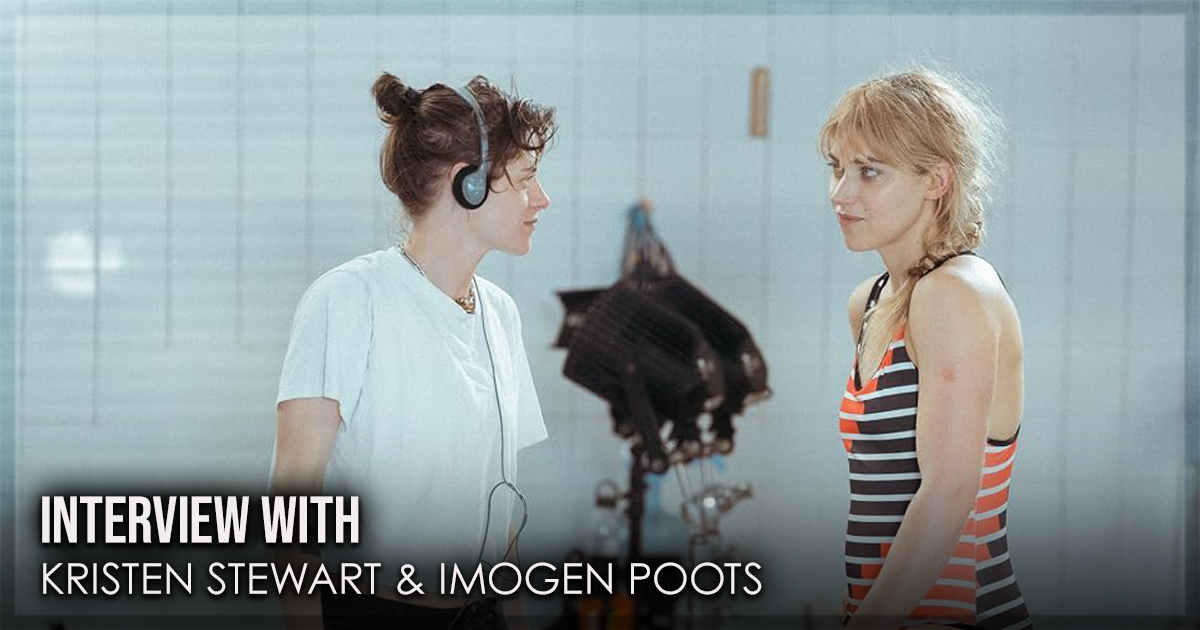
Movies We Texted About had the opportunity to talk to Kristen Stewart and Imogen Poots in an exclusive interview on Zoom. Read our conversation below.
The Interview with Kristen Stewart and Imogen Poots of The Chronology of Water
Editor’s Note: The following has been edited for clarity.
Pedro Lima: Hey, I’m Pedro Lima. Pleasure to talk to you. Congratulations on the film.
Pedro Lima: Firstly, Kristen, you made the bold choice of shooting on 16-millimeter film for your directorial debut. Why did this decide to shoot on the format? And for Imogen, what difference does it make for an actor to perform on film? What changes it?
Imogen Poots: Cool question.
Kristen Stewart: Yeah.
Kristen Stewart: 24 pictures in one second is actually when you go through them one by one, you realise how few those really are. There are so many gaps between each picture that is taken. I think that’s where you put your own soul into the movie. I didn’t want to record an image and doing things. I wanted to take a bunch of pictures so we could rip them up and that you felt these sorts of gaps, the time in which died. I mean, when you take a picture of something, it’s death. I mean, it becomes immediately nostalgic.
Kristen Stewart: And the movie is about recollection and memory and time, and I wanted it to feel elliptical. And often the film kind of would inform the edit. Sometimes you run out of film, the moment’s over, can’t remember what happened after that. It’s what the movie’s about. This movie would’ve failed miserably if we shot it digitally; it just would’ve. It feels like we also got to sort of burn the film, and it felt violent in some way.
Kristen Stewart: It felt like this ephemeral trace of something. I didn’t want to make something that was; I wanted to make a very precisely unclear experience. And so it needed a diffusion and a sort of fog, and I didn’t want to fake that. And it also needed to be incredibly beautiful and luscious and kind of edible because we have this character who’s quite voracious, and the way that she remembers things, I imagine, would be kind of magical. Her perspective is really artful. And so, it spans four decades, and it kind of lives out of time. And so it needed to feel kind of like a relic.
Imogen Poots: I think there’s also an urgency that occurs when you’re shooting on film because it is so expensive and you don’t, even though Kristen and I would always want to try it as many times as we could to make sure we got it, or you’re close to it, you can’t continuously just erase and go, erase and go, each moment is very alive. And I think that also, obviously, I just love films that are shot on film. There’s just something about it, you just know the nature of what you’re making is going to feel different. There’s something that happens, almost like there’s a reverence or something that occurs when you’re shooting on film.
Imogen Poots: And I remember my first ever movie was shot on film and it was like a zombie picture (28 Weeks Later), but there was something about that where people were in the bag and there’s a hair in the gate and these things, which there was one night on set where there was a hair in the gate on a take that we couldn’t go again on, and it just kills you. But it’s almost like the stakes of that are just, it is what it is, and you are like, there’s something, it’s like you are holding fire in that way. And I don’t know, I think it adds an element to it, which is really cool. And also the director’s decision to shoot on film, I think that just says a lot about what they’re setting out to try and achieve.
Pedro Lima: And another thing that I really like about this film is how Kristen captures graphic moments of religious life, but through a very poetic, and as you said, sort of a relic, and this includes depictions of addiction, abuse, sexual experiences, and self-harm. How was for you, Kristen, to find this adequate approach?
Kristen Stewart: Yeah, I mean, I guess traditionally speaking, there aren’t very many scenes in the movie. There’s a collection of striking images, and it’s held by this sonic narrator. I mean, her voiceover is very non-traditional, but it is what kind of holds the movie together. And yeah, I mean, I think I, making something where you’re consistently unmoored is usually not the goal. I mean, trying to sift through this elemental experience that is being alive. It so lends itself to movie-making.
Kristen Stewart: You know what I mean? I am so disinterested in plot-driven films, and so there were striking images that I thought would hold the movie up and create sort of flotation devices. But if you ever asked me what year it was or how old she was at a certain time, or you just don’t, that’s not how you remember your life. And so if we fixate on our schedule and how we’re going to break down these scenes, and oh, what is it all?
Kristen Stewart: It’s like you’re going to suck the poetry right out of it. And so it was a huge leap of faith for not only my crew but also Imogen to be like, okay, cool. Where are we now? I’m like, we’re here, and that’s all you need to know. We’re right here. And yeah, it was painting or something. It was choosing your colours every day and just knowing that the instinct driving was to be trusted and therefore was going to have a precision to it, instead of, I mean, I had a plan. It was completely destroyed and we found something else. And then when I look at the script, and I look at the movie, they’re almost identical. But I don’t know how that happened because I thought we were destroying things every day. But when you destroy things, you find something new, and it emulates my intention, but it has such a life of its own.
Pedro Lima: Thank you so much!
Kristen Stewart: Thank you!
Imogen Poots: Thank you!
The Chronology of Water is now available to buy or rent at the retailer of your choice.
Learn more about the film at the IMDB site for the title.
You might also like…
Interview: Odessa A’zion on ‘Marty Supreme’