
Throughout the more than a hundred and twenty-five years of filmmaking, the film history organized itself into canons and critical retrospectives that analyzed cinema through various prisms. Similar to all of the arts, this canon is white-centered and Anglo-European, excluding the works of people of color, women, and those located in the margins of the globe (Asia, Latin America, and Africa). Yet, in the recent years, there have been efforts to rediscover and put works from those groups into the lens of the film organization, leading to the audience discovery of those films through restorations, retrospectives, and collections. One of the films subject to this rediscovery is Haile Gerima’s Sankofa, a crucial title in the comprehension of the African cinema in its multitudes. Still, there is a contradictory perspective of positioning all of the African production into one, while there is an infinitude of movements and filmmakers that correspond to their proper logic. Thus, the protagonism of the imagery on the African continent and its citizens, especially in Ethiopia, is the interest of the Ethiopian filmmaker in Black Lions – Roman Wolves.
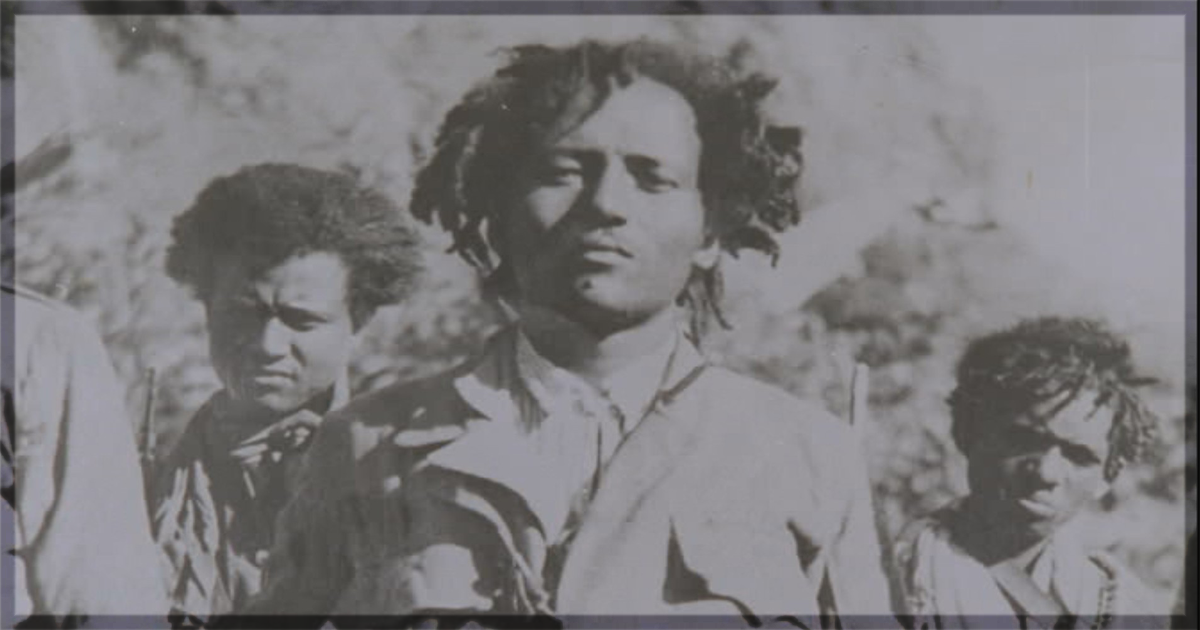
In his most ambitious effort, Gerima tells the story of his country through the imagery shot by the Fascist Italian members of the government, who recorded most of the colonization process on film. In the context of the Belle Epoque and the proliferation of the camera as a technology, the European owners of the tool, and the capital, utilized it as a register machine of the colonized. In the expeditions of the European settlers, they would shoot the imagery of the attacked population as proof of the uncivilized behaviors, therefore, justifying the dominance of the white elites of the Global North. The camera substituted the expositions of humane individuals in jails, which exposed them as animals in a zoo. Throughout the technology presented by the Lumierés, the camera, considered an extension of the eye, would capture the violence and the danger of those individuals who needed the grace of the White Bourgeois.
Gerima, who is well-known for being part of the L.A. Rebellion movement, a generation of young African and African-American filmmakers who studied at the University of California, Los Angeles Film School, and delivered their visions of Black life. Respected names like Charles Burnett, Larry Clark, Julie Dash, Zeinabu Irene Davis, among others, were crucial to changing the perception in American filmmaking about Black film. The new film by the L.A. Rebellion member has been in production since 1996, demanding time and work due to its scope and complexity. Divided into five parts, the Ethiopian filmmaker travels to Italy and rescues the imagery stored in coffins on the invasion of Musollini’s Fascist State on the African country. The almost ten hours of Odyssey is an appropriation of the colonizers’ images by one of the most important filmmakers from the African continent and the Global South.
Organizing the film within the framework of the images shot by the Fascists and interviews with those who experienced the brutality of the Italian invasion, which occurred in 1935, by Musollini’s Army. Gerima shifts the the Italian dictator’s philosophy, who believed that film was a massive tool of propaganda, citing the creation of the Venice Film Festival, the Instituto Luce, and Cinecittá as initiatives created by the Fascist leader. Despite the ten-hour duration, divided into chapters of almost two hours each, the director achieves an anti-colonial result of reclaiming the history of his country. Even if the structure is the most conventional possible, it is necessary to return to the start to retain control. For centuries, the European owners of the capital controlled the narratives and the tools to spread the history according to their vision. A crucial filmmaker like Gerima returns to the central witness of the brutality: his own people.
In this sense, Black Lions – Roman Wolves is indeed an utterly dense and tiring effort. It requires your attention and comprehension of a colonization process that lasted for decades. Wisely, the Ethiopian director decides on the documentary structure that the British popularized to spread their history, the journalistic style that mixes interviews and archives. If Humphrey Jennings and his colleagues utilized the Ministry of Communication to expand the documentary production through the state propaganda, Haile Gerima utilizes the imagery shot by the Italians on the violence they committed to craft an anti-colonial film. Thus, the legendary Ethiopian director designs an epic to request the Italian authorities the rights to the image of his people, causing a necessary discussion on the ownership of the documentary imagery shot by the Europeans during the African colonization, which now deserve to be given to filmmakers of their region, and become pieces of the denunciation against the colonization.
Black Lions – Roman Wolves recently played at the Berlin International Film Festival.
Learn more about the film at the Berlinale site for the title.
You might also like…
