Whenever a new project from Sony Pictures Animation hits theaters, I’ll admit my heart rate picks up just a bit. Whether it’s the visual revolution started by the Spider-Verse franchise or the emotionally resonant storytelling in The Mitchells vs. the Machines, my expectations for any animation from this studio have shifted from simply watching a movie to experiencing a brand-new visual language. Even though the sport at the center of this story isn’t exactly a personal favorite, the involvement of producers who aren’t afraid to take risks — and the curiosity of seeing how a legend like Stephen Curry (Stephen Curry: Underrated) would fare in this new arena, even if mostly behind the scenes — kept me intrigued for GOAT.
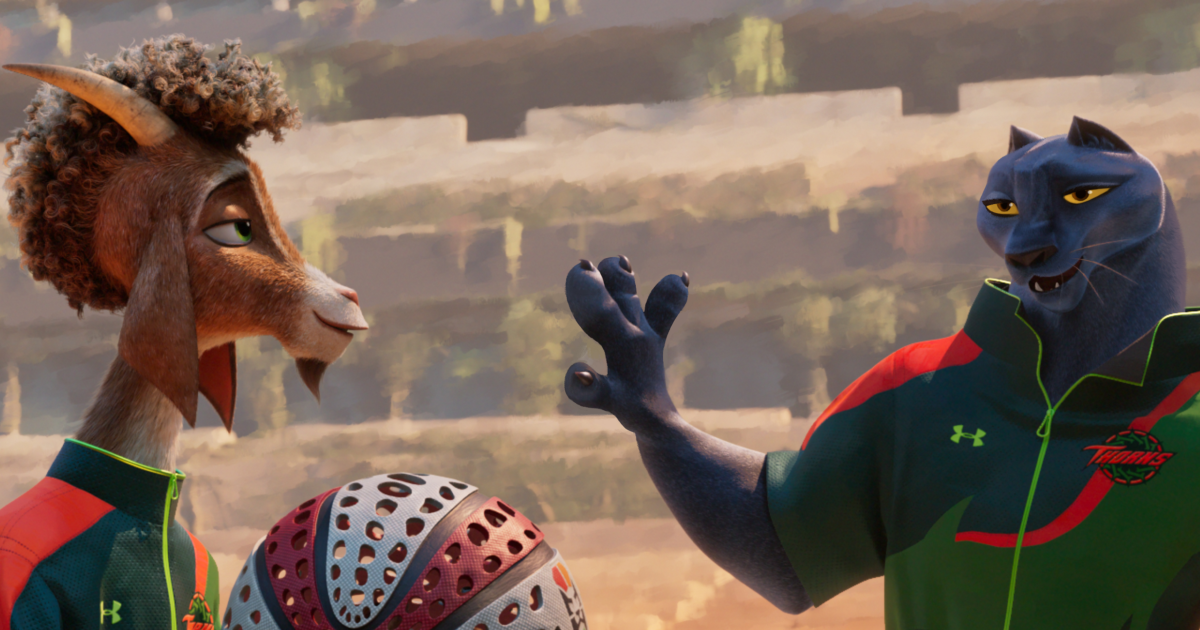
The story transports us to Vineland, a place where Roarball is the law of the land and giants are the only legitimate kings. Directed by Tyree Dillihay (Bob’s Burgers) and written by Aaron Buchsbaum (The Lego Ninjago Movie) and Teddy Riley (Trolls), the film features the voices of Caleb McLaughlin (Stranger Things) as Will and Gabrielle Union (Bring It On) as the iconic Jett Fillmore. Will is a small goat working as a coffee runner, spending his days dreaming of the success of his idol, Jett, the star of the Thorns, who carries the heavy burden of a team in a total freefall. When a video of Will embarrassing the arrogant Mane Attraction (Aaron Pierre, Rebel Ridge) goes viral, he’s recruited for the team, thrusting him into a world of fierce competition where his small stature is viewed as an unacceptable anomaly.
GOAT flows through a pertinent analysis of what actually constitutes greatness in an environment that prioritizes raw, physical power. The script doesn’t just show Will’s unlikely rise to the top; it dissects the myth of the “natural” athlete versus the reality of resilient persistence. It’s fascinating to watch how the movie treats physical limitations not as an insurmountable burden, but as a strategic opportunity to rewrite the rules of the game. Will understands that he doesn’t need to get bigger to win; he just needs to focus on his unique attributes and apply them on the court against the predictable weaknesses of others. This message of radical self-acceptance is what separates the film from more generic sports productions.
The beating heart of the movie lies in the complex relationship between Will and Jett. McLaughlin’s vocal performance conveys a genuine and contagious exuberance, but it’s in Union’s work that I found the layers of greatest dramatic weight. Jett isn’t the perfect mentor the audience might expect. She’s a cynical, defensive figure, visibly worn down by years of losing and the crushing isolation that comes with being a “GOAT.” One of the most human moments in GOAT happens in a local diner, where fans share personal memories and promises of victory for the community of Vineland. Jett’s arc, which evolves from a selfish, scared individualist to a leader capable of sacrificing herself for the collective, effectively complements Will’s journey of growth.
However, it’s impossible to ignore that when it comes to its fundamental structure, GOAT treads on very familiar ground. At times, I felt like I was anticipating every conflict and every resolution with almost mathematical precision. From the inevitable scene where the team’s cohesion falls apart due to Jett’s momentary ego to the way the final play of the deciding game is executed, the film follows rhythmic beats everyone has seen in countless other genre flicks. This narrative predictability prevents the story from surprising the viewers as much as its innovative visual aesthetic.
Visually, though, GOAT is an absolute triumph that largely compensates for these narrative gaps. The use of a rougher, “scribbled” art style and “impact frames” during the games gives the Roarball sequences a brutal kinetic energy. The arena designs are brilliantly creative, and I was especially impressed with the way the “home-field advantage” is transformed into something that actually affects the game through dynamic physical changes in the court. It’s an animation that pulses with life and color, turning every match into a spectacle of light and movement.
Yet, that same energy seems to lose some steam when GOAT tries to lean on more childish humor. Certain easy jokes and simplistic animal puns take away some of the necessary gravity during moments when Will is facing his deepest internal insecurities. That being said, the presence of supporting characters like Archie (David Harbour, Black Widow), a rhino who’s a single father to twins, or Carol (Ayesha Curry, Irish Wish), the llama owner of the diner where Will used to work, helps fill out the world of Vineland. These figures provide an important communal texture that justifies Will’s deep desire to save the team and his city’s identity.
The climax is an exercise in pure adrenaline, where several events before and during the final game encapsulate the central message of GOAT. It’s not just about scoring the final point or hoisting a trophy; it’s about proving that teamwork, solidarity, and mutual trust can topple the status quo represented by the arrogance of Mane’s team. The resolution is the expected ending, but it’s no less satisfying from an emotional standpoint.
Final Thoughts on GOAT
GOAT doesn’t reinvent the wheel, but it manages to soar through vibrant technical execution and a palpable emotional chemistry between its leads. It’s a film that shines brightest when it focuses on Will’s personal growth and Jett’s necessary redemption, even when it stumbles over expository dialogue or a predictability that cools the impact of certain twists. It’s an inspiring tribute to all those who daydream in small contexts, reminding us that true greatness isn’t measured by someone’s height, but by the indomitable courage of those who refuse to accept the limits others have placed upon them.
Rating: B-
GOAT is now playing in theaters.
Learn more about the film, including how to buy tickets, at the official website for the title.
You might also like…