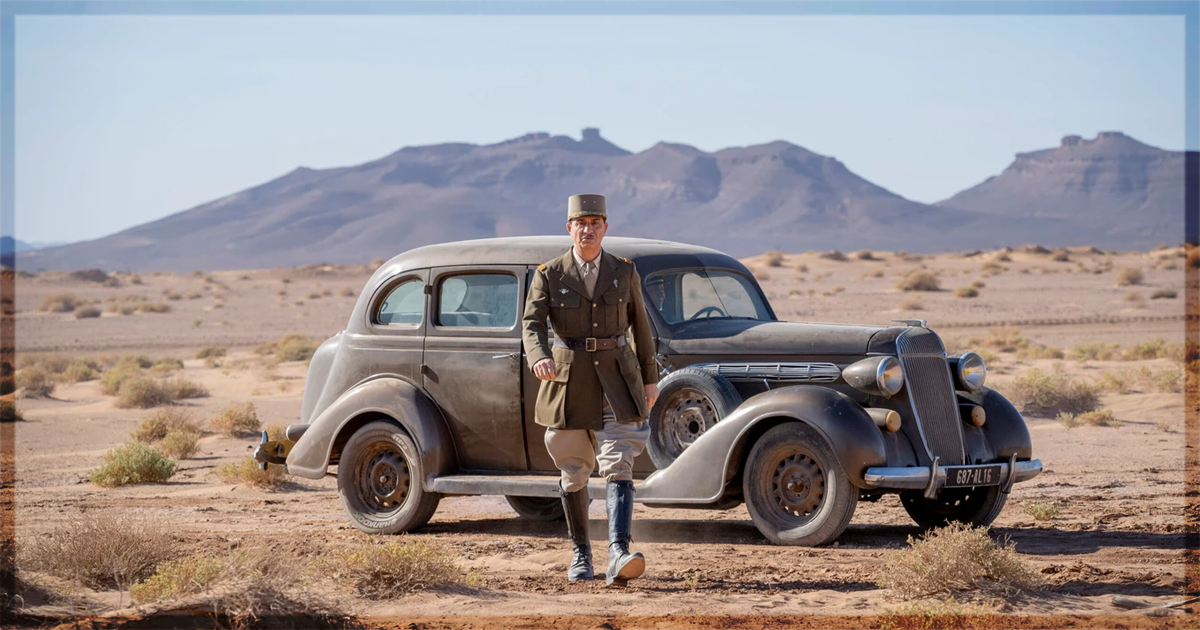
The best film of the 2026 Cannes Film Festival premiered out of competition. La Bataille de Gaulle: L’Âge de Fer, which has the English title De Gaulle: Résistance, is an absolute triumph of cinema. It is a fast-paced and largely true historical epic that handles complex and layered political events with ease. It is a terrific and unusually emotional war story. But above all De Gaulle: Résistance is a major blockbuster that does not exist for the international markets. This movie is so French it makes you want to change your passport. It demonstrates how French cinema, which has been noticeably shifting in this direction for a few years, is now very much its own and complete cinematic universe. We are very, very lucky indeed to have such a magnificent epic fly the flag.
The movie has two entwined strands. A teenage Parisian student named Fernand (Florian Lesieur) is horrified when the French government surrenders to the Nazis and begins making small acts of resistance as he can. On a larger scale, General Charles de Gaulle (Simon Abkarian) manages to escape to London where he proclaims himself the head of the “Free French” government. Vichy embassy officials are contemptuous of this one-man army, and the British government, obviously led by Winston Churchill (Simon Russell Beale) points out that he is alone. But shortly some Breton fisherman – and more on hearing the Breton language in a French film later – present themselves and their boats at de Gaulle’s service. They are the first of many who escape France to fight the war from elsewhere, meaning in short order the Free French actually stand a fighting chance. All de Gaulle needs is support from his allies and he will win the war. His radio broadcasts from the BBC into France also serve as an important rallying cry for people like Fernand who were losing hope.
De Gaulle, who is pompous and inflexible and therefore a figure of fun among even his closest allies, is also someone with an unusual ability to keep his eyes on the prize. It is not enough to defeat the Nazis. He will not kill French citizens in order to do so; he will not for any reason start a civil war. This means when the British navy sinks ships of the French fleet in Mers-el-Kebir, Algeria, killing thousands of French sailors, there’s a major schism between de Gaulle and Churchill. In his search for allies and a position from where the Free French can plant their feet, de Gaulle connects with former colonies across Africa, starting with Chad. He works closely to align with French allies wherever he can find them; has anyone ever been able to find St. Pierre and Miquelon, home to five thousand or so French citizens, on a map? Whether or not this irritates Churchill and Franklin Roosevelt (Campbell Scott) is beside the point; the British and Americans are shoulder to shoulder against the Nazis, but de Gaulle will protect the interests of France above all. Meanwhile Fernand and some schoolfriends, namely Livia (Anamaria Vartolomei), secretly arrange a pro-de Gaulle protest in the middle of occupied Paris. The kids have a wonderful time finding community before it all ends so badly Livia must go on the run and Fernand ends up in Algiers.
Now it’s improbable that, when America entered the war, de Gaulle said this meant European nations would now become vassal states of the USA as the price for that intervention. But in the political climate of 2026 that sentiment rings loud and clear. There’s also a major extended battle sequence of the Battle of Bir Hakeim, where a trapped brigade of 3,700 Free French fighters led by Kœnig (Benoît Magimel) held out so magnificently against 40,000 Nazi soldiers that they single-handedly altered the course of the war. This is so stirring, with the sense of sacrifice and honor so palpable, that it is up there with some of the best war sequences ever put to film. But Hollywood hasn’t ever done a thing with this true story. The fact that the soldiers are of every ethnicity and also include one woman (Susan Travers, played by Noémie Schmidt) is a major development in French cinema, which has only recently begun to center non-white characters in their storytelling. But it is also historical fact, which it is high time our art reflects.
The constant whirlwind of activity around de Gaulle as he leads his political battles, negotiates with his allies, and even more occasionally sees his family is easy to understand thanks to excellent casting and tight editing by Rehman Nizar Ali and Katie McQuerrey. Mr. Abkarian does a wonderful job of ensuring de Gaulle’s righteousness and priggishness always serve a purpose. We never forget his sense of his responsibilities. But Mr Abkarian also demonstrates how very good de Gaulle is at managing others – the many scenes of Churchill and him going toe to toe make this abundantly clear – and how successful he could be at winning the war, if only his allies would let him. Mr Russell Beale, switching between French and English, is equally good at showing how fighting similar but non-identical battles shapes who you are. In his first major role Mr Lesieur is of equal importance and carries his sections with ease. As is normal for Ms. Vartolomei her beauty does much of her work for her, but that camouflages an unexpected rod of iron.
But the inclusion of the Breton language and the accurate depiction of the multicultural Free French is not the only proof that director Antonin Baudry, a former diplomat who co-wrote the script with Bérénice Vila based on a non-fiction book by Julian Jackson, is attempting to modernise history. This is made obvious thanks to the character with one brief scene, named in the credits only as English Teacher (Tulika Srivastava), who is clearly meant to be Noor Inayat Khan. This heroine of the English resistance was a Muslim with American and Indian parents, the first female SOE agent sent into France undercover, and who endured ten months of torture by the Nazis before her execution in 1944. And yet of all the movies the UK has made about the Second World War, Ms. Khan has featured in none of them. (The 2019 American movie A Call to Spy seems to be the only one.)
So it’s not just that Mr. Baudry is trying to tell a historical story that leaves no one out. It’s also that his goal, through the focus on Fernand, is to show how any single person can make a difference if you’re in the right place at the right time. The revelation of Fernand’s identity and how he, personally, alone, single-handed, also changed the course of the war is a major shock for those who don’t know all the details. (It’s fairly clear this biography has been simplified for cinematic purposes, but that’s not unusual.) Anyone with the courage of their convictions can make a difference, and the whole purpose of De Gaulle: Résistance is to say that anyone should. The French language title, which literally means ‘the age of iron’ is in reference to a small discussion de Gaulle has with his aide-de-camp Courcel (Kacey Mottet Klein) during a frightening flight across Africa. He quotes from somewhere that in times of strife – an age of iron – the goal of people in those times must be to tilt it into an age of gold. It’s a downright inspiring sentiment for the current moment.
The movie ends with the death of Vichy Admiral Darlan (Mathieu Kassovitz), with a second part, with the English title De Gaulle: Liberté, released in France in June 2026, in plenty of time for Bastille Day. But as yet there are no confirmed release dates for either parts of the film either in the US or the UK. This is strange to say the least, since people in the Anglophone world hunger for victory over fascism as much as the French do. A war film that can be called hopeful and inspiring is so unusual you’d think distributors worldwide would be fighting over the chance to show it. But that means anti-fascists everywhere will have the pleasure of seeking out De Gaulle: Résistance for themselves. We need it now more than ever.
Finally, the repurposing of silly pop ballad Boum! by Charles Trenet into a protest song is a surprising cherry on top.
La Bataille de Gaulle: L’Âge de Fer recently played at the Cannes Film Festival.
Learn more about the film at the Cannes site for the title.
You might also like…