
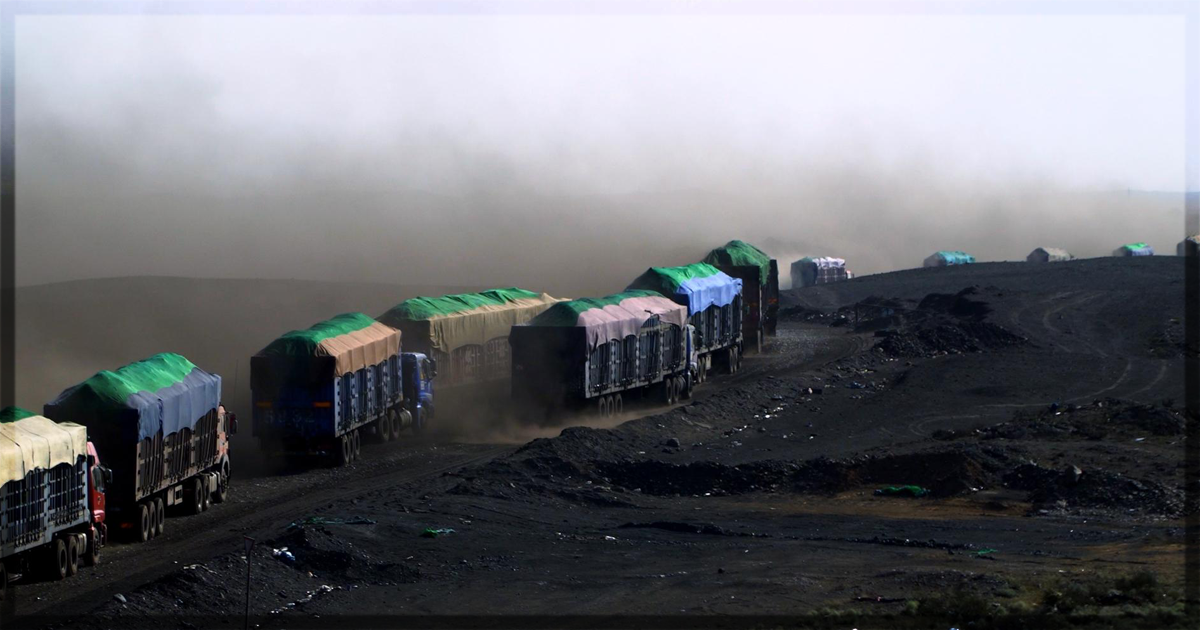
We all know China is an industrial superpower, but we (especially in the west) don’t devote much time wondering how China has become an industrial superpower. Well, part of the answer is that it buys a lot of its raw materials in from Mongolia. China’s upstairs neighbour is a nation famous for its vast and empty spaces, but in recent years it’s clear that under the surface is enormous material wealth. So how does that wealth get over the border? In trucks, driven by drivers who are paid by the load, whether delivery takes six days or six weeks. And it can in fact take six weeks; the weather is treacherous, the border guards unreliable, and safety regulations simply don’t exist.
In a place where sleeping drivers can wake to find their trucks being pushed out of the way by someone in another truck determined to get ahead of them on the road, it’s up to each individual to determine where their limits are. Almost all of the drivers are men, but director Khoroldorj Choijoovanchig found one of the very few women, Maikhuu Sengee, living this tough life. Colors of White Rock follows Ms. Sengee both on the road and back at home as we see for herself why she’s making the choices she does, and how those choices fit in with the options available in Mongolia. It’s a riveting experience.
The documentary begins with a prayer voiced by Ms. Sengee: “Lord of the Mountains and Waters, Spirits of the Sacred Land, I humbly seek your protection and blessings for my work and my being.” She is a twice-divorced single mother with three children, and the money she earns hauling coal is much, much more than anything she could earn closer to home. The money is so good it’s worth her kids sometimes getting beat up at school because their mom doesn’t have a man, and there’s obviously only one job an independent woman can do. Mongolia is not exactly winning prizes on the gender equality front. But out on the road Ms. Sengee is largely just another one of the drivers, with friends she shares noodles with and tries to stick close to, as being in a group tends to mitigate some of the risks.
The risks are serious. The sequence of Ms. Sengee dumping one of her loads of coal in flimsy shoes with no helmet, no breathing protection or protective gear or equipment of any kind, will give western health & safety professionals heart attacks. The wreckage of various crashes Ms. Sengee encounters, as other rubbernecking drivers complain not about the death of one of their peers but the delay this death is causing them, are just as heartstopping. Ms. Sengee goes weeks sitting in her truck, trying not to need to pee, cooking on a travel stove perched on the seat beside her, joking about road conditions over videocall, and desperately missing her children. Her sister does the brunt of the childrearing, though everyone is in constant touch via videocall. She could get a visa to work as a long-haul trucker in the USA, but even with the better money and the better working conditions she would not be allowed to bring her family with her, and that’s not something she’s willing to consider.
So this is her life instead. Mr. Choijoovanchig – who also did the filming – clearly spent a great deal of time on the passenger side of Ms. Sengee’s truck and they clearly built a close rapport that enabled Ms. Sengee (and her kids) to open up. The landscape sequences are breathtaking, both when the surrounding are the bleak and flat vistas Mongolia is known for, but also when they’re the kind of gold rush (or coal rush) encampments that spring up whenever people only care about making money. There’s a raw combination of ugliness and beauty here that has been regulated out of existence in the west, and even though some brave souls are trying to unionise the drivers, everyone is so focused on their own bottom line that the bigger picture doesn’t matter. It’s hard to see things the west takes for granted, like “clean air” or “adequate rest,” be completely absent here. Right now Ms. Sengee can handle it. But she’s paying a high price, and her youth and her health won’t last forever, not to mention the missed time with her children. And of course a damaged environment is a different kind of headache.
In addition to the gorgeous images, special praise must be directed to Gael Rakotondrabe’s impactful score. The ways in which the music rises to meet the spectacular landscapes is an ideal match of location and mood. And the mood here is what you’ll remember; Ms. Sengee’s insight into her decisions and her hopes for the future are both utterly normal and completely extraordinary. She is on the front line of global change which could not happen without her work, and while she is getting paid she (and all the other drivers) are obviously not getting paid enough. The way in which Colors of White Rock shows the importance of her life is the very best of documentary work: it makes complex global issues easy to understand, and does so through a worker who is much smarter than her circumstances allow. This is an unusually powerful documentary that by enabling us to share in one person’s struggle gives us a new way of seeing the world.
Colors of White Rock recently played at the Sheffield DocFest.
Learn more about the film at the festival website for the title.
You might also like…

‘Reacher’ Review – Season 4, Episode 1: City of Brotherly Love