
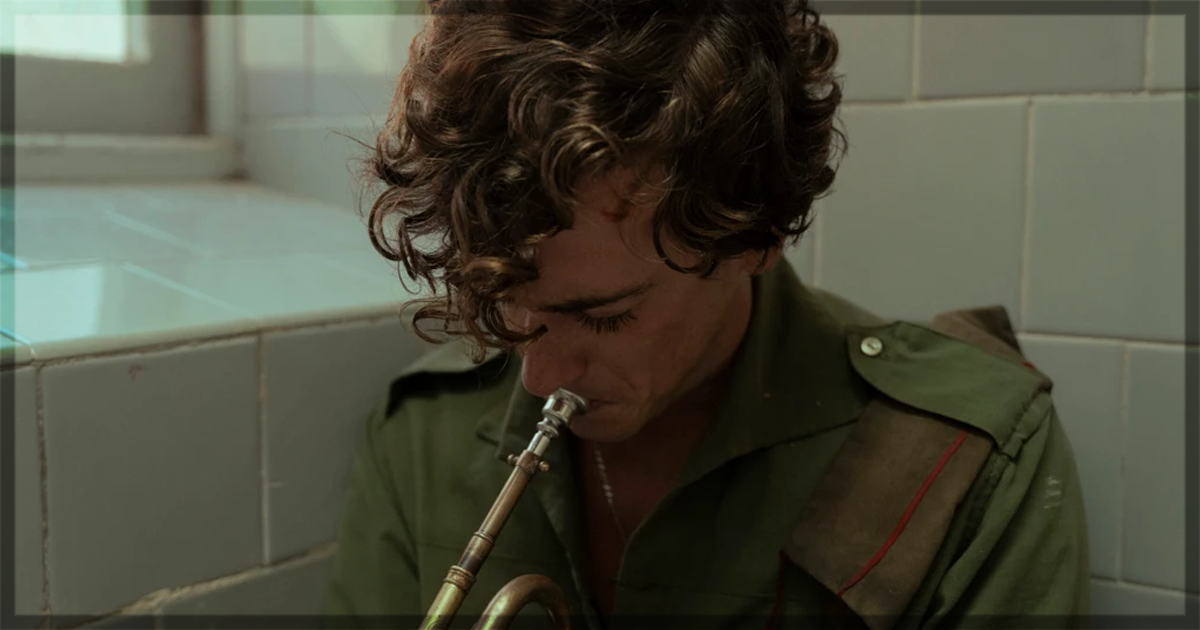
In The Black Ball directors Javier Ambrossi and Javier Calvo (known as Los Javis) and cinematographer Gris Jordana have created an unusually beautiful work of art. The Black Ball is kind and tender, very clear-eyed about the trauma of war and the misery of addiction. But above all it is about the importance of people being able to be open about their sexuality and the terrible costs involved when homosexuals are forced to keep their natures hidden. The Black Ball is an extraordinary film, both to look at and to feel, and was by far the best movie in competition at this year’s Cannes.
In 1932 Carlos (Milo Quifes) has applied to join the casino which is the social center of his town, for which the membership committee votes using white and black balls. But the rumor in Granada is that Carlos is gay, meaning that he is likely to be blackballed in the voting. In 1937 Sebastián (Guitarricadelafuente) is the trumpet player in a little village that has been untouched by the Spanish civil war, until it is completely destroyed from the skies. Sebastián somehow survives, is picked up by a nationalist army troupe and forcibly enlisted, the alternative being death. And in 2017 postgrad Alberto (Carlos González), whose specialism is hidden queer identities in earlier Spanish history, is surprised to learn a grandfather he never met has left him a legacy in his will. The way these three stories intertwine before and after we understand how they are connected is done with maximum drama and maximum beauty.
The wealth of the world in which Carlos moves, with marble staircases, stuffed peacocks and crystal chandeliers, is a luxurious cover for some difficult and unpleasant personal choices. Sebastián is a terrible soldier and so upset he seems perpetually on the cusp of tears. He is therefore tasked with guarding a captured republican, Rafael (Miguel Bernardeau), who was a famous footballer before the war and now so badly injured he cannot stand on his own two feet. Even Sebastián can’t mess that up. And yet Rafael sees something in Sebastián that Sebastián had never seen in himself, and the way their interactions shift and spiral in their time together is an absolute triumph of mood and beauty. One night Sebastián joins other soldiers at a theatre for a raucous cabaret. The star Nené (Penélope Cruz, more on whom later) pulls Sebastián into her dressing room for a chat and a smoke in between songs. When Alberto learns of his legacy he first tries to discuss it with his mother Teresa (Lola Dueñas), the kind of mom who improves a boring lunch with her kid with some cocaine. He then approaches Isabelle (Glenn Close!!!!), a world-renowned scholar on Federico García Lorca, the poet and playwright who was murdered during the Spanish Civil War. Obviously the connections between everyone must not be spoiled. But the way it all ties together involves such exceptionally beautiful imagery that the movie would have worked even if the plot didn’t.
Ms. Cruz enters and exits the movie like a shot of adrenaline. Nené must scream at soldiers trying to molest her dancers while they’re onstage but also laugh with Sebastián about the life they’re leading on the road. The entire 1932 sequence has such unusually vivid imagery, poetic and dreamlike, that Carlos’ inability to decide how to address the rumor about his sexuality is almost secondary. But only almost. And in the modern section, Alberto travels from Greece to Spain sampling all the joys of hookup apps, nightclubs and openly queer life with a sense of boredom that the ancestors would have killed for.
But it’s the sense of wonder which is The Black Ball’s achievement. It is hard to explain how unusually beautiful it is, starting with the main actors. Mr. Bernardeau as the suffering angel especially radiates a level of handsomeness and charm that will give him the career he wants for the rest of his life. Guitarricadelafuente has the toughest part, as the innocent who through no fault of his own becomes the devil, but his wide eyes allows his tormented goodness to shine through. All this high praise is to implore you to allow the beauty of The Black Ball to transport you to a place where it’s very easy for everyone to be their genuine selves. A place where everything is beautiful and nothing hurts. It is a bewitching knockout of a picture and a modern classic.
The Black Ball (La Bola Negra) recently played at the Cannes Film Festival.
Learn more about the title at the IMDB site for the film.
You might also like…
The Loving but Angry Heart of ‘Ben’Imana’ (Cannes 2026 Film Review)