
Each generation faces the inevitable clash with the ones before. They were morally superior, enjoyed life better, and lived through their days properly. The generational clash is arguably never fading. Each age gap has divergences within the collective of individuals, particularly in their relationships with the environment and with society as a whole. It is the theme of Francesco Sossai’s sophomore effort, Le Citta di Pianura (The Last One for the Road). Following his 2021 film, Altri Cannibali (Other Cannibals), which premiered at Tallinn Black Nights Festival, where it won the First Feature Competition. In his subsequent film, he made a massive career jump: he got into Un Certain Regard at the Cannes Film Festival and a main slate spot at the New York Film Festival, two of the most prestigious venues in the arthouse circuit.
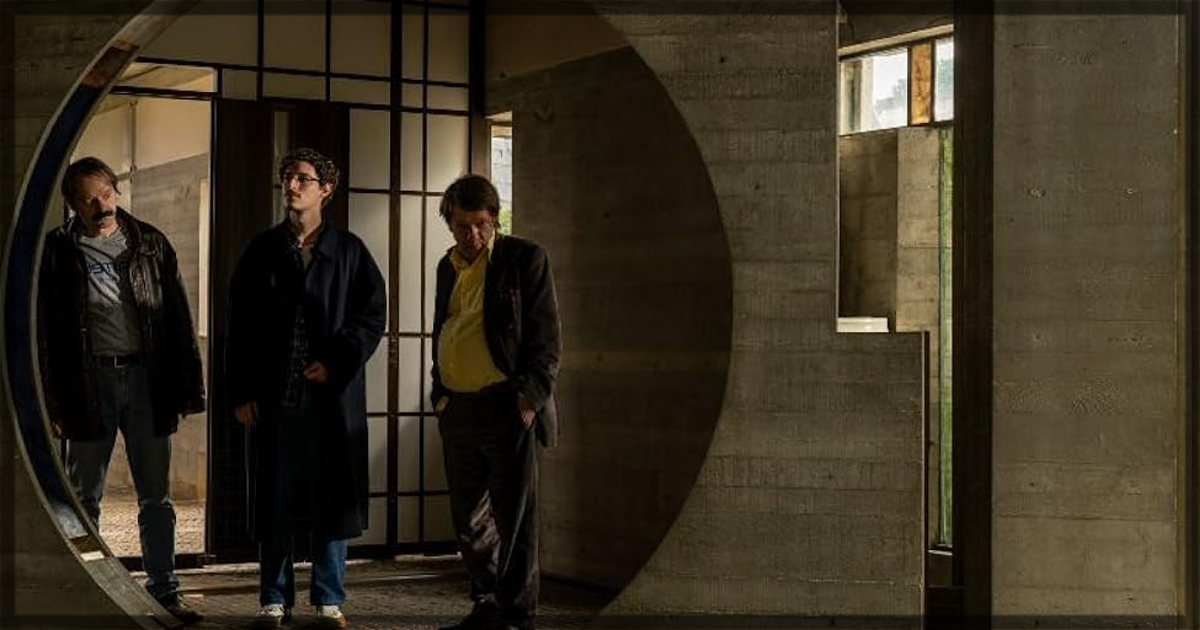
In his latest film, Sossai narrates the story of a duo of drunkards, Carlobianchi (Sergio Romano) and Doriano (Pierpaolo Capovilla), two old friends who are always eager for the next round of drinks, wandering around their town in search of a pub to get a glass. Hence, they interact with and bother everyone they encounter on the streets and at the venues they visit. At one of those drinking nights, they meet a group of architecture students, some of whom are graduating and others who are still in school. They meet Giulio (Filippo Scotti), a dedicated student who loves one of the girls in the pack, but she does not reciprocate. Although he insists on going home to finalize a school project, the drunk pair manages to convince him to spend the night and the following hours with them, where they generation clash, and they teach the young architect about life and his land.
Beneath the layers of a road-trip drunk-comedy, Sossai constructs a melancholic commentary on life and the passage of time, particularly for older individuals. In his first scene, he introduces the interaction between an industry owner and his workers. Surely, the class differences are evident: the proprietor arrives at the plant by helicopter, wearing a designer suit, while the employees wear cotton jackets. He congratulates one of his staffers who has spent the last decades working for him; accordingly, he gifts him a Rolex, and they celebrate with champagne. Yet, although it is a scene that feels tonally separated from the rest of the film, it is a necessary, albeit utterly expositional, one that introduces crucial information on that region. Carlobianchi and Doriano are bon vivants, dedicated to the labor of drinking and celebrating life. At first, the audience may judge them as useless, much like their community does.
However, the major triumph of the young Italian filmmaker is the combination of the melancholy of post-financial-depression Europe, mainly in Italy, which diminished industrial production and affected the working class, with the necessity of celebrating life. Each toast counts, each new glass represents the pouring of memories, and a communal sharing of the fragment of time. Fascinatingly, the young core juxtaposes with the two celebrators; Giulio loves the history of architecture and understanding the intentions behind every ounce of concrete poured into a building. Yet, the other two fellas learn about their history, the humane and Italian ones, in the practical field. Each new conversation introduces them to an unknown world. Hence, the comic efficiency of Sossai’s film goes beyond the facile jokes of two middle-aged men vomiting and their absurd actions. Visually, he uses the beauty of Massimilliano Kuveiller’s 16mm cinematography to compose frames that capture the proximity of those characters. The ending has the magnificence of this work, particularly through a travelling shot that begins as a silent close-up and pans to a wide one, capturing the drunk duo following Giulio’s train to Verona and screaming to him as a sign of tenure.
Ultimately, despite the slowness in developing the audience’s fascination, Francesco Sossai achieves it through the charisma and shyness in Filippo Scotti’s performance, the young talent who shines in Paolo Sorrentino’s The Hand of God. He proves to be one of the new exciting talents in this upcoming generation of Italian actors. The young star has enough to demonstrate his character’s journey and the necessity of guidance, even though his mentors are two wasted, crazy men. In the end, The Last One for the Road is a bittersweet toast to life and the glasses we raise around it, even though those moments present us with the most varied figures.
The Last One for the Road is now streaming on Mubi.
Learn more about the film at the Mubi page for the title.
You might also like…
