
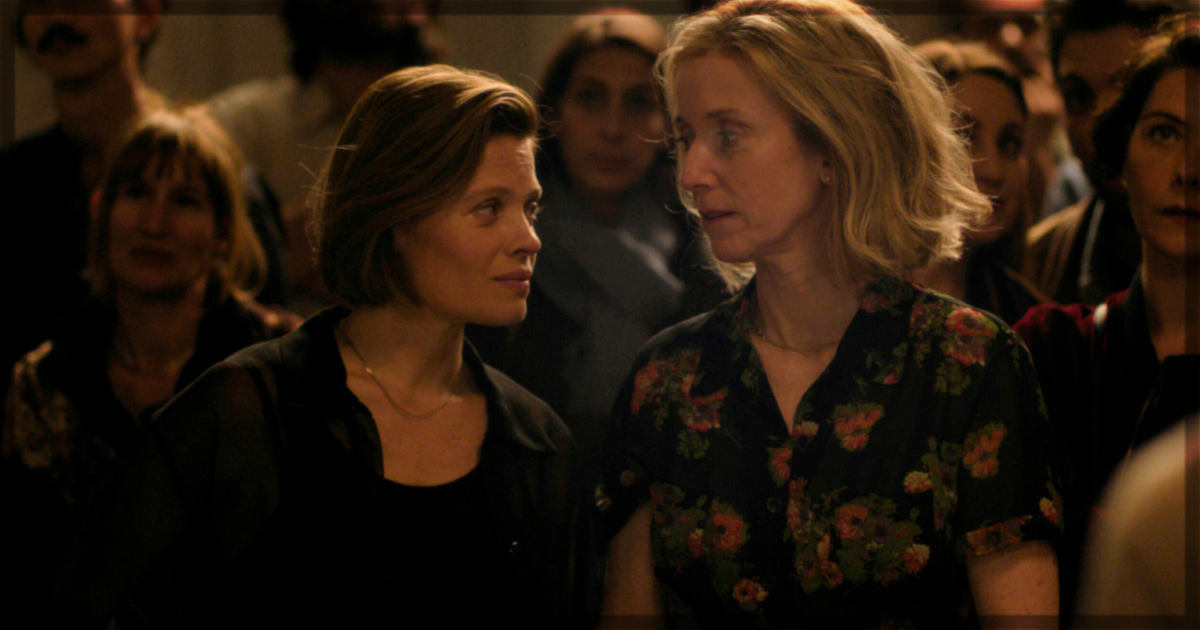
A Woman’s Life (La vie d’une femme) is the kind of daily-life movie at which French cinema excels. What we have here is nothing more and nothing less than slices from one woman’s life over a few years and the everyday problems that she experiences. This is both the kind of movie that doesn’t make a splash but is also art of the highest order, in that it will show the future how things are now. We also do not nearly pay enough attention in art to women’s working lives, which makes this movie about a woman who’s always put her career first downright revolutionary.
Gabrielle (Léa Drucker) is a surgeon who specialises in facial reconstructions at a teaching hospital in Paris. She has been promoted to running the unit, which she does with aplomb, handling the smallest matters alongside the bigger picture. She also undertakes surgeries which can last up to six hours at a time (though we don’t really see them; mercifully there’s about the same level of surgical detail here as in your average broadcast TV procedural). She also volunteers training doctors in Ukraine, and while we don’t enjoy a trip there we do hear a lot about the logistics. She is married to Henri (Charles Berling), with two adult stepchildren she helped raise less out of love but mostly because Henri was a package deal. She also has a fragile sister, a nephew she is putting through university, as well as a mother who is beginning to be swallowed by Alzheimer’s. This is a lot of responsibility but Gabrielle shrugs and gets on with it. Someone has to. But as we begin she is being shadowed for a day by a novelist named Frida (Mélanie Thierry), who is researching a doctor character similar to Gabrielle. She stays in the background of a complex surgery, taking notes in a little book about how Gabrielle and the others interact. Afterwards Frida sends Gabrielle some thank you flowers, and makes it clear she’d be happy to express her gratitude other ways.
Gabrielle loves her husband – the opening credits play over shots of them having sex – though it’s something of a joke in the hospital that she loves her deputy Kamyar (Laurent Capelluto, who made such a strong and terrible impression in We Believe You) even more. They work really well together, but Kamyar holds his distance. Or at least he tries to, especially now he has a new partner and a new daughter, who Gabrielle named. When infant Esther is brought to the office to meet her dad’s colleagues, Gabrielle brags that all Kamyar’s kids have different mothers but the same godmother. The repeated questions, from multiple people in multiple scenarios, about why Gabrielle never had any children herself are kind of mean, especially when you look at the level of career she has achieved. There’s aren’t many men who would be willing to stay home with the baby while their female partner saves lives all day at work. But then there is the new possibility of Frida, and what choosing a relationship with her might represent. That would be a leap into the unknown and generally Gabrielle is too in control for something like that. But we all know what love can do to us, whether we want it to or not.
Writer-director Charline Bourgeois-Tacquet is examining how a woman manages to have it all, or as much of that as she wants. The sense of workplace camaraderie here could probably only exist in France, with some vicious jabs about the state of the French health service thrown in. The argument that Henri and Gabrielle have on the rainy night in the car could almost certainly only happen in France, a nation famous for its citizens understanding that even the best and most positive relationships/partnerships/what-have-you have their limits. Ms Drucker is completely believable as someone running a surgical ward, telling off the interns as needed, working cheerfully with various colleagues to manage various problems and expressing nothing but kindness with her patients.
Ms. Thierry plays Frida as a little too self-deprecating about her own career to be believable, but then again she is a novelist of little success instead of a journalist who asks questions for a living. Her curiosity and willingness to explore is deeply attractive though, and it’s clear Gabrielle likes Frida because of how she breaks the normal career-centric routine. Most women aren’t doctors with international reputations of course, and the fact that half of Gabrielle’s problems are solved because she has always kept, separate to the family home, her own Parisian apartment, one that’s fully furnished, bills kept up, and without pesky tenants. This allows her a level of freedom and independence that’s extremely rare for women, mothers or not. This privilege is never directly addressed, which is perhaps the movie’s biggest mistake. The fact that this woman has the financial wherewithal to do as she pleases is not often seen, and this is much rarer than a woman choosing not to have children. But this is a minor gripe in the face of a fascinating movie. And it’s possible that lots of young women will watch A Woman’s Life and figure out how to do even better than this.
One final thing: Gabrielle’s bisexuality going without comment is a thing of joy.
A Woman’s Life (La vie d’une femme) recently played at the Cannes Film Festival.
Learn more about the film at the IMDB site for the title.
You might also like…