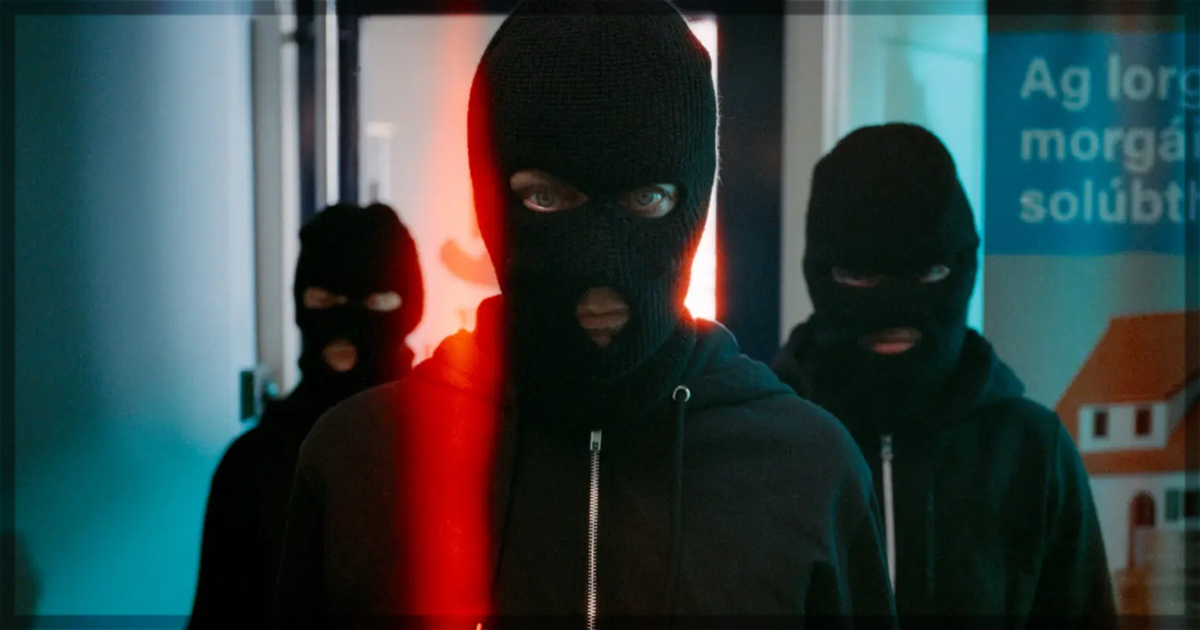
This clever no-budget thriller is automatically recommended by me because it’s in the Irish language. Its aspirational depiction of life entirely inside the Irish language, which rarely happens in real life, is just wonderful to see. It is also a heist movie, with three women (two of whom are middle-aged) at its center, and this is simply so cool that it’s hard to express. And that’s even before we get to the central mystery of who dies in the bank robbery! In every way Aontas is something to enjoy figuring out for yourself.
The movie opens with Cáit (Brid Brennan) standing in the middle of the street with a bloody head wound as some paramedics fuss over her. The village is out in shock watching as a man is arrested and a body is brought out into an ambulance. Someone has robbed the credit union – ie the only bank, one explicitly to handle the savings of the neighbourhood – and clearly Cáit has been involved in one way or another. But the reasons she ended up there unspool in reverse, and slowly we come to learn that they center on Cáit’s estranged sister Mairéad (Carrie Crowley, who made a huge impression as the lovely foster mother in The Quiet Girl and whose work here is as night to day). The very unhappily married Sheila (Eva-Jane Gaffney) and Colly (Sean T. Ó Meallaigh) are also caught up in this, as is Dara (Marcus Lamb), the richest but least popular man in town. Jobs are being cut in the whole area and the local people are not coping well; several have committed suicide. This means that someone like Dara, who sees himself as a cut above, is able to throw his money and influence around more than anybody else appreciates. But what can a woman like Mairéad or Cáit do about it? Suffice to say that Mairéad is a woman on her very last good nerve, and she prowls the village like a hawk. Ms. Crowley makes another tremendous impression as someone who has been driven to the unthinkable and therefore will go the whole way because no one will be able to stop her, including herself.
Aontas literally translates as ‘union’ but also has the broader sense of togetherness that is often found in small towns where everyone has known everything about everybody else for several generations. In Ireland especially that unspoken knowledge hangs heavy, because that sense of belonging is not given anywhere else and regardless of how much you dislike a place, it is extremely difficult to leave the safety of being known behind. And yet Sheila’s experience, where the abuse she is suffering is by no means a secret, is the unhappy downside of village life. The violent marriage she is too frightened to leave is seen as a trap she built for herself and not something anyone else has a responsibility to get her out of. How far is someone expected to go for family? Can a person be judged fairly when they’re measured against the whole of their family tree and not just as their own person? And how is it possible to prevent bad things from happening when individual efforts to change things are frowned upon?
Issues like this are so knotty a bigger budget or a larger choice of settings aren’t necessary. Instead cinematographer Damien Elliott and editor Sorcha Nic Giolla Mhuire focus on the details – a quiet conversation at a funeral, a coffeepot in a break room, Mairéad’s body language – as the complications pile up. Director Damian McCann, who cowrote the script with Sarah Gordon, is clearly just as strongly determined to modernise Irish-language cinema as rap group Kneecap (whose fictionalised biopic was a scream). Mr. McCann’s method is to make the language wholly ordinary, and the lives being lived with it as modern as any you’ll see in the supermarket tomorrow.
Only the final twist makes it perfectly apparent the answer to that question, and it’s really satisfying to see a movie understand that all things are indeed possible, but living with them isn’t. Someone who sees all human interaction as just business will proceed through life very differently to someone hugely sensitive to the impact her choices have, and it is incredibly interesting to see how people can be forced out of their comfort zone. The weight of human history is also both literal and metaphorical here, and the ways in which that’s respected, or not, has another major impact. In other words Aontas punches considerably above its weight with its intelligence about a plot that seems simple on the surface. But Aontas’s hidden depths only make this movie more satisfying the more you think about it, and it would be recommended regardless of its chosen language.
Aontas is now in limited theaters.
Learn more about the film at the IMDB site for the title.
You might also like…
