
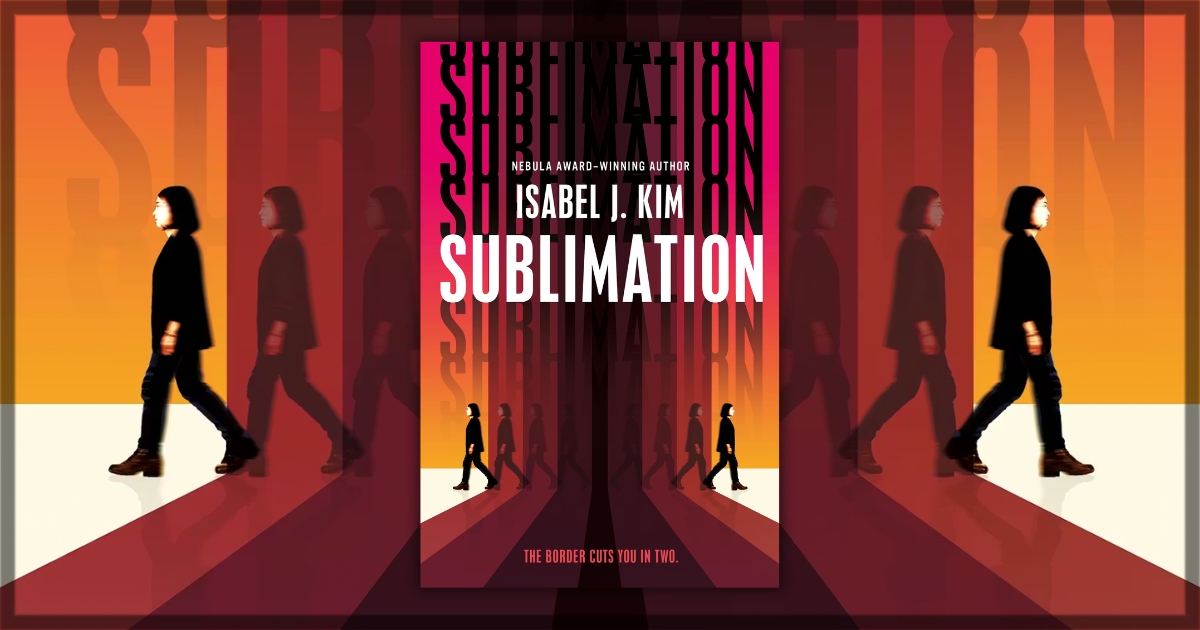
Everybody enjoys a good “what-if”. It’s a thriving genre of literature and movies alike. And of course, we all do this constantly in our own lives, “What if I hadn’t married him?” “What if I finished college?” “What if I never moved there?” The questions are enough to drive you crazy, especially since we can never really know the answer. But what if we could? That is the premise behind Isabel J. Kim’s Sublimation. When Rose gets a glimpse of the life she left behind as a child, she finds out that the Rose who stayed behind isn’t happy that she was left behind. She wants what Rose has, no matter what it costs.
[Note: While I am reviewing this novel independently and honestly, it should be noted that it has been provided to me by Tor Books for the purpose of this review. Warning: My review of Sublimation contains some spoilers!]
One person, two lives
In the world Isabel J. Kim creates, people naturally split into two identical copies of themselves when crossing a border in the right state of mind. If this happens, then the two copies, known as instances, go on with their lives. The one that makes it out gets to lead a new life, and the one left behind continues on as if nothing changed. Some instances stay close after a split, and others, like Rose and Soyoung, never reach out to each other.
Until one day, when Soyoung calls Rose and tells her that their grandfather has passed away, and asks Rose to attend the funeral. Rose isn’t sure how she feels, but she decides to go back anyway. When she arrives in Seoul, Soyoung hands her a black bracelet with MERGEBREAK on it right away, showing Rose that she was also wearing one.
This is important because if instances touch, they instantly merge into one person, with the memories of both lives fused together. Rose is confused by her feelings upon returning to Seoul, but she knows for sure that she wants to return to America, so she’s glad that her instincts are on the same page. But then Rose finds out that her grandfather told her instance to reintegrate with Rose as his dying wish. Rose is angry at the grandfather for requesting such a thing and suspicious of Soyoung for not bringing it up. But then the two talk it out, and Soyoung assures Rose that she doesn’t want to reintegrate.
Too bad that lying to yourself is so easy. Now Rose-Soyoung regrets reintegrating and is desperately looking for a way to undo what Soyoung did. They find out that they have a chance. Mergebreak is working on a new technology that can separate instances without the trauma of a border crossing. And it turns out Soyoung’s best friend is working on the project! But it turns out that separating instances isn’t all that this new technology can do. Now Soyoung-Rose is facing a dilemma. Is her personal happiness worth the happiness of countless others? Who can be trusted with the level of control that this new technology will give the owner? What’s the right path forward, if there’s only one path forward? Soyoung-Rose will have to decide just what kind of life she really wants, and what she’s willing to sacrifice to get it.
Sublimation is a more complicated story than I first thought
Sorry for the long summary above. Believe it or not, that doesn’t even cover most of what is going on in Sublimation. When I first picked up this book, I thought it was going to be a pretty straightforward, if imaginative, look at immigration and its effects on people. But the more I read, the more I realized that immigration is only a small part of what Sublimation is about. I mean, it is about immigration and the immigration experience. The not fitting in, the missing what you left behind, the guilt over not missing more. That is all explored in the experiences of Rose and YJ. But there’s also an exploration of power and who should control it. Does the government have the people’s best interests at heart? And which governments? After all, some are much more problematic than others. Or is the private sector the best place for power? Is it fair that money and the ability to pay get to make such important life decisions for everyone? What if everyone had equal access? Is there still a way that power can be abused?
Besides the question of power, Sublimation asks what do we owe the people we leave behind? In many cases, it is the family that the instances leave behind. Sometimes the instance that leaves stays in close contact with those they left behind. But if there’s still a version of them there, do they still have the same responsibility to those they left? Does the instance that was left have the right to eventually return and take over the life their instance has continued at home? One of the characters in Sublimation asks if reintegration is the same thing as murder. The question is an uncomfortable one for the other characters. But it’s a valid question because from the moment that the two instances split, they start growing into different people. If those two people then get smushed into one person, hasn’t someone disappeared? The new person isn’t the instance that left, and isn’t the instance that stayed. Instead, they’re a third version that is equal to more than the sum of the parts. Which life should this new person take up? Or should they start a new life of their own? Soyoung-Rose takes the reader on a deep dive through these questions, finding answers that might only apply to Soyoung-Rose because one of the morals of Sublimation is that everyone sees things differently, even if they’re arguably the same person.
Sublimation perfectly sums up Soyoung-Rose’s experience
I have to admit that the title originally threw me. I usually go back to science class when I hear “sublimation”. But the change from solid to gas doesn’t really make sense in this case. Then I honestly linked the word to “subsume,” and that made more sense as I started reading. After all, it looked like one instance was going to engulf the other, and the second would cease to exist. But then I looked up the definition of “sublimation” and was reminded of the psychological definition of “sublimation”, which is to turn an unacceptable impulse into an acceptable action. “Sublimation” can also mean transforming something into a purer form. Both of those definitions fit with the story of Sublimation so well, especially the latter one, that I was glad I’d looked it up. It both improved the title and helped me understand what was going on in the story. And now I’ve done the work for you! You’re welcome. But I can’t read the book for you, so I suggest you pick up a copy on June 2nd and get reading. Sublimation will ask some hard questions of you, but it’s worth it to find the answers.
Rating: 8/10
Sublimation by Isabel J. Kim is available on June 2, 2026, from Tor Publishing.
Learn more about the book at the official website for the title.
You might also like…