Independent Nigerian cinema is so rare that it’s automatically worth a look, but nothing gets a pass based on its cultural background alone. Whether a story is set in Liverpool, Los Angeles or Lagos it needs to be viewed within the same critical framework, and if a concept is offensive in one it is likely to be so in the others. What writer-director Olive Nwosu has done is make a calling card for her skills. Unfortunately she used the bodies of a group of brand new actresses, three with the rare ‘introducing’ credit, to do it. They do such strong work they won a Special Jury award for best acting ensemble in world cinema at the Sundance Film Festival, but that’s because they earned it.
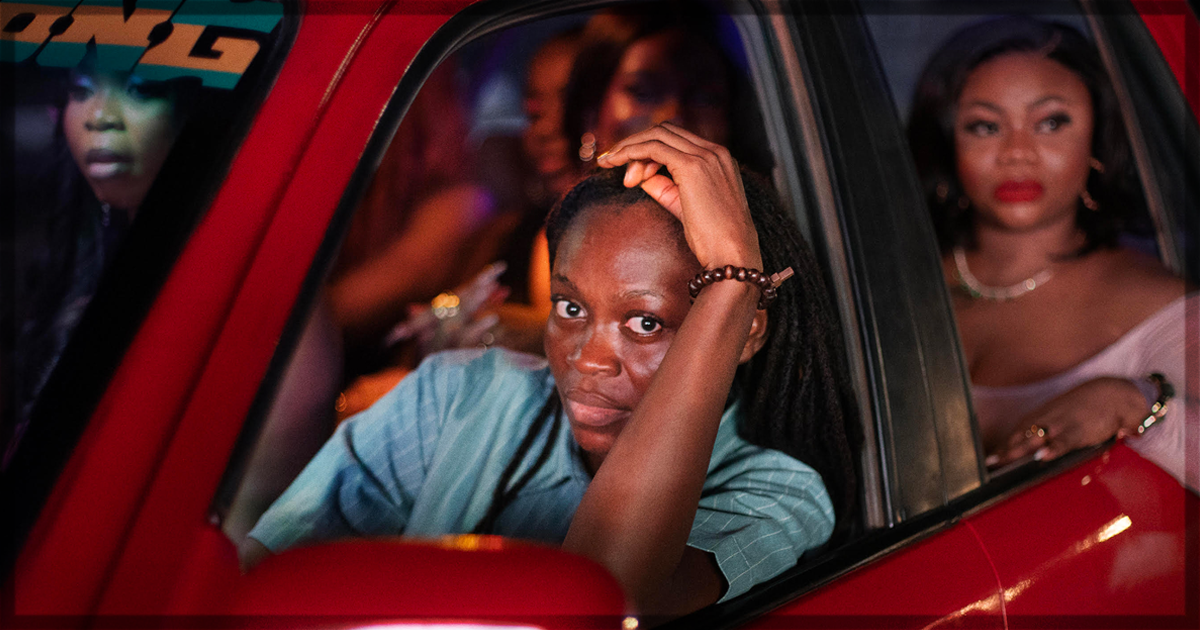
Lady (the wonderful Jessica Gabriel’s Ujah) is a young woman who lives alone in a Lagos boat favela. She drives a taxi – unusually, her little car is red instead of the standard yellow – and is the only woman taxi driver in her part of the city. She spends her evenings caring for the neighbour who took her in as a child, and dreaming of earning the money to move to Freetown, Sierra Leone. A bus ticket there costs 200,000 Naira (so about £100/$150), but prices, especially gasoline/petrol prices, are rising so high it might as well be on the moon. Then Lady’s childhood best friend Pinky (Amanda Oruh) reappears. She is now a prostitute under the control of a gangster named Fine Boy (Bucci Franklin), who needs a new driver to chauffeur his ladies around. Suddenly Lady’s nights involve taking five or six women, most notably Pinky and Sugar (Tinuade Jemiseye, in a brave and forthright performance) to wherever their services are required. Lady waits in the car, wearing a chauffeur cap that’s actually a baseball cap with a two-word phrase, and thinks about her money. Until she doesn’t.
The women speak with such terror of Fine Boy that’s it’s disappointing how little he features. The main dilemma turns out to be Lady’s fear of other people, which is to say a fear of sex, in contrast with the working girls who know too much, learned much too young. The story Sugar tells of her childhood and how she began her profession is as awful as any you could hear, and told in such a way that makes it clear there are a million other girls in a million other cities who could tell you the same thing. Lady, whose isolated and lonely life is by choice, insisting that she can achieve her dreams by herself is seen as foolish instead of an understandable survival tactic. But this is a movie with a very simplistic idea of what women’s bodies are for, and an even more basic way of enforcing that idea. It’s a huge waste of a fascinating central character and leads to an ending sadly overwhelmed with cliché.
Ms. Nwosu, who has made two shorts in addition to this, has the chops to be a solid filmmaker and she has certainly demonstrated a knack for getting attention. But if this movie had been made in Liverpool or Los Angeles it would not be winning awards, and just because it was made it Lagos doesn’t automatically make it worthy of praise. That said, Alana Mejia Gonzalez’s cinematography gives a thrilling sense of Lagos and Pat Adaeze’s costumes make thoughtful use of colour to convey mood. There was a really interesting group of character studies bubbling under Lady’s surface. It’s a shame therefore that someone decided the surface was enough.
Lady recently played at the Sundance Film Festival.
Learn more about the film at the Sundance site for the title.
You might also like…