
Before the spread of the academia as a central form of producing and teaching knowledge, the indigenous communities already understand crucial learnings about the world. Historically, civilizations such as the Mayans and Aztecs produced immense amounts of information on mathematics and engineering. Human being tends to seek understanding of their environments, the natural order of life, and the reasoning behind the world. In the forests of Latin America, indigenous communities understood crucial information about the plants around them. On the continent, there is an immense variety of different plant species that provide food and medicine. Hence, those ingredients are usually not well-known, particularly due to the lack of funding for studies within the deep forests. More importantly, there is no research on those plants led by members of the communities in which those plants grow. In Otilia Portillo Padua’s Daughters of the Forest, the director portrays the story of the women who specialize in those plants.
Padua documents the life of Eliseete Ramírez Carbajal, a senior woman. She is a native of the Mexican mountains. The other woman is Julieta Serafina Amaya Pérez, a young biologist who studies the mushrooms that grow in that region. Two different generations of indigenous women are mycologists; one graduated through the school of life, and the other by the university. Together, they share the knowledge on the different types of mushrooms and fungi that provide food with multiple flavors. Daughters of the Forest is the story of two different generations of indigenous people who believe in the natural properties of the land. Carbajal learned about those properties through her seniors, grandmother, and mother, who taught her about the different colors that assign different functions to those fungi. In this sense, the relationship between the ancient and Pérez is the transmission of learning, keeping that information alive.
Accordingly, Daughters of the Forest focuses on the conversation between those two individuals who represent opposite sides. Carbajal is the face of the past, the roots of the knowledge that spread through the daily life in the woods. Pérez represents a new form of indigenous understanding, combining the ancient learning with science. In a sense, we follow the journey of the young biologist who spends four hours on a bus to access a laboratory. Thus, she faces the difficulties of getting a vacancy for a master’s degree, as it is harder for her to enroll. The traditional academia has a barrier with the indigenous learnings, keeping itself far from the reality that embraces the ancient learnings. Most of the passages of the young woman in the scientific environment are a fascinating documentation of the hardships in accessing the opportunities as a young indigenous woman. Despite the history of Mexico as a society that derives from multiple indigenous communities, even from the chronology of the understanding of the Mayans, there is a gap that prevents the original knowledge from being accessed.
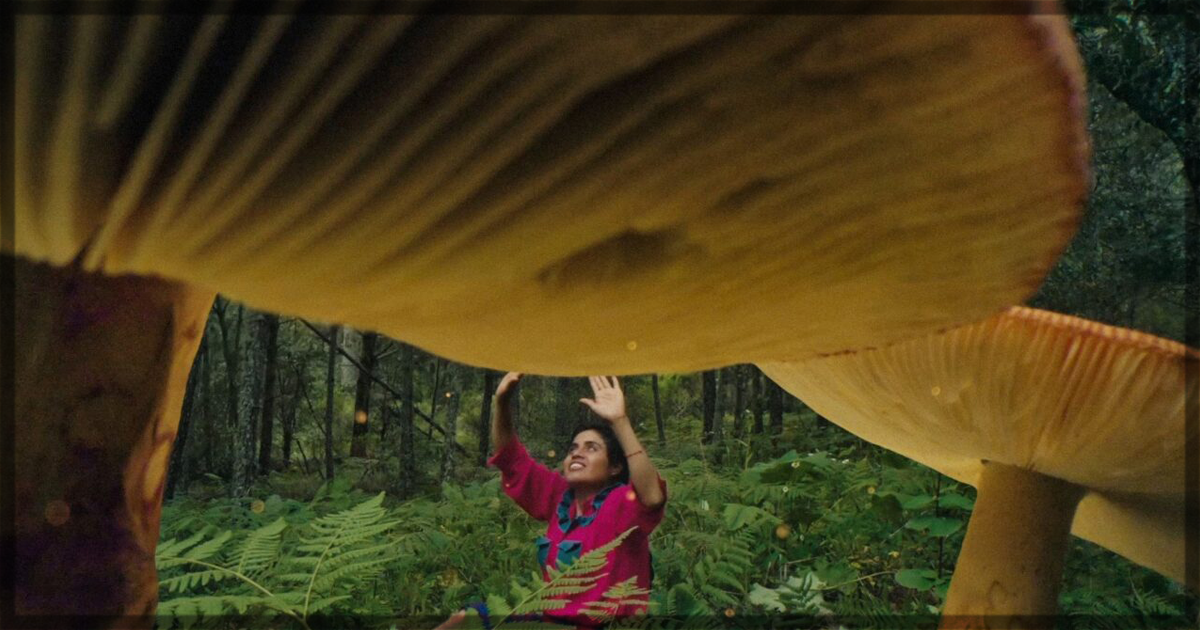
In another aspect, Otilia Portillo Padua creates a compelling visual construction of the forest. The cinematography dives into the grounds to document the mushrooms and fungi from a closer perspective. Additionally, there is a comprehension of the dialogue between the past and the future. However, those fantasies and imaginations of the future feel distant from the conversation of generations that work well enough. Thus, there is a distance in both timelines that showcases two different films. The past is a compelling work that positions Carbajal as the owner of an encyclopedic knowledge that transmits to the new generation, the one that is about to gatekeep, and propel the information about the benefits of the unknown mushroom. The most emotional scene is a passage of perspective that cuts from the presence of the ancient woman to the absence of her body in that chair, symbolizing her passing away. Opposite to the future imaginations, who try too hard to feel futuristic and bold, are foolish compared to the beauty of the simplicity of the editing that focuses on the emotional construction between two frames.
Daughters of the Forest is a mostly fascinating work on the importance of the indigenous knowledge, in this case, protected and spread by women from Mexico. Yet, the work by Otilia Portillo Padua attempts to flex two different timelines, which separate them between the past, Carbajal, and the ancient work, and the future. When focusing on the dialogue between generations, the documentary is compelling and emotionally strong. However, the director attempts to experiment with the form too hard in his imagination of the future, landing it in a shallow territory.
Daughters of the Forest premiered at the CPH:DOX Festival.
Learn more about the film at the CPH:Dox site for the title.
You might also like…

‘Phenomena’ Documentary Review: The Fascinating Experimentations with Colors and Shapes