The first thing I liked about this movie was its title. The 1953 ascent of Everest has often been told as Edmund Hillary’s story, with the Sherpa who reached the summit beside him mentioned as the other guy in the photo. This film is called Tenzing. Not “Everest,” not “The First Ascent,” not something built to sell a Western star. It’s named after the man, and that one choice tells you a lot about what it’s going to be.
The biggest name on the poster is still Tom Hiddleston (Crimson Peak), Willem Dafoe (The Lighthouse) is here too, but it’s behind the camera that my personal expectations were, since Jennifer Peedom (Sherpa) is making her first narrative feature after years of documentaries about the Himalayas and the people who work there, from a script by Luke Davies (Lion).
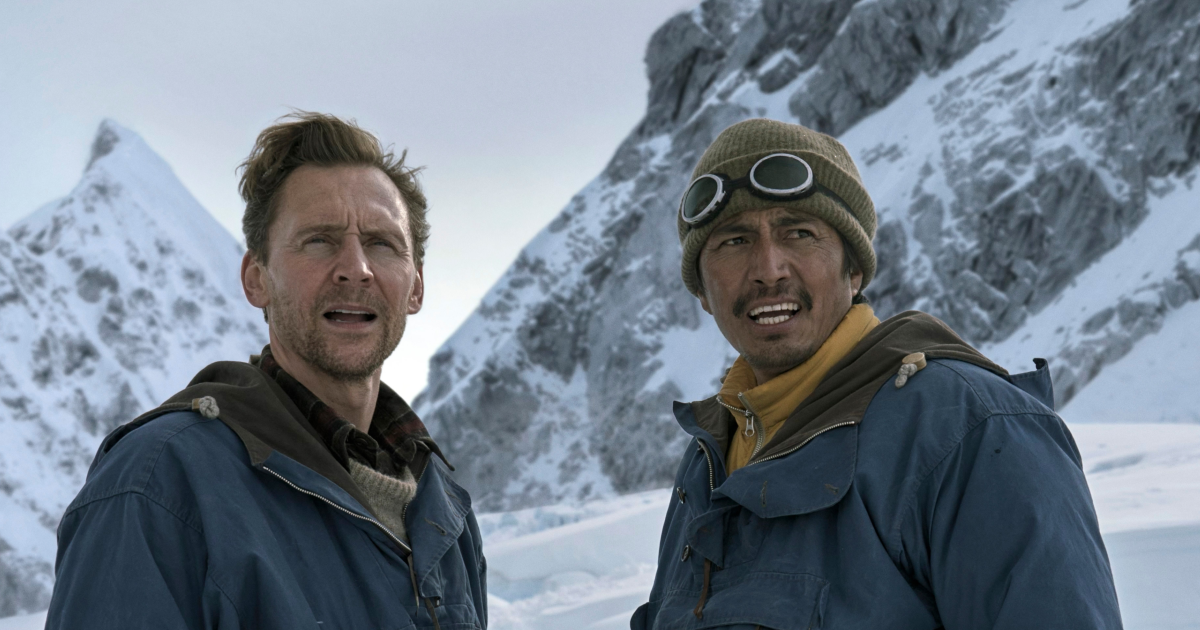
Tenzing Norgay (Genden Phuntsok) has dreamed of standing on top of Chomolungma since he was a boy in a village beneath it. By the early 1950s, he’s a veteran of several failed expeditions, hired by foreign teams to carry their loads and fix their ropes, but never treated as one of the climbers. When the British organize a new attempt, he wants a real place on the team. With encouragement from his wife Dawa (Thinley Lhamo) and help from expedition secretary Jill Henderson (Caitríona Balfe, Ford v Ferrari), he has to convince Colonel John Hunt (Dafoe) that he belongs among the climbers, and then find a partner in a New Zealander named Edmund Hillary (Hiddleston). Flashbacks to his childhood and family fill in where all that devotion comes from.
Phuntsok is the reason it works. He plays Tenzing as a man whose faith doesn’t crack, both in the mountain and in his own ambition. That kind of certainty could easily come across as stubborn or flat on screen, but he makes it warm. You believe this person has been walking toward one place his whole life and never once doubted he’d get there. He also gets to do much of it in his own language. The Sherpa language isn’t a few token lines before everyone switches to English. It gets real screen time, and that alone gives Tenzing an authenticity a lot of biopics about non-Western figures never bother with. There’s no whitewashing, no Hollywoodizing of the protagonist. He’s allowed to be exactly who he was.
The idea I keep coming back to is the name of the mountain. The British call it Everest, and they talk about it the way you’d talk about an enemy fortress: something to attack, beat, and claim. For Tenzing and the Sherpas, Chomolungma is a goddess. They pray to her and ask her permission. She’s part of them, and Peedom never turns this into a lecture. It sits under almost every conversation between Tenzing and the expedition, two groups standing on the same rocks and seeing completely different things. I found every conversation around this much more interesting than any summit push.
Hiddleston understands which of those two worldviews Tenzing belongs to. Considering how often he’s been the most magnetic person on screen for me, the best compliment I can give him here is that he never steals a single scene. He plays Hillary as dry, practical, and quietly impressed, complementing Phuntsok’s every effort instead of competing with it. Their partnership grows out of respect for each other’s skill, not some sudden brotherhood, and that just feels right.
Visually, it’s a gorgeous movie to look at. Stefan Duscio (The Invisible Man) shot on location, and the production brought in real Sherpas with actual Everest experience, so the whole thing often plays like a quasi-documentary. Combined with Peedom’s background, that gives it an immersive, atmospheric quality, the feeling of thin air and cold light rather than a soundstage with fake snow. There are also very few “let’s have some action now” moments. No invented avalanche every twenty minutes, no villain sabotaging ropes. Some people looking for basic thrills will be bored. I appreciated it simply because the story never asks for that.
Restraint has a cost, though, and here it’s friction. Tenzing is a by-the-numbers biopic. You know the shape from the first scene: the childhood dream, the setbacks, the doubters, the ally who opens a door, the triumph. It’s also too sanitized and too inspirational at points. Everyone is either good or gently condescending in a way that gets corrected. Nothing ever really scrapes.
Something else bothered me. The protagonist isn’t Hollywoodized, but the story still gives a lot of space to British characters, more than I think a native filmmaker would have. Hunt, Henderson, and the expedition machinery take up a good chunk of the runtime. Maybe that’s unfair to Tenzing, since the British were the ones deciding who climbed. Dafoe and Balfe are both perfectly fine, but their characters are thin, as they’re there mostly to block or open a path for the protagonist. Then again, the film is called Tenzing, it’s a character study, and I’d rather have an underdeveloped Hunt than a thin Tenzing.
The flashbacks are necessary. They establish his family, his village, and where the obsession started. They also get repetitive, returning to the same kind of moment more often than the story needs, and Dawa deserved better. Lhamo does what she can, but the role is mostly encouragement and waiting at home, and for someone the movie clearly sees as his foundation, she’s barely given anything to play. It isn’t a heavy slow-burn, but it’s definitely contemplative, and that pace doesn’t always justify a runtime over two hours. A few of those middle stretches could go without losing anything.
Final Thoughts on Tenzing
Tenzing is a nice enough biopic, and more respectful than most. I love that it’s named after its hero and actually keeps him at the center, and that the Sherpa language gets real space. Genden Phuntsok is extremely compelling as a man with unbreakable faith in his own ambition, while Tom Hiddleston plays the supporting role perfectly. The on-location cinematography, the real Sherpas, and the Everest-versus-Chomolungma idea make it immersive, and I appreciated how few cheap action beats it bothers with. It’s also formulaic, too sanitized, low on friction, fuller of British characters than it needed to be, and slower than its two-hour runtime can support, with repetitive flashbacks that leave Dawa with very little. I respected it more than it moved me, and I’m glad it’s his name on the poster.
Rating: B-
Tenzing releases on Apple TV+ on October 16th.
Learn more about the film, including how to watch it, at the official website for the title.
You might also like…