
Entering a movie theater with low expectations is a dangerous yet necessary exercise. Two weeks after its release, I finally sat down to watch Mercy, and I couldn’t escape the wave of negative reception that’s been flooding the internet. That said, I’ll confess I held onto a sliver of hope. There’s something inherently fascinating about concepts that explore the future of technology and its interference with our morality, and Timur Bekmambetov (Wanted) has proven in the past to have a sharp eye for modern tension and digital language.
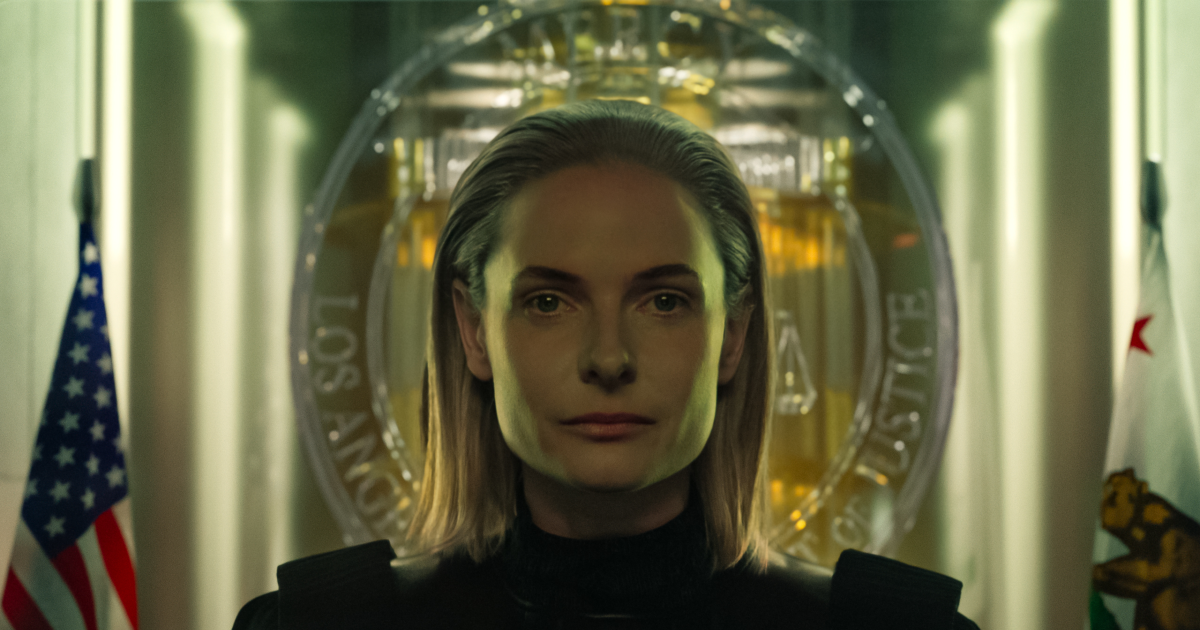
In Mercy, audiences are transported to a not-so-distant future where the legal system has been radically transformed. Directed by Bekmambetov, written by Marco van Belle (Arthur & Merlin: Knights of Camelot), and starring Chris Pratt (Guardians of the Galaxy) and Rebecca Ferguson (Dune), the story focuses on James Hunt (Pratt), a detective who suddenly finds himself on the wrong side of the law. Accused of a violent crime, Hunt is subjected to a new judicial protocol: a real-time trial conducted by an advanced artificial intelligence, Judge Maddox (Ferguson). The goal is total impartiality, eliminating human error through an algorithm that analyzes global data in seconds to dictate the defendant’s fate — a process where the presumption of innocence seems to have been replaced by a cold, statistical probability of guilt.
The premise is undoubtedly stimulating and touches on essential points regarding the digital landscape we live in today. The idea of an impartial judge, jury, and executioner being an AI form raises pertinent philosophical questions about what the concept of justice actually means. If the goal is to decipher who committed crimes based on hard, irrefutable evidence, no one would theoretically be better than an independent source, devoid of emotions and with access to every digital footprint on the planet. However, the execution of this idea wanders down a path filled with narrative contradictions that weaken the story’s internal logic. From the opening moments, Maddox helps the suspect without him even requesting it, which contradicts the system’s supposed absolute neutrality. Even stranger is the absurd ease with which the system accesses personal devices across the globe. I get that this is a sci-fi flick, but it bothers me that there isn’t a single line of dialogue touching upon privacy policies or the ethical limits of such a massive intrusion. This lack of context makes the message about technology confusing and, at times, contradictory, leaving me unsure whether Mercy intends to be a serious warning or just a vehicle for fleeting entertainment.
One of the most problematic points of the narrative structure lies in how the trial is initiated, which strips the system’s supposed justice of any credibility. If Maddox’s purpose is to be the fairest of judges, why is the suspect’s “awakening” so abrupt, shocking, and frantic? Hunt wakes up from a hangover, and in less than five minutes, they explain the inner workings of a complex technology, activate a ninety-minute life-or-death timer, and essentially tell him to figure out the buttons and voice commands to prove he didn’t kill anyone. A system that prides itself on justice should grant the defendant time to adjust and prepare his case or, at the very least, provide legal assistance to guide him through the digital labyrinth. As it’s presented, even an obviously innocent person would succumb to the pressure of the moment, failing to prove their truth simply due to technical and emotional incapacity. This scenario becomes even more glaring when Mercy suggests that other characters didn’t receive the same help from Maddox that Hunt did, which reeks of a plot convenience that’s far from subtle just to keep the protagonist in the race.
When it comes to the performances, Pratt delivers a pretty good job, successfully conveying the desperation of a man cornered by a machine. I fundamentally disagree with the criticisms pointing to him as miscast because he’s stripped of his usual humor; Pratt demonstrates that he can carry serious and vulnerable roles, proving that his dramatic range is higher than many give him credit for. Beside him, Ferguson does the best she can with a character that inhabits the uncanny valley. Her Maddox tries to balance robotic stoicism with small system “glitches” that suggest a spark of humanity. However, these emotional interactions between Maddox and Hunt often feel forced by the script rather than a natural evolution of the characters or themes. It’s an unearned development, serving only to push the narrative where the director wants it to go instead of genuinely exploring the nuances of an artificial consciousness.
The central question that Mercy fails to answer satisfactorily is one of accessibility and social justice. Hunt gets away with it because he’s a trained detective with investigative skills and knowledge of the law. But what about the average citizen? Would someone without a basic education or daily access to high-end technology be able to transform into a blend of Sherlock Holmes and Bill Gates in an hour and a half? The movie ignores this fundamental inequality, preferring to focus on data clues that are solved almost magically through maximalist visual aids that, while appealing, hide an intellectual void regarding the human reality of those who don’t master these tools.
Visually, the Screenlife narrative concept is a choice I appreciate and one that fits the theme of constant surveillance. It’s no surprise that Bekmambetov opted for this path, considering his production history with films like Searching and Missing. By forcing the audience to watch the trial through the same interfaces the characters use, the filmmaker makes the audience a complicit part of the jury, which is a captivating and immersive element. Nevertheless, the editing and camera movements are excessively frenetic, moving far too rapidly to allow for any reflection on what we’re seeing. The creativity feels mute, jumping between video sources without logical explanation, simply because it’s written in the script that one can access that specific camera at that exact moment, without the slightest respect for spatial geography or technical logic.
The central mystery ends up being a safe, generic bet that then gets escalated into something else entirely in a clumsy manner. For most of Mercy, the time is spent trying to figure out the killer, only for the reveal to be made bluntly when Maddox announces that Hunt’s guilt probability index has dropped below a certain threshold. From there, the movie transforms into an action-heavy finale that seems to have lost track of the themes it initially intended to explore. It’s a transition that throws away the tension built previously, trading thematic analysis for an overlapping, unnecessary storyline that takes the weight off the crime’s resolution. I’m left with the bittersweet feeling of a film that was afraid of being just a digital courtroom drama and felt the need to become a generic action flick.
Final Thoughts on Mercy
Mercy is an experience that sits between a fascinating premise and a careless execution, presenting a scenario of algorithmic justice that gets lost in narrative contradictions and plot conveniences. Although the performances of Chris Pratt and Rebecca Ferguson offer some stability, and the tension levels are maintained by an effective score and competent visual effects, the movie fails to deepen the ethical implications of total surveillance and technological inequality. It leaves behind a somewhat confusing reminder that no matter how much we try to automate the truth, justice without the context of human fragility is just a line of code devoid of a soul.
Rating: C-
Mercy is now playing in theaters.
Learn more about the film, including how to buy tickets, at the official website for the title.
You might also like…