
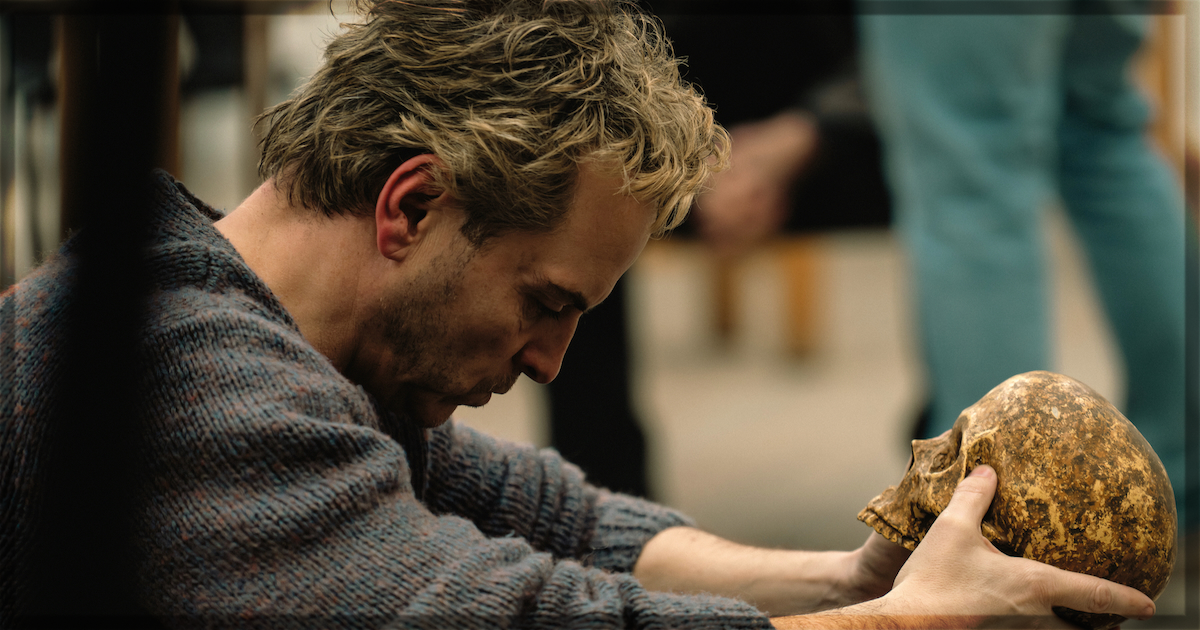
Hamlet is an Everest, as director Richard Eyre (Johnny Flynn) announces to his assembly of actors early on in Elsinore, Simon Stone’s film opening the London Film Festival. The title role alone has 4167 lines. Mounting a production at the National Theatre of Great Britain’s Olivier Theatre, which seats 1100, adds further scale to the mammoth undertaking; your performance must read for the back row as well as those close by. These facts are stated plainly as the action of Elsinore ramps up, and as Ian Charleston (Andrew Scott) – an actor best known for Chariots of Fire but who has not had major success on stage or screen since – assumes the title role in 1989, famously after Daniel Day-Lewis walks out mid-scene. Charleston, openly if not publicly gay, sees HIV turn into full-blown AIDS shortly before Eyre approaches him to take on the role; suddenly, the role of a lifetime turns tragically into the very last chance he will get.
Despite the tearjerker true-story premise, there is a lot of humour in Elsinore, and the first hour crackles with dry wit and a keen interest in the quotidian details of Charleston’s intersecting lives: as a working actor hungry for a meaty role, and as a gay man amidst the omnipresence of the AIDS crisis. Friends, (former) lovers, and the public eye all dance around the inevitable, and laughs and tender truths sit comfortably together. The production design, notably the costumes, beautifully evokes the era.
Scott, whose skill with Shakespeare’s text is matched by few today, is magnetic and fully committed. Stepping into another actor’s shoes is no easy feat: the line between impression and embodied performance is a gossamer thread, but Scott never veers towards the former. He holds nothing back as Charleston’s early bravura and dismissal of medical intervention give way to doubts and grief under the very thespian urge to make the show go on at any and all costs.
Billie Piper’s Pasty, a casting agent and Charleston’s best friend, stands out among the supporting cast, bringing a vibrant, irrepressible sympathy to a woman determined not to lose those closest to her. Olivia Coleman’s Dr. Margaret Johnson is sadly relegated to playing the same caring stern-ness, only letting in vulnerability when quietly observing. Flynn, who coincidentally played Richard Burton as Hamlet at the National Theatre a few years ago, makes Eyre a man whose commitment to art never comes before his commitment to the people who trust him to make a show work.
Unfortunately, Elsinore then becomes a paint-by-numbers biopic that veers dangerously close to misery porn for straight people. The strangely antagonistic (and impression-esque) portrayal of Derek Jarman (David Dawson) rankles as a way to separate and sanctify Charleston rather than honouring the diverse, lived experiences of queer men in 1980s London. Hamlet, and the role of theatre in Charleston’s life and loves, takes a backseat to graphic suffering in a way that undercuts his choice to undertake the Prince of Denmark in the first place. As he returns to the National Theatre after shooting an action film, Charleston bemoans the fact that film is for editors and directors, chopping up actors’ performances; he craves to return to the stage, with nothing between him, his character, and the assembled room. It is somewhat depressing that the back half of Elsinore relies so heavily on montage – most egregiously its climactic minutes, combining non-chronological Hamlet excerpts with Charleston’s dying agonies.
In this, Elsinore brings to mind the 1955 film Prince of Players, another middling, saccharine biopic where an actor famous for playing Hamlet portrays an earlier generation’s star actor who was renowned for his Hamlet, both using the role to redefine themselves when faced with tragic forces beyond their control. Both films fail by their neat, reductive assertions that a powerful Shakespearian performance coupled with a dignified silence offstage holds the key to public and private redemption. Prince of Players, however, gives Richard Burton as Edwin Booth the scope to explore full scenes and monologues without cuts or remixes; his “To be or not to be”, candlelit as Booth begins to wrest his reputation out from under his father’s, is one of the best put to film even without the context of the full play. Scott as Charleston is never trusted with such grace, which is a tremendous disservice to his talent. The nuance and naturalism with which he imbues his portrayal of Charleston – the film’s strongest quality by far – is thus unable to reach Charleston-as-Hamlet.
Stone, an accomplished stage and opera director, does not feel confident behind the camera. His shot-reverse shot cuts often change angles distractingly, and his “more is more” editing approach fights against the performances rather than enhances them. The approach may have been an attempt to put the viewer in the midst of the action, going for grit over polish, but it distracts more than a static, slightly wider camera angle would.
Elsinore is an effective weepie and brings Charleston back to a public prominence that, due to his early death and paucity of mainstream screen roles, faded far too soon. Scott may deservedly win several acting awards for this film, but unfortunately the rote structure and over-egged emotional turns do its tragic tales no favours.
Elsinore will be in theaters in December of 2026. It recently played at the London Film Festival.
Learn more about the film at the IMDB site for the title.
You might also like…

‘Nope’ Film Review: A Near-Perfect Blockbuster