
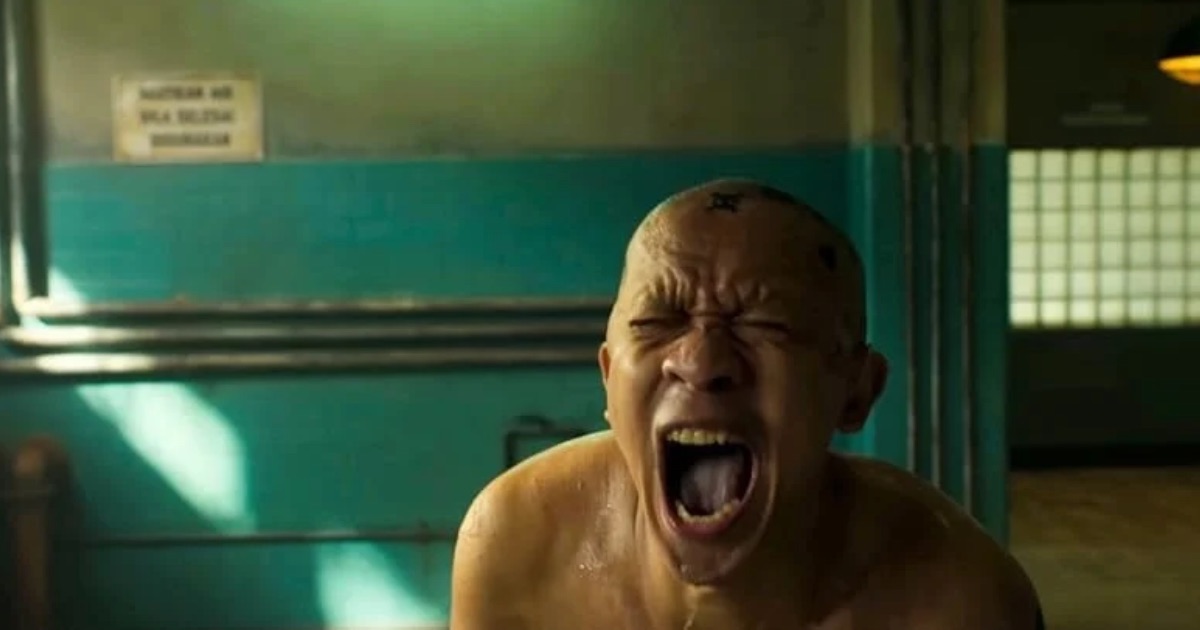
The camera never stops moving in Joko Anwar’s thrilling Ghost in the Cell. It moves and moves and moves and moves until it hits us with a sequence of gore so extreme, so visceral, that it will likely put off viewers who thought this genre offering would be more sophisticated. The fact that it played at the Berlinale, a festival historically known for playing more arthouse fare than anything else, shows great audacity in subjecting audiences to such violence. But it might also be the best thing I’ve seen come out of that festival this year, a far cry from last year’s lineup, which included Hélène Cattet and Bruno Forzani’s mind-melting masterpiece Reflection in a Dead Diamond.
Anwar will never reach the formal and aural heights of that film, but does he need to? What he’s doing is completely different – and singular – in a landscape that seems afraid to mash genres together. The film starts as a journalistic thriller, but immediately subverts expectations as it shifts to a prison complex, where a new inmate, Dimas (Endy Arfian), arrives and changes the dynamics inside its walls. He has been accused of murdering his boss, who criticized the publication of an investigative report he wrote, but Dimas swears he has never hurt anybody.
That’s not enough to make him the prime target for a murder that’s bound to happen on his first night, arranged by the jail’s corrupt warden. However, these plans are quickly upended by a series of brutal killings where inmates have their bodies opened wide, in various positions, and hung as art pieces for the world to see. Of course, many characters are immediately suspected, until inmate Six (Yoga Pratama), who has the ability to see otherworldly figures (the name is an obvious nod to M. Night Shyamalan’s The Sixth Sense), believes a ghost is lurking in the prison and is killing people close to Dimas one by one until the newly arrived inmate dies.
The premise is simple, but Anwar elevates it by deftly blending multiple genres within the prison setting. Instead of purely leaning into atmospheric (and gory) thrills, he introduces a framing device that makes the film far more entertaining than it should be. As Six sees auras being positioned on inmates that could be killed by the ghost, the characters can change their fates if they dance or pray. Their aura must be kept positive at all times, as the ghost seems to be affected by negativity and rage. The movie then becomes a quasi-musical actioner where unpredictability becomes Anwar’s modus operandi.
At some point, and it’s par for the course, the gory killings get redundant. How much extreme violence, where humans get brutally mutilated or have their bodies opened wide, can you sustain if the film doesn’t reinvent itself? At that point, Anwar incorporates dance as a potential repellent for the spirit, then stages a death scene with dance, and starts finding new ways to keep the gore exciting and fast-moving. He also adds a dash of action to the mix, drawing on his knowledge of the genre from last year’s The Siege at Thorn High, especially when the film desperately needs something beyond gore to sustain our attention.
The fight choreography is so creative and intricate that it almost recalls the poetry of Lau Kar-leung, or the kooky, otherworldly pleasures of films directed by Kuei Chih-Hung and Ho Meng-Hua. The blend of martial arts with brain-exploding horrors feels so fresh and invigorating that it almost feels miraculous when characters begin to break into dance in the middle of a fight scene to ward the spirit away. Stuff like this is the kind of creative art genre cinema desperately needs, but there’s doubt Ghost in the Cell will reach the masses unless you’re familiar with Anwar’s work.
The director does have a bit of difficulty drawing compelling characters, and his plot doesn’t make much narrative sense, but does it really matter when the offerings on display are this imaginative? Again, the camera never stops moving. It always points at elements the audience should pay attention to, and accompanies us within the claustrophobic prison walls as an apparition haunts and maims inmates in ways that simultaneously terrify and excite us. Rarely has a movie pushed the boundaries of gore like this one, and some might find Anwar’s approach off-putting. But the mélange of gore and comedy works so well that it almost feels like a completely original work in its own right, even if the director proudly wears the influences he draws on on his sleeves.
That’s the main reason Ghost in the Cell works so well. Anwar doesn’t pretend to know more about genre cinema than his contemporaries, but he has a strong vision. That vision drives the pleasure of watching a film that never takes itself too seriously but isn’t afraid to let the blood flow, either. And if our landscape of horror movies were as entertaining as Anwar’s work, Hollywood would be in much better shape than it is right now…
Ghost in the Cell is now in theaters.
Learn more about the film at the IMDB site for the title.
You might also like…
‘Primetime’ Film Review: A Bone-Chilling Excavation of America’s Penchant for Sensationalism