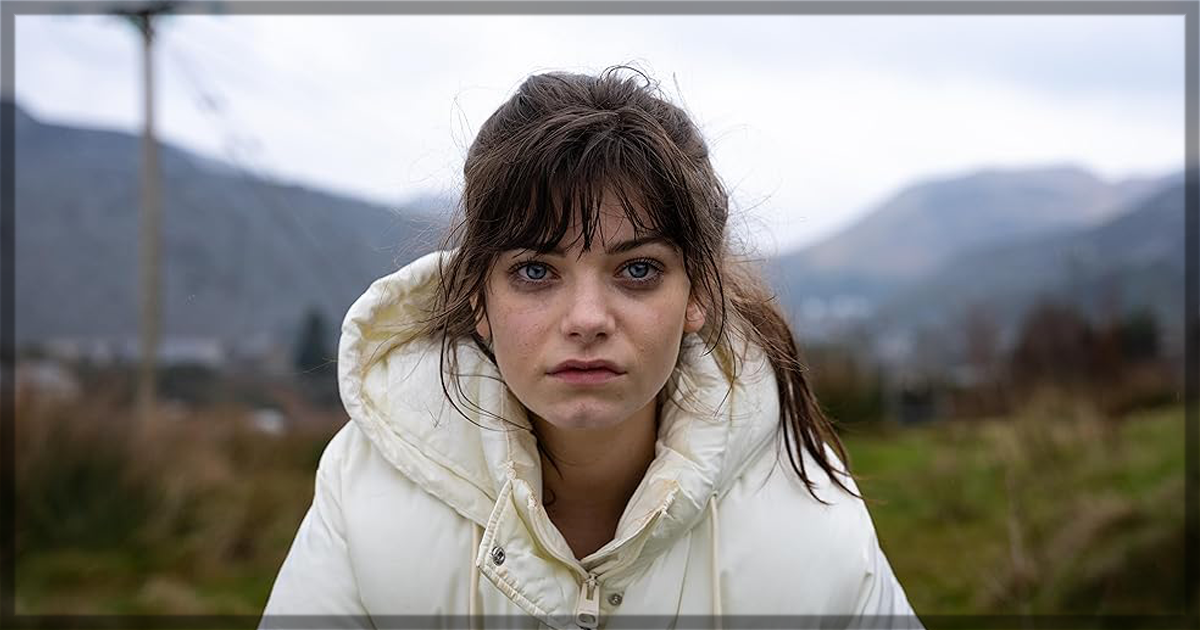
Effi (Leisa Gwenllian) is a person and Blaenau Ffestiniog is the name of the village where she lives. In Welsh – everyone’s first language in this wonderful little film – the title therefore means “Effi from Blaenau.” (It’s pronounced Blay-nah.) It is an adaption of a one-woman play by Gary Owen with the un-beautiful title Iphigenia in Splott, and the deliberately chosen name of the heroine is meant to emphasise themes of female strength and female sacrifice. Its point is that tough places make tough people, and even the safety net of the British welfare state can’t redeem a culture of casual cruelty and thoughtless misogyny. Fortunately a huge performance from Ms. Gwenllian elevates Effi o Blaenau above its difficult subject matter into something very nearly sublime.
Effi lives with her best friend Leanne (Nel Rhys Lewis) in a house on the edge of Blaenau, which was a busy and prosperous town until the mines closed a long time ago. It’s a gray place, with stone buildings and overcast skies hanging low overhead. There’s barely any work and everyone is broke, stressed, bored and permanently squabbling. If Leanne and Effi were at university no one would bat an eye at how much ‘doctor voddy’ they drink or how they misbehave, but because they are from the workless working-class no one is very kind. In fairness to everyone, they are also exhausting: careless, noisy, smug and self-centered whether drunk or sober. A small-time local dealer, Kev (Owen Alun), has a thing for Effi, which she tolerates because he’s harmless and means well. One Saturday night they all take the train to go clubbing, where Effi makes eye contact with an older man named Lee (Tom Rhys Harries). The encounter that follows surprises them. Lee is a former soldier who lost a leg in the war and is ashamed of his disability, but Effi’s frankness about whether or how that matters saves the night. Meeting him is the biggest chance she’s ever had to get out of Blaenau, and of course their encounter has consequences. But only for Effi.
At first Effi does not react well, and in fact goes significantly further than anyone should despite Leanne’s best efforts to stop her. But once the shock wears off Effi sets her chin and goes her own way. Her grandmother Meg (Carys Gwilym) takes this to mean Effi’s maturing at last. But Effi was mature already. There was just nowhere for that maturity to be shown. What’s the point of keeping a schedule if you have nowhere you ever need to be? Why save money for an impossible future when the day’s pain is a more pressing concern? And yet we are meant to be surprised that a foul-mouthed party girl can rise above her trauma to be thoughtful and considerate. Poor Ms. Gwenllian is bashed from pillar to post in an absolute tour-de-force performance that will establish her in British cinema, and the work she does here is the best reason to see the film. It is also a deeply rare treat to see a modern film in the Welsh language, but it’s clear that indigenous language preservation in the UK has shook off its cobwebs and decided to have some fun.
The major subplot focused on the medical treatment that Effi receives via the NHS (the British healthcare service, which is paid for by taxes so free at the point of use, and stretched impossibly thin these days) is both a wonder and a tragedy. Medical professionals rushed off their feet with insufficient resources don’t have the resources to be kind, but kindness and proper care is what someone in Effi’s position needs. The entire sequence in the hospital does indeed smell like Mr. Owen was settling some personal scores, but anyone used to the American healthcare system, aka where you must pay thousands of dollars to be treated like this, might not understand the bile here.
Mr. Owen adapted his play for the screen with director Marc Evans, but they made Effi’s journey from whore to Madonna so blindingly obvious that its power is muted. The horrible story Effi tells at the end, of a childhood memory of some neighbour boys torturing a kitten to death, should have taken place near the beginning. If the lesson is that this tough place has made this girl tough, the dots should have been laid out sooner for us to connect. The cruelty and misogyny is also just life. Unfair, unkind, poisonous life, but sometimes that’s all there is. Effi o Blaenau’s themes of have all been examined before, but not by Ms. Gwenllian and not in Welsh. The way Effi uses herself as a weapon is a valuable reminder of the different forms strength and power can take, and makes it clear that no one is disposable. Hopefully the audiences for this film will learn never to underestimate girls like this again. In that context Effi o Blaenau is a perfect title.
Effi o Blaenau recently played at the Glasgow Film Festival.
Learn more about the film at the IMDB site for the title.
You might also like…