
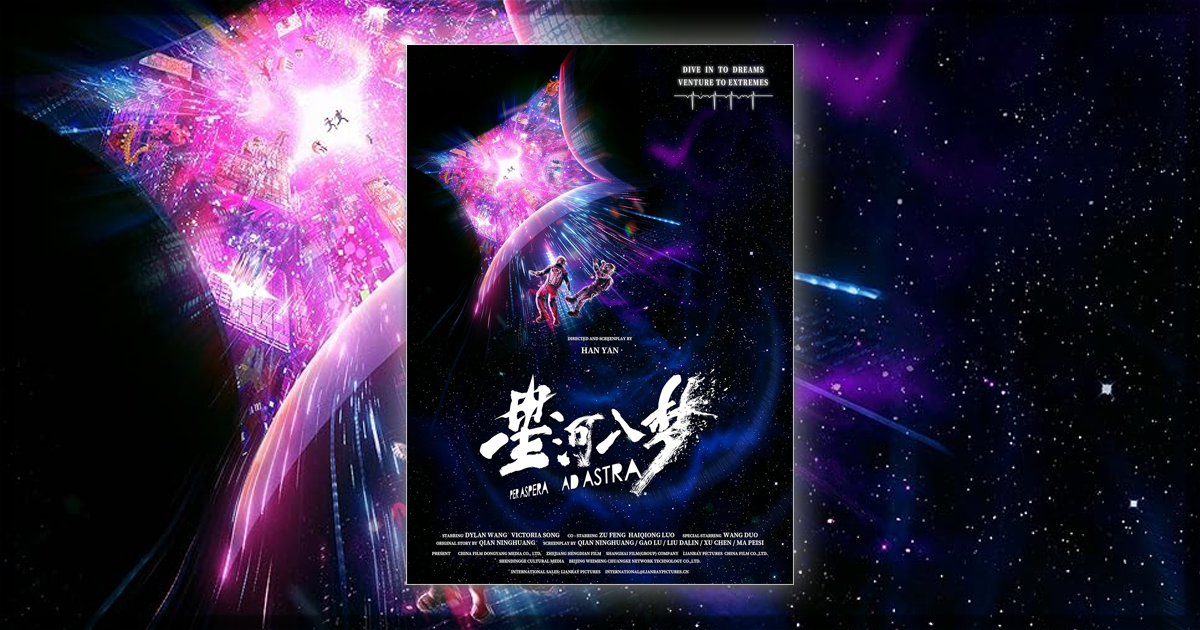
It’s so nice to see something uniting the entire world, especially when that thing is a hatred for artificial intelligence. Per Aspera Ad Astra is a Chinese kids’ movie, released for the lunar new year, with some very big Chinese stars at its core, all about the importance of our own personal, individual imagination. It’s also set in space, where the explorer’s imaginations are the only things keeping them alive. This is a fresh twist on the very many tropes that populate the film, but younger audiences won’t get the references for a while. Instead right now they’ll care about its message of the importance of curiosity and making friends, and on that level Per Aspera Ad Astra delivers like you wouldn’t believe.
It’s some time in the future and the issues of interplanetary travel have been resolved. The body is now capable of being perfectly preserved in statis for decades without being harmed, but only recently has the technology to prevent neural damage caught up. That’s been created by a company called Sweet Dreams, which uses language models to enable people in statis to have such healthy and active long-term dreams that they arrive without brain damage, capable of immediately getting to work colonising the galaxy. Go science! A ship called the Mengya, which is shaped kind of like a syringe with three twisting rubber bands on the plunger, is on a 70-year interstellar journey to establish an agricultural colony on a planet called Sailun. On the Mengya, crewman C91, named Xu Tianbiao (Dylan Wang, a preposterously handsome actor and singer who started his career by winning a TV talent show as a teenager) is woken up from statis once a month or so to perform standard checks. But this time there’s a problem, and Tianbiao can’t use his stupendous coding skills to fix it himself because the interface between the language model that protects the crew and the ship’s operating systems is damaged. Therefore Tianbiao must urgently alert the captain, Li Simeng (Victoria Song, a ridiculously beautiful actress and singer who spent nearly a decade fronting Kpop girl group f(x) and who now mainly works in both South Korean and Chinese television). But thanks to the technical issue, the only way he can wake her up is by breaking protocol, which means a prison sentence, and hacking into her dream.
Simeng is dreaming about the day as a teenager when she took her astronaut’s exam in a purple tracksuit, and doesn’t recognise the cute young man with purple hair who slips a forbidden phone into her pocket. But once everyone is back in the real world on the ship, everything is explained and Tianbiao has been adequately scolded for his potty mouth while doing it, the captain realises Tianbiao’s concern is correct. Everyone’s lives are in imminent danger, both from neural damage and because the ship is irreversibly heading off-course into a meteorite belt. So it follows that the only way they can save the crew and the ship is by waking up several other crew members by hacking into their dreams.
So prison sentences be damned, we’re off the races, as the crewmembers’ dreams must be navigated like videogame levels, with Tianbiao and Simeng as different fighters every time in some truly outlandish and peculiar scenarios. The wig teams must have been thrilled! Ning Tang’s costumes have a lot of fun providing immediate characterisation without being distracting, and the visual effects are remarkably smooth and organic-feeling, especially when they’re having a great time getting weird. Dream logic (as in Everything Everywhere All At Once, which the target audience of kids won’t have seen) is so clearly established early on that the thread of the plot never gets lost. A debt is also owed to the ‘glitching’ trick made famous by Into the Spider-Verse that easily establishes where real dangers are pervading the dream logic.
From an international perspective, more characters than you’d think mention societal restrictions can only be escaped in dreams, and it’s also repeatedly mentioned how no one likes the relentless, endless competition that this society is built around. But for the most part director Han Yan, who co-wrote the script with four other credited writers, is exploring how people get along with others in a me-first society that frowns on breaking rules, even though sometimes other people’s needs must come first and rules must be broken. It even has the self-awareness to point out that the villain wearing a clown mask to demonstrate they’re a sociopath is a cliché learned by watching too many movies, which is very funny. But best of all, once it becomes clear who the real villain is, all rules and restrictions go out the window in order to fight the real enemy.
It is tiresome to see a battle between good and evil once again devolve into a fistfight between the hero and the baddie, but when the hero throws punches while yelling “Screw your bullshit meta-verse, I’ll beat the shit out of you!” then we have no choice but to stan. It is absolutely thrilling to see a kids’ movie end with two people explaining to a glitching computer program which fancies itself sentient that humanity can never, ever be replaced. The reasons given are the understanding people have for each other based on their experiences and feelings, and how those feelings and experiences enable people to change. The idea that feelings can be programmed or coded by machine learning is one of the major issues of our time that cinema is only starting to wake up to. While the American Good Luck, Have Fun, Don’t Die is aimed at teenagers who can’t live without their phones, it’s just as important to discuss these issues with little kids who don’t know a world without artificial intelligence.
That’s why it’s a surprise that Per Aspera Ad Astra has landed in the West to virtually no attention. Big-budget Chinese movies do generally get distribution outside China even if the stars aren’t globally famous. While it probably doesn’t help that the Chinese film industry is notorious for not pandering to international audiences in any way, the fact not many people outside China bother to go and see Chinese movies while they’re in the cinema is really weird. The best way to understand what a society values is by seeing what becomes a big hit! As the world tires of the American superhero blockbusters that have dominated world box-office for much too long, film audiences from around the world should absolutely be seeking out big stories from everywhere. And it’s really important to be reminded through art that we are closer to the people in China than we thought we were.
For some reason though that’s harder than it ought to be. If I am not mistaken, this is the third review of Per Aspera Ad Astra from a professional critic writing in the English language anywhere on the internet. I should be only one of very, very many. Per Aspera Ad Astra is a super fun thrill ride about the importance of people over machines, and let me be the first to say it will provide a spectacular time to people all around the world.
Per Aspera Ad Astra (Xing He Ru Meng) is now in theaters.
Learn more about the film at the IMDB site for the title.
You might also like…