
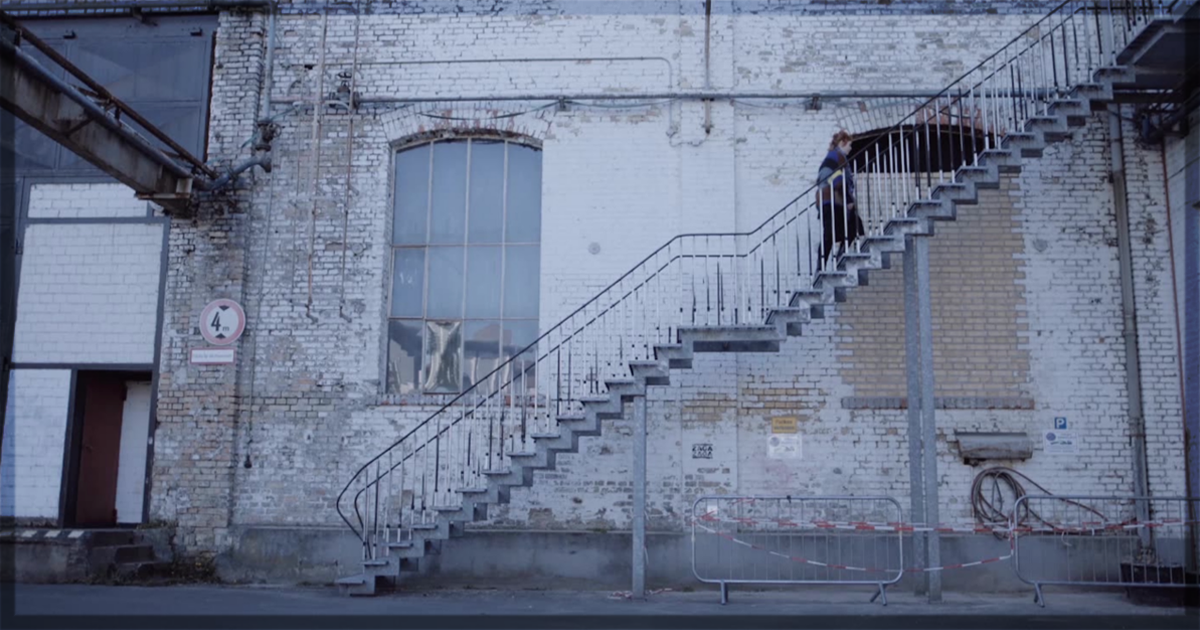
At the beginning of the 20th Century, Europe was boiling with ideas and cultural movements. Modernism, Brutalism, and the Belle Epoqué bloomed with multiple currents that provoked changes in the cultural and societal landscape in the world. In 1919, a particular school in Germany taught and shaped artists whose work left a mark. It was the Staatliches Bauhaus, recognized solely by its former name. Founded by the architect Walter Gropius, the school would become a reference in modern art and architecture. A few of the most prominent former students are László Moholy-Nagy, Wassily Kandinsky, Paul Klee, and Josef Albers. The Nazi party shut down the institute in 1933; yet, its legacy is undeniable. The director Nico Weber attempts to expand its importance in Bauhaus Forever, a free-form essay that analyzes the school, the Bauhaus Archiv – the museum that preserves its history, and the impact of the exponents of German modernism.
In its first minutes, Weber explores the space of the Archiv, the huge museum, library, and school located in Berlin. Therefore, in a few scenes, the cameras of Marc Nordbruch, René Dame, and Florian Lehmann walk through the long halls, exposing the layers of concrete that characterize the 1960s building. Designed by the school’s founder himself, Groupius eternalized his institution, slashed by the Nazi throughout the redemption three decades later. Thus, the Archiv rescues the legacy of an organization that impacted culture in fourteen years. In this sense, as the title of the film suggests, the director aims for the construction of the explanation of the impact of the organization. Culturally, it is a massive pillar to European modernism and to the currents post-World War I and before World War II. The artists from the Bauhaus fled Germany and became art professors across the globe; their impact is massive on the last century of artistic production.
Yet, the project by Weber attempts to navigate the similar wavelength of the Bauhaus philosophy in its experimentation and utter modernism. The result is a film that structures itself differently in each chapter, opening itself to the moments of explanation, exploration of the artistry, and the space of the physical importance of the archive. However, in the first twenty minutes of Bauhaus Forever, it is noticeable how the director is unsure in their approach. As a free-form essay, it is too conventional to drift away from its formal ambitions to reach a fascinating status. Instead of creating a poetry of its imagery and the artistry of the Bauhaus as a guideline to his artistic endeavors, the film feels bloated and disorganized as a documentary film.
Consequently, the unveiling of its information and the display of the content in Bauhaus Forever is tiresome and unclear about the organization that is providing to comprehend the director’s ambitions. Surely, Nico Weber aims to emulate the free spirit of the 1910s modernists, the artists and architects who positioned themselves between the gaps of the post-World War I and suffered with the state interference before the Second Great Conflict. At its core, that institution was a countercurrent of the artistic endeavors, experimenting with the possibilities of an uncertain time. In a similar sense, the director finds himself in a closed museum, currently undergoing renovations, but far from a specific day to reopen to the public. Realistically, Weber is free in a closed reality, a physical space where people are unable to reach and walk. Still, the execution feels trapped in a necessity to experiment with multiple elements, the architecture, and the wide shots of the ambient, but it fails to cohere as a whole. Unfortunately, the punishment for the failed swing of the director is an utterly bland effort that is dense, but still soulless at its core.
The essay by Nico Weber is a tentative attempt to organize the canon of a historical institution. Fourteen years of school that became a crucial museum in Berlin, but most notably, a physical space that holds a massive meaning as an architectural pillar of the modernism and brutalism, and also a historical home to a hundred thousand works related to the Bauhaus and its artists. However, the essay the director proposes fails to encounter a wavelength offering a glimpse of the magnitude of the 1910s school. It becomes a tiring effort in an artistic current. Therefore, the forever mentioned in the title is vague; it feels like an incomplete view on the history of the German modernism, which ironically, fails as an effort due to its form. Thus, the forever sounds like a see you soon instead, far from the definitive, too conventional and bland to welcome us as an occasional source of curiosity.
Bauhaus Forever recently played at the CPH.Dox Film Festival.
Learn more about the film at the CPH.Dox site for the title.
You might also like…

‘Scarlet Girls’ Documentary Review: Legal Violence in the Dominican Republic