
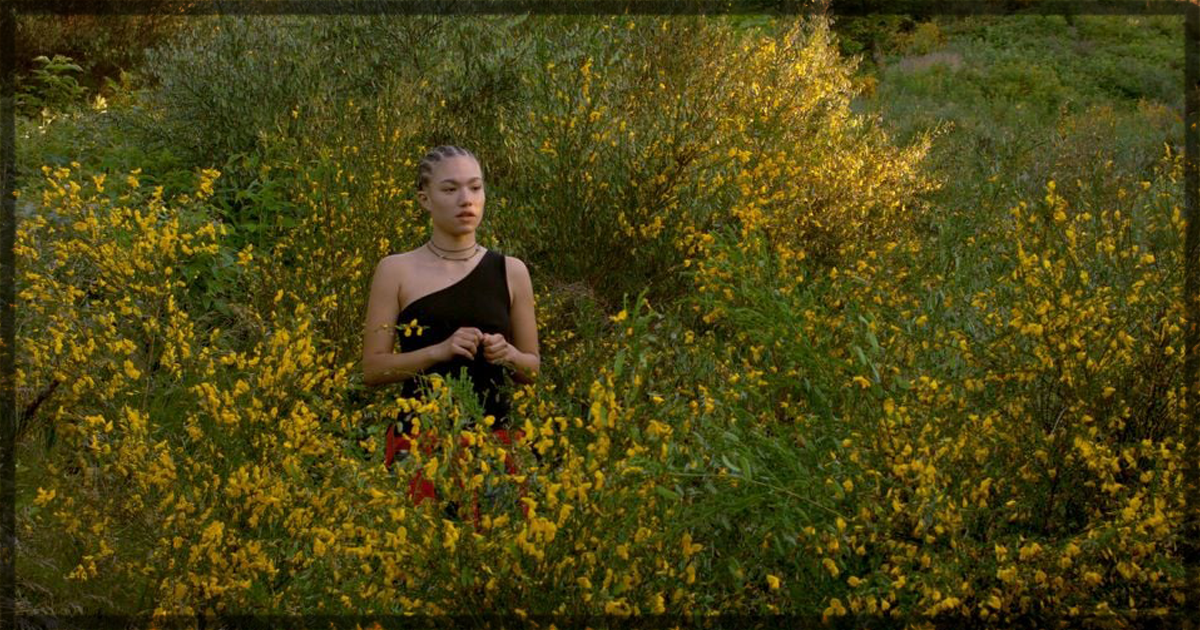
The French filmmaker Sarah Leonor returns to the Locarno competition after seventeen years, when her A Real Life (Au voleur) was in the running for the Golden Leopard. Now, she presents D’ici là, a contemplative film about three different individuals living in the Vosges valley, in France. Firstly, Lucien (Frank Beauvais) searches for utter peace in his own presence, in solitude. Meanwhile, Aline (Dinara Drukarova) is celebrating; however, she and her guests hear wolves in the forest at night. Suddenly, she receives the worst news of her life, confronting her fear as she fears the pack that wanders through the woods. Lastly, Jade (Louiza Aura) is experiencing the peaks of young adulthood: the emotional rush of love, the doubts about tomorrow, and the uncertainties of the age. Hence, the veteran director encapsulates three different stories about people in that same region, living and facing dilemmas in their lives.
Structurally, Leonor opts for the triptych, presenting three distinct stories within a single narrative, each featuring varied elements that together compose the whole. In this sense, there is a problem in the film from the beginning. As an audience, we do not care for them equally. In this sense, the glue of the three different arcs is the city. The director and the cinematographer Laurent Desmet (a frequent collaborator of Emmanuel Mouret) capture the mountain chains, which are the central aspect of the region’s relief. Visually, the cliffs are important to the story, appearing in Aline’s journey through the proximity to the wild and in Jade’s exploration of the fields with her boyfriend. Desmet opts for the naturalistic approach, documenting the region’s natural beauty and its contrasts with the human. A scene that illustrates this shows Jade and her boyfriend lying in the grass, while the cinematographer draws attention to the contrast between her skin and the hay on the ground. Even if nature is fundamental in the visual, the cinematographer never forgets about the individual.
Still, there is an imbalance between the three stories. Firstly, Lucien is a character who lacks substance overall. We know his tendency toward solitude, but the film promptly forgets him. However, Aline is the character with the most story points. Led by a strong performance from Dinara Drukarova, this segment recounts the discovery of a tragedy for someone celebrating life. Set mostly in the cabin, the director uses the liminal space to capture the reality of a woman who is getting older and feels that life is passing by. Thus, life presents her with a challenge in the moment that she decides to live fully. In this aspect, there is a fascinating core to the story: the melancholy of commemoration of being alive when reality throws you a curveball. It is the best of the three, but the writer-director limits it when she shifts to the wolves’ threat. The life content, the bittersweet conflict of being alive opposed to facing death, gets a stronger connotation through the pack’s appearance; yet, it feels redundant. Leonor is textually portraying that and also decides to insert another element that reinforces the idea.
The last story is about the life of a young woman in the valley. She is in love with a boy she does not publicly acknowledge as her partner, but the abandoned cabins near the mountains have become their sanctuary. Led by the rush of love and youth, her boyfriend suggests moving out together to one of the abandoned cottages and building a life together. Therefore, Leonor completes the trio of feelings: solitude, fear, and love. Despite the charming, charismatic Louiza Aura, the last part is less engaging than the middle section, and the boyfriend interactions are middling. The director’s characterization portrays a boy who is jealous of his partner and afraid of losing her. But the execution presents an irritating individual who, in contrast to Jade’s sweetness, fails to be a good complement. Thus, it suffers from an insistence on portraying their love, especially when juxtaposed with moments when she reflects on her feelings and on herself on that mountain.
Lastly, the title is an expression meaning “until then.” Yet, Sarah Leonor documents the decisions to the posteriority, the then meant by the sentence. In this sense, we learn only the conditions that move them now, pushing them into the future. However, D’ici là presents a structure that diminishes the overall impact because the stories are not equally engaging. When we compare the first part to the second, we see a considerable change, exposing the fragility of each story’s construction. Despite the beautiful portrait of the Vosges mountains, there is little to admire in the project.
D’ici là recently played at the Locarno Film Festival.
Learn more about the film at the IMDb site for the title.
You might also like…
‘Tomorrow a Long Time Ago’ Film Review: A Contemplative Sophomore Feature