
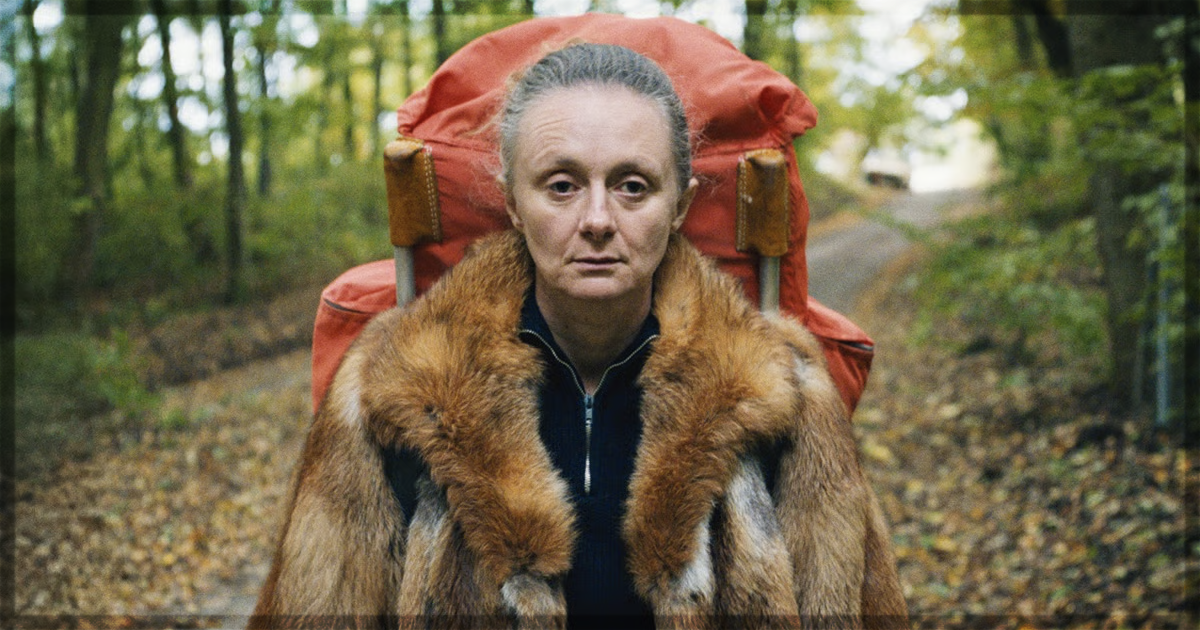
In her sophomore feature, Luise Donschen attended the Locarno Film Festival’s Cineasti del Presente section to present Tomorrow a Long Time Ago, Morgen vor langer Zeit. After Casanova Gene, which screened at the Berlinale Forum, the German filmmaker introduces her second film to audiences. Set in 1990, in the middle of German reunification, it follows Patty (Gerti Drassl), a woman who just lost her job. She decides to collect discarded objects to sell them and make some money. Yet, somewhere along the way, two important events happen in her life: her flat becomes crowded with belongings, and she meets Franz (Clemens Bobke). Therefore, she decides to leave everything behind and explore the forest, searching for some meaning in life.
Similarly to other films in the section, such as Beatrice Gibson’s At Night and Ana Vaz’s Hanabi, Tomorrow a Long Time Ago narrates the story of a woman seeking to expand her understanding of life abroad. If Gibson uses the Parisian night to explore a filmmaker’s intentions and Vaz travels to Japan to comprehend a writer’s background, Donschen sees Patty’s experience as a device for studying the past. The woman lives in an East German town, a communist state at the time, which divided the Western and Eastern visions of the world during the Cold War. Materialism-wise, the woman’s routine recounts the days leading up to the reunification of a country divided by geopolitical interests. Patty is someone affected by the dissolution of an entire country and its reunification with another, a process that took a year. In the meantime, collecting objects is a viable source of income for the woman, who needs it to survive, but she ends up collecting too much. Still, in a scene, Donschen illustrates the necessity of accumulating too much to get a few coins. In this logic, the quantity of garbage is inversely proportional: getting too many items means getting few coins.
In this sense, the film follows this woman’s need to dig into the woods. The exterior is bursting with chaos, even if the director only slightly portrays it; the coin scene and a few segments are indicative of the ongoing situation in the country. Thus, Patty, played here by Drassl, a veteran who has acted in films such as The Piano Teacher by Michael Haneke and As Estações by Maureen Fazendeiro, is a 50-year-old woman who resists the passage of time and the political forces that shape her reality. Suddenly, in the matter of a year, her town is no longer in Eastern Germany, but part of the unified country, something that last happened when she was ten years old. In this sense, her cold, plain facial expression conveys someone who is just going through so much at the moment. Hence, there are moments of distraction that she welcomes, such as her relationship with a younger man, Franz, who brings something good into her life.
The connection to nature is an escape from life inside that full flat, and the necessity to flee from the entropy. Indeed, the contemplative nature of the film demands a great deal of the viewer, asking them to enter that reality. In a few sequences, there is a slow-paced feel that requires the viewer’s attention, especially when Patty travels to the jungle. Another aspect is the limited dialogue and lines from the lead character, who unveils herself through actions and expressions. Then, the film is about the impact of those activities: both the collecting or the wandering in the woods, and how they affect the woman. At the same time, she patiently waits for the unification and stabilization of her small city in the Eastern part, which became a part of the whole again. In a broader sense, Patty is a symbol for the entire German population, who waited for the results of that process, which took a year to conclude.
Ultimately, Tomorrow a Long Time Ago (Morgen vor langer Zeit) invites the viewer to enter into the reality of a woman facing the effects of a historical moment. Everyone studies the fall of the Berlin Wall, but we might not know as much about what came afterward. Donschen does not portray that moment, but the moment of waiting until it was fully finalized. Although it is a slow, contemplative experience, the young director uses the time to observe people’s lives on the eve of something major. It features Gerti Drassl at her most compelling, even if her character shines for her expressions rather than her direct dialogue. In the end, it is an engaging exercise in time, and in the way filmmakers represent it.
Tomorrow a Long Time Ago (Morgen vor langer Zeit) recently played at the Locarno Film Festival.
Learn more about the film at the IMDB site for the title.
You might also like…